Sport, pastimes and the theatre (Edexcel GCSE History): Revision Notes
📚Revision Notes
Sport, pastimes and the theatre in Elizabethan England (1558-88)
Introduction
During Elizabeth I's reign, leisure activities were a clear reflexion of England's rigid social hierarchy and gender expectations. What people did for entertainment depended entirely on their social position, with stark differences between the pastimes of the wealthy elite and ordinary working people. These activities not only provided entertainment but also reinforced social boundaries and demonstrated one's place in society.
Note
Understanding Elizabethan leisure activities provides crucial insight into the period's social structure. Entertainment wasn't just about fun - it was a way of displaying and maintaining social status, making it an important historical indicator of how society was organised.
Social divisions in leisure activities
Elizabethan society's entertainment was strictly organised according to social class, creating distinct worlds of leisure for different groups of people.
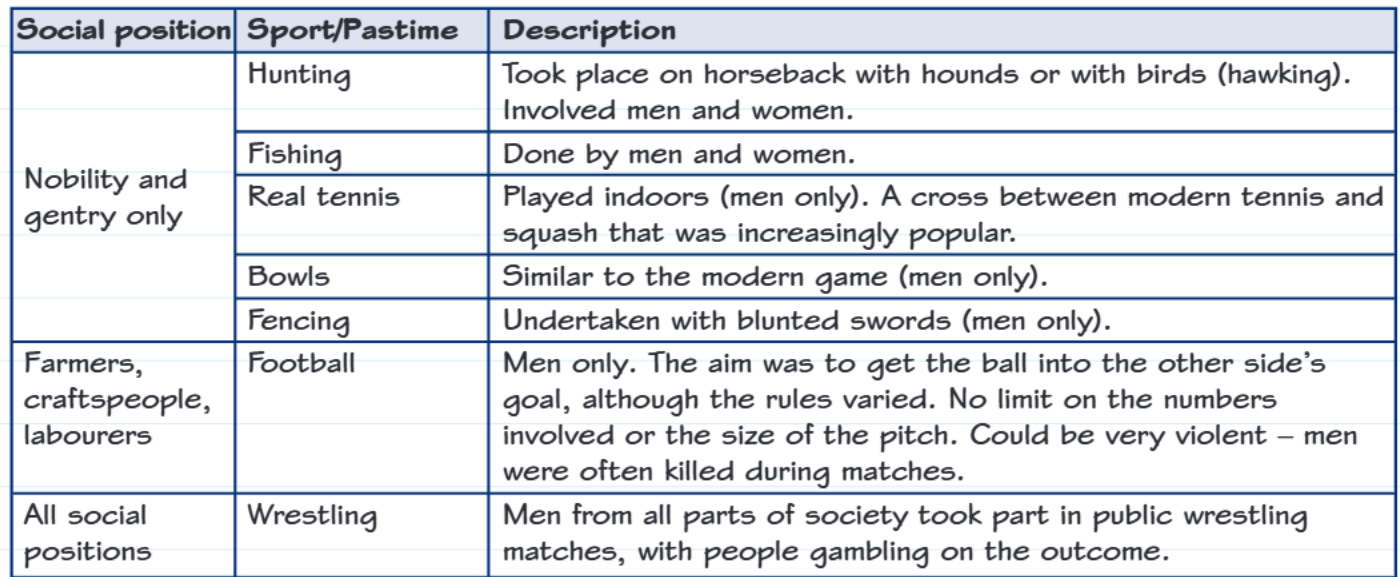
Activities exclusive to nobility and gentry
The wealthy elite enjoyed sophisticated and expensive pastimes that ordinary people could never afford. Hunting formed the centrepiece of noble leisure, taking place on horseback with specially trained hounds or through hawking with birds of prey. This activity involved both men and women, making it one of the few sports where gender mixing was acceptable among the upper classes.
Fishing provided a more peaceful pursuit for both noble men and women, while real tennis offered an indoor sporting challenge. This early version of tennis was played only by men and combined elements of modern tennis with squash, becoming increasingly popular throughout Elizabeth's reign. The nobility also enjoyed bowls, similar to the modern game, and fencing with blunted swords for safety, though both activities excluded women entirely.
Note
The cost of maintaining hunting grounds, horses, and trained animals meant that hunting was effectively impossible for anyone below the gentry level. A single hunting hawk could cost more than a craftsman's annual income.
Common people's entertainment
Working people - including farmers, craftspeople, and labourers - had access to much more limited but often more violent forms of entertainment. Football dominated as the most popular sport among common men, but bore little resemblance to modern football. With no rules governing team sizes or pitch dimensions, matches were incredibly brutal affairs where men were frequently killed during play. The sole objective was to get the ball to the opposing side's goal by any means necessary.
Important
Elizabethan football was so violent that it regularly resulted in deaths. Unlike modern football, there were no referees, no limits on team size, and virtually no rules - making it more like organised warfare than sport.
Cross-class activities
Wrestling provided one of the few entertainment forms that brought together men from all levels of society. Public wrestling matches attracted participants from every social background, with spectators placing bets on the outcomes. This created rare moments when social barriers temporarily dissolved in the excitement of competition.
Spectator sports and blood sports
Elizabethan England's appetite for violent entertainment reached its peak in organised spectator sports that involved animal cruelty and death.

Animal baiting formed the most popular spectator entertainment, where audiences gathered to watch dogs attack chained bears and bulls. These events combined the thrill of violent spectacle with gambling opportunities, as spectators placed bets on which animals would survive or win their fights. The animals were deliberately chained to prevent escape, ensuring prolonged and brutal contests that often ended in death.
Cockfighting provided similar entertainment on a smaller scale, particularly popular in small towns across England. Specially trained roosters fought each other using metal spurs attached to their legs, with spectators again betting heavily on the outcomes. Purpose-built arenas were constructed specifically for these fights, demonstrating the significant commercial value of such entertainment.
Important
Blood sports were considered normal entertainment across all social classes in Elizabethan England. What modern society considers animal cruelty was then viewed as exciting spectacle, highlighting how dramatically attitudes towards animal welfare have changed.
The transformation of theatre
Elizabeth's reign witnessed a revolutionary change in English theatre, marking a shift from religious to secular entertainment that would define English culture for centuries.
From mystery to secular plays
At the beginning of Elizabeth's reign, mystery plays dominated theatrical entertainment. These religious performances had been particularly popular among Catholic communities, but the Protestant settlement led to their gradual replacement with secular, non-religious productions. This change reflected broader religious and cultural shifts occurring throughout English society.
Example
Historical Transformation: Religious to Secular Theatre
Before 1560s: Mystery plays dominated - religious stories performed by local guilds, often about Biblical events like the Nativity or Crucifixion
1560s-70s: Protestant authorities discouraged religious drama as potentially Catholic
1580s: Secular comedies and histories became popular - professional companies performed non-religious stories for entertainment rather than religious instruction
The rise of purpose-built theatres
The construction of dedicated theatre buildings marked a crucial development in Elizabethan entertainment. Purpose-built theatres such as the Red Lion and the Rose were specifically designed to accommodate growing audiences who came from all social backgrounds. These venues needed to be large enough to hold diverse crowds while providing suitable stages for increasingly sophisticated performances.
Professional theatre companies
The emergence of professional acting troupes represented another significant innovation. Companies like the Queen's Men and Leicester's Men operated under the patronage of wealthy nobles and even royalty itself. These professional players were funded by their sponsors, allowing them to develop their craft and create increasingly elaborate productions.
Comedy became particularly popular during this period, with professional companies performing for audiences that included both wealthy nobles and common people. The fact that people from all social positions attended theatre performances made it necessary to construct larger, more accessible venues to accommodate the growing demand.
Note
The patronage system was crucial for theatre development. Having a noble or royal patron provided legal protection for acting companies, as performers without patrons were often treated as vagrants and could be arrested.
Music and dancing in Elizabethan society
Musical entertainment flourished across all levels of Elizabethan society, providing one of the most democratic forms of cultural expression during the period.
Musical instruments and performances
Many Elizabethans learned to play musical instruments, with lutes (similar to guitars), spinets, and harpsichords (both similar to pianos) being particularly popular. Musical performances became a regular feature of both official functions and public events, with professional musicians earning money by playing at fairs, markets, and various public occasions.
Music found its way into virtually every aspect of daily life. Churches, taverns, barbers' shops, and street corners all regularly featured musical performances. Wealthy families employed their own musicians - always men - to provide entertainment during meals and feasts. Collections of songs became popular possessions among those who could afford them.
The connection between music and theatre grew stronger throughout Elizabeth's reign, with musical compositions being written specifically to accompany theatrical performances in the new public theatres.
Note
Unlike most other forms of entertainment, music was relatively accessible across social classes. While the wealthy could afford expensive instruments and private musicians, even common people could enjoy music in taverns, at markets, and during public celebrations.
Social dancing
Dancing remained a popular pastime that brought together men and women, though with important social restrictions. While people from different social backgrounds enjoyed dancing, the nobility and gentry maintained their exclusivity by not dancing with people from other parts of society. This preserved social hierarchies even within shared entertainment activities.
Timeline of key developments
- 1558: Elizabeth becomes queen; mystery plays still dominate theatre
- 1560s: Decline of religious plays begins as Protestant settlement takes hold
- 1570s: First purpose-built theatres constructed (Red Lion, Rose)
- 1570s-80s: Professional theatre companies emerge with royal and noble patronage
- 1580s: Secular comedy and non-religious plays become dominant
- Throughout reign: Blood sports remain consistently popular across all social classes
Summary
Key Points to Remember:
-
Social hierarchy dominated leisure: What you could do for entertainment depended entirely on your social class and gender, with the nobility enjoying expensive, exclusive activities while common people had access to more violent, basic sports.
-
Blood sports were mainstream entertainment: Animal baiting and cockfighting were popular spectator sports that combined violence with gambling, accepted across all social levels despite their brutal nature.
-
Theatre underwent religious transformation: Elizabeth's reign saw the replacement of Catholic mystery plays with secular entertainment, leading to the creation of professional companies and purpose-built theatres.
-
Gender restrictions were widespread: Most sports and many leisure activities excluded women entirely, with only a few pursuits like hunting, fishing, and dancing allowing mixed participation.
-
Professional entertainment emerged: The development of theatre companies with royal patronage and purpose-built venues marked the beginning of England's commercial entertainment industry that would flourish for centuries.