The failure of Virginia (Edexcel GCSE History): Revision Notes
📚Revision Notes
The failure of Virginia
The first English settlement in Virginia represents one of the most significant colonial disasters of the Elizabethan era. Despite ambitious plans and considerable investment, the venture ended in complete failure when the remaining colonists abandoned their settlement and returned to England in 1586. Understanding why this early attempt at colonisation failed provides crucial insights into the challenges facing English explorers during the Age of Exploration.
Note
This failed settlement at Roanoke Island was England's first serious attempt at permanent colonisation in North America, predating the more famous Jamestown colony by over twenty years.
Background to the settlement
England's first serious attempt to establish a permanent colony in North America began in 1585. The settlement, established on Roanoke Island off the coast of what is now North Carolina, was intended to serve as a strategic base for English operations against Spanish interests in the New World. However, from the very beginning, the colonists faced overwhelming challenges that would ultimately doom their venture.
Key reasons for the colony's failure
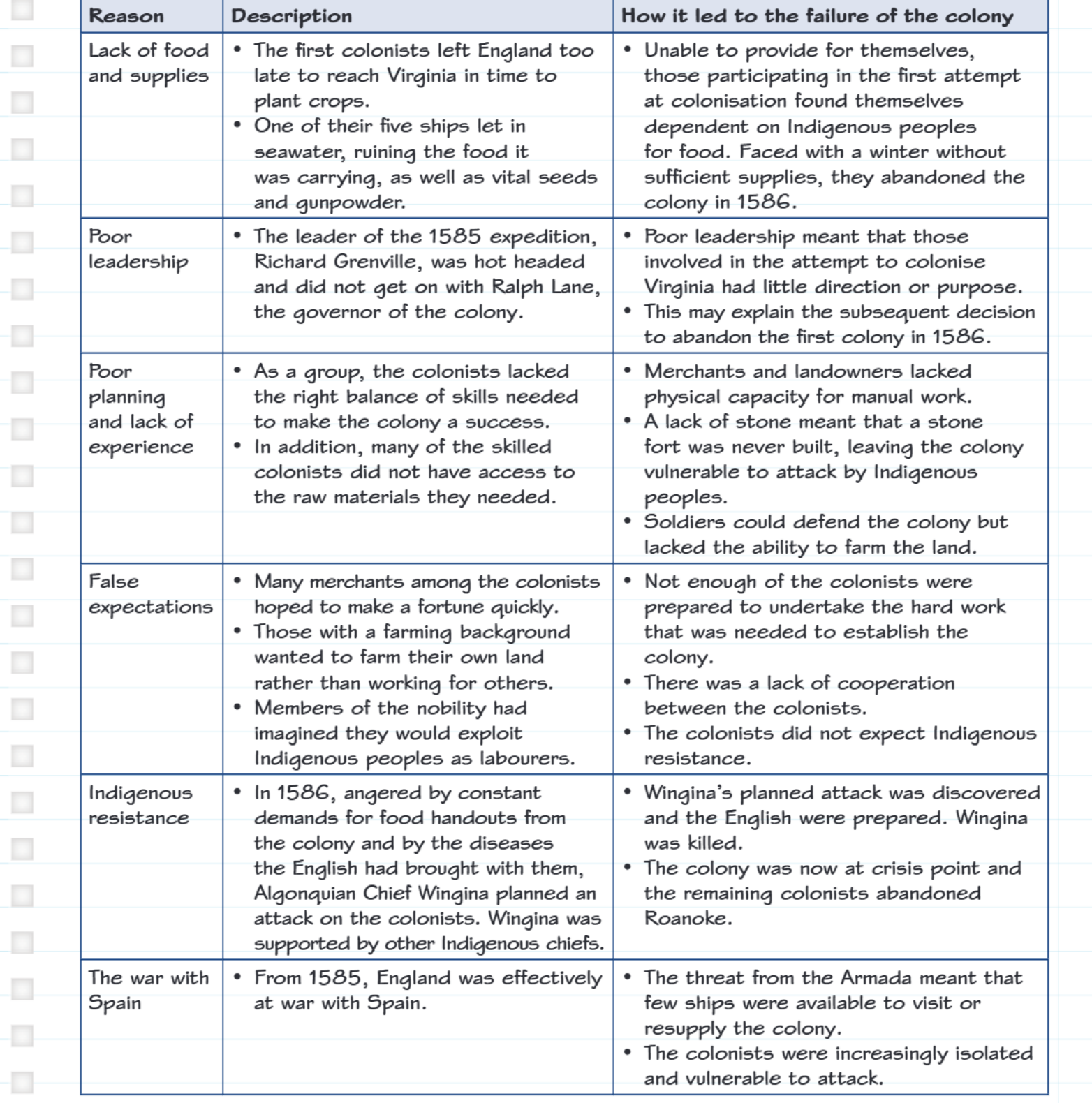
The failure of Virginia's first settlement resulted from a combination of interconnected problems that the colonists were unable to overcome.
Shortage of food and supplies
One of the most critical problems facing the colonists was their inability to sustain themselves with adequate food and supplies. The timing of their arrival proved disastrous - they reached Virginia too late in the season to plant crops that could sustain them through the winter months. This poor timing meant they were immediately dependent on limited provisions brought from England.
Important
The loss of one of their five supply ships at sea was catastrophic - it took with it vital food supplies, seeds, and gunpowder that were essential for the colony's survival.
The situation became even worse when one of their five supply ships was lost at sea, taking with it vital food supplies, seeds, and gunpowder. Without these essential resources, the colonists found themselves in a desperate situation, forced to rely heavily on Indigenous peoples for food. This dependency created tension and ultimately contributed to the colony's vulnerability.
Leadership conflicts and poor governance
The expedition suffered from serious leadership problems that undermined the colony's chances of success. Richard Grenville, who led the 1585 expedition, was described as hot-headed and failed to work effectively with Ralph Lane, who served as the colony's governor. These personality conflicts and lack of unified leadership meant that important decisions were often delayed or poorly executed.
The poor leadership created confusion among the colonists and prevented them from developing clear strategies for survival. Without strong, cooperative leadership, the settlement lacked the direction and purpose necessary for overcoming the numerous challenges they faced.
Inadequate planning and colonial inexperience
The English colonists were severely unprepared for the realities of establishing a settlement in the New World. Many lacked the practical skills needed for colonial life, such as farming, construction, and basic survival techniques. The group included merchants and landowners who had little experience with manual labour or the harsh conditions of frontier life.
Important
Critical oversight: The colonists lacked access to essential raw materials, particularly stone for construction. Without proper building materials, they couldn't construct a stone fort for adequate defence, leaving the settlement dangerously vulnerable to attack.
Perhaps most critically, the colonists lacked access to essential raw materials, particularly stone for construction. Without proper building materials, they were unable to construct a stone fort that could provide adequate defence against potential attacks from Indigenous peoples. This left the settlement vulnerable and exposed, contributing to the colonists' sense of insecurity.
Unrealistic expectations and motivations
Many of the colonists had completely unrealistic expectations about what life in the New World would be like. Merchants hoped to make quick fortunes without understanding the hard work required to establish a successful colony. Members of the nobility imagined they would be able to exploit Indigenous peoples as a ready source of labour, much like European peasants.
These false expectations meant that when colonists encountered the reality of colonial life - which required hard physical work, cooperation, and long-term commitment - many were unprepared and unwilling to undertake the necessary tasks. The lack of cooperation between colonists and their unwillingness to adapt to new circumstances significantly hampered the settlement's development.
Indigenous resistance and conflict
Relations with local Indigenous peoples quickly deteriorated, creating a serious threat to the colony's survival. In 1586, Algonquian Chief Wingina became increasingly frustrated with the English presence. The colonists' constant demands for food handouts, combined with diseases that English settlers had inadvertently brought with them, created significant hardship for Indigenous communities.
Note
The introduction of European diseases to Indigenous populations was a recurring tragic pattern throughout colonial history, often devastating native communities who had no immunity to these foreign illnesses.
Chief Wingina planned a coordinated attack on the English settlement, supported by other Indigenous chiefs in the region. Although the English discovered this planned attack and killed Wingina, the incident demonstrated how precarious their position had become. The colony now faced active hostility from Indigenous peoples, making their situation virtually untenable.
The impact of war with Spain
From 1585 onwards, England was effectively at war with Spain, which had dramatic consequences for the Virginia settlement. The Spanish threat meant that few English ships were available to visit or resupply the colony, as most were needed for defence of England or attacks on Spanish vessels and territories.
This isolation left the colonists increasingly cut off from England and unable to receive the regular supplies and reinforcements they desperately needed. The threat of Spanish attack also made the colony's location seem more dangerous and strategically vulnerable.
Timeline of events
- 1585: First settlement established in Virginia under Richard Grenville's expedition
- 1585-1586: Colonists face severe food shortages and leadership conflicts
- 1586: Chief Wingina plans attack on English settlement; Wingina killed by English
- 1586: Remaining colonists abandon the settlement and return to England
Summary
Key Points to Remember:
-
Supply problems were critical - Late arrival, lost ships, and war with Spain meant colonists couldn't get the food and materials they needed to survive.
-
Leadership failures doomed the venture - Conflicts between Richard Grenville and Ralph Lane prevented effective decision-making and planning.
-
Colonists were unprepared for reality - Many expected quick riches and easy exploitation of Indigenous labour, rather than hard work and cooperation.
-
Indigenous resistance escalated quickly - English demands for food and disease outbreaks led Chief Wingina to plan an attack on the settlement.
-
External war made everything worse - England's conflict with Spain isolated the colony and prevented regular resupply missions from reaching Virginia.