Queen, government and religion, 1558-69 (Edexcel GCSE History): Revision Notes
📚Revision Notes
Mary vs Elizabeth (1568-69)
The political dilemma
The relationship between Elizabeth I and Mary, Queen of Scots became increasingly strained during the period 1568-69. When Mary fled to England in 1568, she presented Elizabeth with one of the most challenging political situations of her reign. Mary's presence on English soil created a complex web of religious, diplomatic, and dynastic problems that threatened Elizabeth's Protestant rule.
Note
Mary's flight to England came after her defeat at the Battle of Langside, where she lost her final attempt to regain the Scottish throne from the Protestant lords who had forced her to abdicate in 1567.
Mary's claim to the English throne made her a dangerous rival. As a Catholic monarch with legitimate royal blood, she represented an alternative ruler that foreign Catholic powers and English Catholics might support. This situation forced Elizabeth to carefully consider her options, as any decision could trigger international conflicts or domestic rebellion.
Important
Mary's presence in England created what historians call the "Mary Problem" - a situation where every possible solution carried enormous risks for Elizabeth's reign and England's stability.
Elizabeth's strategic options
Elizabeth faced four possible approaches to deal with Mary's presence in England, each carrying significant political and military risks.
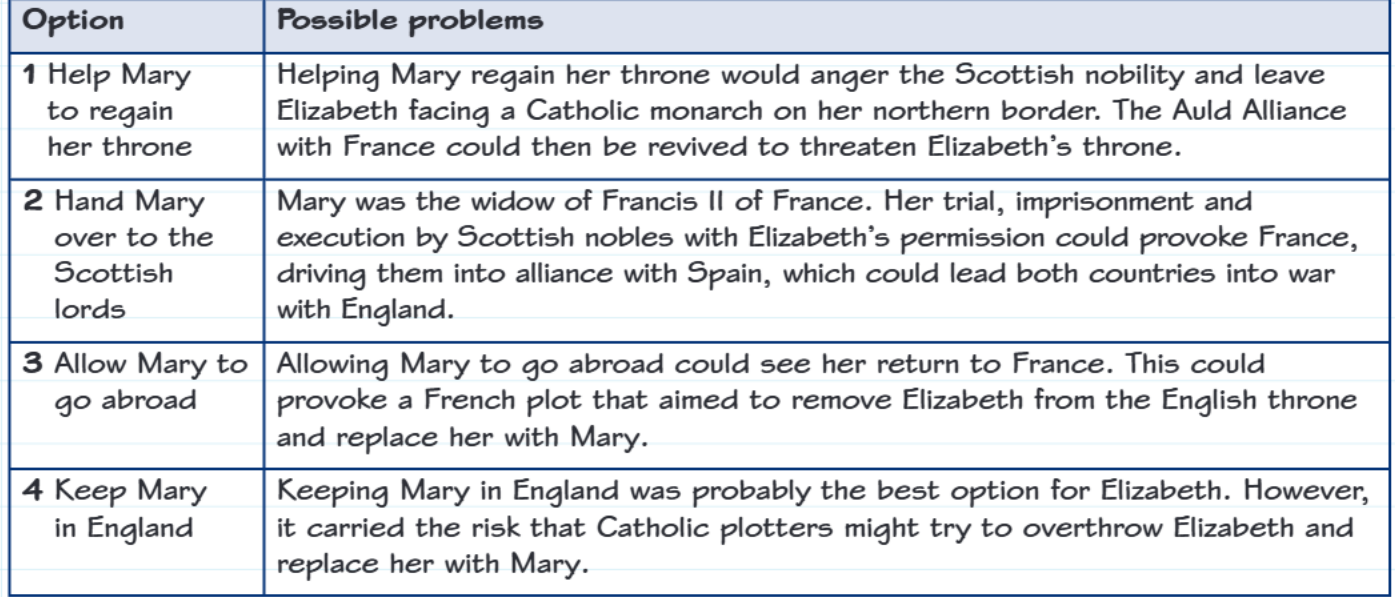
Option 1: Restore Mary to the Scottish throne Elizabeth could have actively supported Mary's return to power in Scotland. However, this approach risked angering the Scottish Protestant nobility who had forced Mary to abdicate. Additionally, restoring a Catholic queen to Scotland might revive the Auld Alliance between Scotland and France, creating a dangerous Catholic coalition on England's borders that could threaten Elizabeth's Protestant government.
Option 2: Hand Mary over to the Scottish lords Another possibility was to return Mary to Scotland to face the nobles who had imprisoned her. This option seemed appealing as it would remove Mary from England while appearing neutral. However, Mary was the widow of Francis II of France, giving the French crown a strong interest in her welfare. Allowing Scottish nobles to imprison or execute Mary could provoke France into forming an alliance with Spain, potentially leading both Catholic powers to declare war on Protestant England.
Option 3: Allow Mary to go abroad Elizabeth could have permitted Mary to leave England and seek refuge in a foreign Catholic court, most likely France. This solution would remove the immediate threat of Mary's presence in England. However, it would also place her in a position where French agents could easily use her as a focal point for plots against Elizabeth's reign. From France, Mary could become the centre of Catholic conspiracies aimed at replacing Elizabeth on the English throne.
Option 4: Keep Mary in England The final option was to maintain Mary under house arrest in England, which Elizabeth ultimately chose. This approach offered the most direct control over Mary's activities and communications. However, it carried the ongoing risk that English Catholic plotters might attempt to free Mary and use her as a replacement for Elizabeth. Keeping Mary in England meant living with a constant internal threat to the Protestant settlement.
Important
Elizabeth's choice to keep Mary in England under house arrest was the least dangerous of four terrible options, but it meant accepting a permanent threat to her reign that would persist for the next 19 years.
The Casket Letters Affair
Between October 1568 and January 1569, Elizabeth attempted to resolve the Mary question through legal proceedings. A special court was established at York to examine the evidence against Mary, particularly regarding the murder of her husband, Lord Darnley.
The Scottish lords presented what became known as the Casket Letters as evidence against Mary. These documents, allegedly love letters written by Mary to the Earl of Bothwell, appeared to prove that Mary had conspired in Darnley's murder. The letters suggested a romantic relationship between Mary and Bothwell that provided a motive for eliminating Darnley.
Note
The authenticity of the Casket Letters remains controversial among historians. Some scholars believe they were genuine, while others argue they were forgeries created by Mary's enemies to justify her deposition.
Mary's defence centred on her status as an anointed monarch. She argued that as a queen appointed by God, she could not be tried by any earthly court. Mary refused to enter a plea unless Elizabeth guaranteed that she would be found innocent, a condition Elizabeth could not accept without compromising the entire legal process.
The court proceedings ultimately reached no definitive conclusions. This outcome suited Elizabeth's political needs perfectly. By not formally convicting Mary, Elizabeth ensured that the Scottish nobility would not imprison or execute her, which satisfied French concerns about Mary's safety. Simultaneously, the lack of a clear verdict meant that Elizabeth's subjects did not feel compelled to punish an anointed monarch, avoiding potential religious complications.
Example
Political Strategy: The Deliberate Non-Decision
Elizabeth's handling of the Casket Letters Affair demonstrates masterful political manoeuvring:
Step 1: Allow the investigation to proceed, showing fairness to all parties Step 2: Ensure no definitive verdict is reached Step 3: Satisfy multiple audiences - the French (Mary not convicted), the Scots (Mary not cleared), and the English (process appears thorough) Result: Mary remains under Elizabeth's control without triggering international crisis
The inconclusive result allowed Mary to remain under Elizabeth's control in England while preventing the international crises that might have followed a definitive judgement either way.
Why Elizabeth rejected Mary as her heir
One additional solution to the Mary problem would have been for Elizabeth to formally acknowledge Mary as her successor to the English throne. This approach could have resolved the dynastic uncertainty while neutralising Mary as a threat.
However, this option was politically impossible for Elizabeth. Naming a Catholic heir would have outraged English Protestants, including many members of Elizabeth's own Privy Council. Elizabeth's government depended on Protestant support, and she could not afford to alienate this crucial political base.
Furthermore, Catholics throughout Europe already distrusted Elizabeth due to her Protestant religious settlement. Acknowledging Mary as heir might not have satisfied Catholic opponents who preferred immediate change rather than waiting for Elizabeth's natural death.
Important
The prospect of naming Mary as heir carried the most dangerous risk of all - it could have triggered immediate civil war. English Protestants might have rebelled rather than accept the restoration of Catholicism, while Catholics might have attempted to accelerate Mary's accession through violent means.
Most seriously, the prospect of a known Catholic successor could have triggered civil war. English Protestants might have rebelled rather than accept the restoration of Catholicism, while Catholics might have attempted to accelerate Mary's accession through violent means. Elizabeth recognised that naming Mary as heir could destroy the religious and political stability she had worked to establish since 1558.
Timeline of key events
- 1568: Mary flees to England after her defeat at the Battle of Langside
- October 1568 - January 1569: The Casket Letters Affair court proceedings at York
- 1569: Mary remains in English custody following the inconclusive court verdict
Summary
Key Points to Remember:
- Elizabeth faced an impossible choice with Mary - every option carried serious risks of foreign invasion or domestic rebellion
- The Casket Letters Affair was deliberately left inconclusive to avoid international complications while keeping Mary under English control
- Religious tensions between Catholics and Protestants made Mary's presence in England extremely dangerous to political stability
- Elizabeth could not name Mary as heir without risking civil war and losing Protestant support
- Mary's status as an anointed monarch complicated legal proceedings and gave her protection from normal judicial processes