Elizabeth's religious settlement (Edexcel GCSE History): Revision Notes
📚Revision Notes
Elizabeth's religious settlement
Introduction
When Elizabeth I became queen in 1558, England faced serious religious divisions between Catholics and Protestants. Elizabeth needed to create a religious settlement that would bring stability and be acceptable to both religious groups. In 1559, she established what became known as the Elizabethan Religious Settlement - a carefully crafted compromise that aimed to unite her subjects under one Church of England.
Key features of Elizabeth's religious settlement of 1559
Elizabeth's religious settlement consisted of several important components that worked together to establish a new form of English Christianity.
The Act of Supremacy
This act made Elizabeth the Supreme Governor of the Church of England, rather than Supreme Head (the title her father Henry VIII had used). This subtle change was important because it suggested Elizabeth had authority over the church but acknowledged that Christ was the true head.
Note
All clergy and royal officials had to swear an oath of allegiance to Elizabeth in this role, rejecting the Pope's authority over the English church. This was a crucial step in establishing English independence from Rome.
The Act of Uniformity
This legislation controlled how religious services should be conducted across England. It required everyone to attend church and dictated the appearance of churches and how religious services were to be held. This ensured consistency across the country and prevented regional variations that could cause conflict.
Note
The Act of Uniformity was essential for maintaining religious order throughout the kingdom. By standardising practices, Elizabeth prevented the kind of regional religious conflicts that had plagued England during previous reigns.
The Book of Common Prayer (1559)
Elizabeth introduced a new prayer book that had to be used in all churches. The clergy were required to follow the exact wording during services, and anyone who refused could face punishment.
Important
This book was carefully written to be acceptable to both Catholics and Protestants through its ambiguous language. The deliberate vagueness allowed different religious groups to interpret key passages according to their own beliefs.
An Ecclesiastical High Commission
Elizabeth established this special commission to maintain discipline within the Church and enforce her religious settlement. The commission had the power to punish disloyal clergy who refused to accept the new arrangements, ensuring the settlement was properly implemented across the country.
The Royal Injunctions
These were detailed instructions given to the clergy about how they should conduct their duties and enforce the religious settlement in their local areas.
The aims of Elizabeth's religious settlement
Elizabeth designed her religious settlement to be inclusive and flexible, hoping it would be accepted by as many of her subjects as possible. The wording of key documents, particularly the new Prayer Book, was deliberately ambiguous so that different groups could interpret it in ways that suited their beliefs.
Appeals to Catholics
Important
Features that appealed to Catholics:
The settlement included several features that Catholics could accept. The Communion Sacrament mentioned in the Book of Common Prayer could be interpreted as referring to the actual body and blood of Jesus (transubstantiation), which Catholics believed. Catholics would also have approved of the continued use of candles, crosses, and special vestments in church services, as these were part of their traditional worship.
Appeals to Protestants
Important
Features that appealed to Protestants:
Protestants found aspects of the settlement they could support too. They would have approved of the ban on pilgrimages to 'fake' miracles, as they believed only God could perform true miracles. The emphasis on English rather than Latin services also appealed to Protestant beliefs about making religion accessible to ordinary people.
Impacts of the religious settlement
The religious settlement had significant practical effects across English society, though its success was mixed.
Clergy acceptance
Note
Clergy Response Statistics:
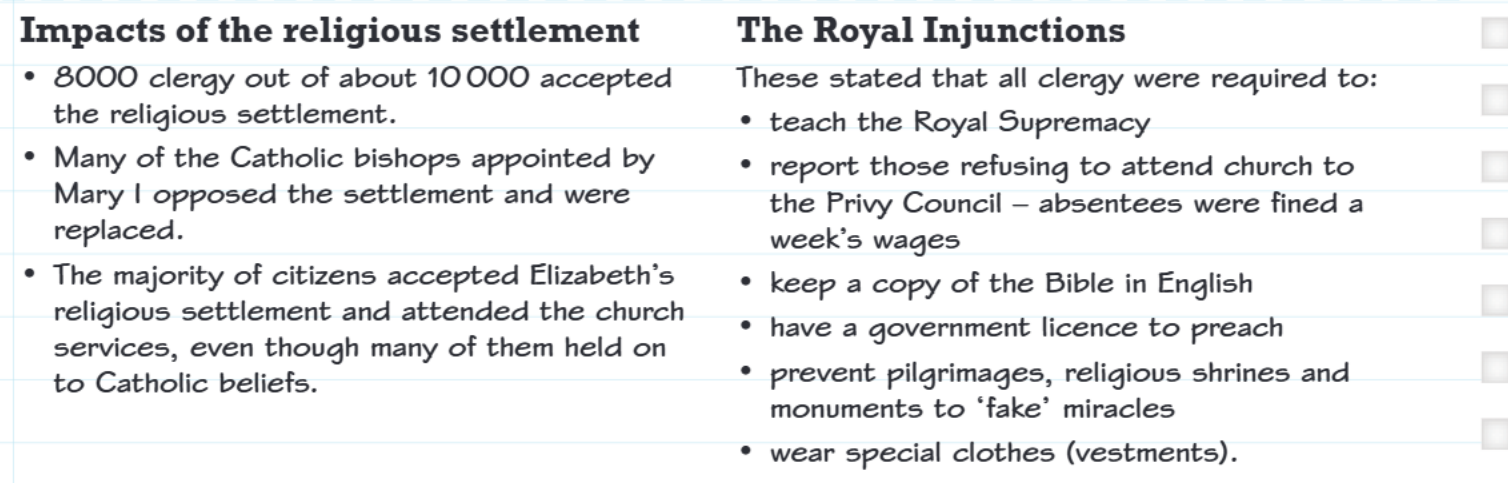
Around 8,000 clergy out of approximately 10,000 accepted Elizabeth's religious settlement. This high acceptance rate of about 80% showed that most parish priests were willing to work under the new system, ensuring continuity of religious services across the country.
Episcopal opposition
Many Catholic bishops who had been appointed by Mary I strongly opposed the settlement and were consequently replaced. This was a major change at the top level of the church hierarchy and helped ensure the settlement would be properly implemented from the highest levels down.
Public compliance
The majority of ordinary citizens accepted Elizabeth's religious settlement and attended Protestant church services as required by law. However, many of these people privately maintained their Catholic beliefs while outwardly conforming to the new requirements.
Note
This suggests the settlement achieved its aim of public religious unity, even if private beliefs remained divided. This pragmatic approach allowed Elizabeth to maintain stability while avoiding the religious persecution that had characterised previous reigns.
The Royal Injunctions
The Royal Injunctions provided specific and detailed requirements for how clergy should implement the religious settlement in their daily work.
Teaching and reporting duties
Note
Key Clerical Responsibilities:
All clergy were required to teach the Royal Supremacy, ensuring their congregations understood that Elizabeth, not the Pope, was head of the English church. They also had to report anyone who refused to attend church services to the Privy Council, and these absentees faced financial penalties of a week's wages.
Religious materials and licensing
Clergy had to keep a copy of the Bible in English in their churches, making scripture accessible to ordinary people who couldn't read Latin. They also needed to obtain a government license before they could preach, giving the authorities control over what religious messages were being spread.
Controlling Catholic practices
Important
The injunctions specifically aimed to prevent Catholic pilgrimages and the veneration of religious shrines and monuments that Catholics considered miraculous. This helped establish Protestant practices while discouraging Catholic traditions.
Appearance requirements
Clergy were required to wear special prescribed vestments during services. This maintained some traditional ceremonial aspects of worship while ensuring uniformity across all churches.
Timeline of key events
- 1558: Elizabeth becomes queen, inheriting a religiously divided nation
- 1559: Elizabeth establishes her religious settlement through parliament
- 1559: The Book of Common Prayer is introduced to standardise worship
- 1559: The Royal Injunctions are issued to clergy with detailed implementation instructions
Summary
Key Points to Remember:
- Elizabeth's religious settlement of 1559 was designed as a compromise to unite Catholics and Protestants under one English church
- The settlement included the Act of Supremacy (making Elizabeth Supreme Governor), the Act of Uniformity (standardising services), and the Book of Common Prayer
- About 80% of clergy (8,000 out of 10,000) accepted the settlement, though most Catholic bishops were replaced
- The Royal Injunctions gave clergy specific duties including teaching royal supremacy, reporting church absences, and preventing Catholic pilgrimages
- While most citizens attended Protestant services, many privately maintained Catholic beliefs, showing the settlement achieved public unity but not necessarily private conversion