Religious divisions in England in 1558 (Edexcel GCSE History): Revision Notes
📚Revision Notes
Religious divisions in England in 1558
Elizabeth's foreign challenges upon accession
When Elizabeth became queen in 1558, England faced serious threats from powerful European nations. These challenges were closely connected to religious divisions, as Catholic countries viewed Protestant England as both a religious enemy and a political threat. Elizabeth inherited a weak position internationally, with England isolated and facing potential invasion from multiple directions.
The young queen had to navigate carefully between much stronger Catholic powers while establishing her legitimacy as a Protestant ruler. Her approach would prove crucial in determining whether England survived as an independent Protestant nation.
Note
Elizabeth's accession came at a particularly dangerous time in European politics. The religious wars following the Protestant Reformation meant that Catholic powers like France and Spain saw Protestant England as a heretical state that threatened the stability of Catholic Europe.
The French threat
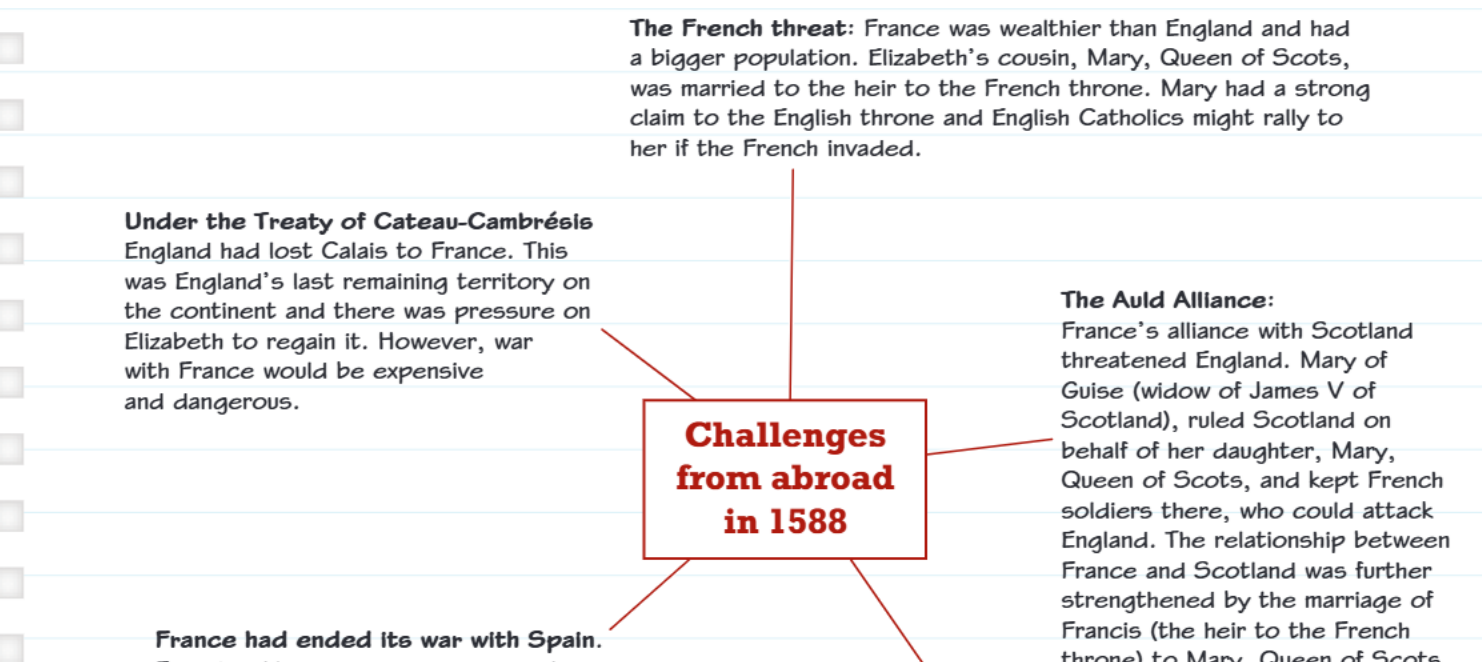
France posed the most serious challenge to Elizabeth's new reign. The French kingdom was significantly wealthier and had a much larger population than England, making it a formidable opponent. The threat became even more dangerous because of France's connection to Mary Queen of Scots, who was Elizabeth's cousin and had married the heir to the French throne.
Important
Mary Queen of Scots represented a direct challenge to Elizabeth's legitimacy. As a Catholic with a strong claim to the English throne, Mary could potentially rally English Catholics to her cause if France decided to support an invasion. This meant that any conflict with France carried the risk of civil war within England itself.
The religious dimension made this threat particularly serious. Catholic Europe, including France, viewed Elizabeth as illegitimate because they didn't recognise her father Henry VIII's divorce from Catherine of Aragon. This gave France both political and religious justification for supporting Mary's claim to the English throne.
The loss of Calais and diplomatic isolation
Under the Treaty of Cateau-Cambrésis, England had recently lost Calais to France. This was England's last remaining territory on the European continent and its loss was deeply humiliating for English national pride. More importantly, it removed England's only military foothold in Europe, making the country more isolated and vulnerable.
The loss of Calais also created pressure on Elizabeth to attempt its recovery through military action. However, war with France would be extremely expensive and dangerous, especially given England's weak financial position. Elizabeth faced the difficult choice between accepting this national humiliation or risking everything in a war she might not win.
Note
Calais had been in English hands since 1347 and was seen as a symbol of English power in Europe. Its loss under Mary I's reign was considered a national disaster, and many expected Elizabeth to attempt its recovery through military force.
The Auld Alliance
The traditional Auld Alliance between France and Scotland created a nightmare scenario for England - the possibility of fighting on two fronts simultaneously. Under this alliance, France maintained soldiers in Scotland and could potentially coordinate attacks from both north and south.
Mary of Guise, who ruled Scotland on behalf of her young daughter Mary Queen of Scots, strengthened these ties with France. When Mary Queen of Scots married Francis, heir to the French throne, in 1558, the alliance became even stronger. This marriage meant that if Francis became king of France, Mary would become queen of France while also maintaining her claim to the Scottish and English thrones.
Important
The Auld Alliance was strengthened further when Francis actually became Francis II of France in 1559, making Mary Queen of Scots the queen of France as well as Scotland. This created the terrifying possibility that France, Scotland, and potentially Catholic England could all be united under French control.
Financial constraints and military limitations
England's government was heavily in debt, which severely limited Elizabeth's military options. War was an extremely expensive undertaking, and England simply could not afford prolonged military campaigns against France, Scotland, or Spain. This financial weakness meant that Elizabeth had to rely on diplomacy rather than military strength to address the challenges she faced.
The debt problem also meant that England could not maintain large standing armies or build up its defences quickly. Any war would likely bankrupt the government and leave England even more vulnerable to future attacks. Elizabeth needed to find ways to neutralise these foreign threats without engaging in costly military conflicts.
Elizabeth's diplomatic solutions
Elizabeth showed remarkable skill in managing these dangerous challenges through careful diplomacy rather than warfare. Her approach focused on dividing her enemies and avoiding the multi-front war that could have destroyed England.
Her first major success was signing the Peace of Troyes in 1564, which formally recognised the French claim to Calais. While this was humiliating, it removed a major source of tension with France and allowed Elizabeth to focus on other threats. By accepting the loss of Calais, Elizabeth avoided a costly war she probably could not win.
Elizabeth's handling of the Scottish threat proved even more masterful. When Mary Queen of Scots fled Scotland in 1568 and sought refuge in England, Elizabeth placed her in comfortable captivity rather than returning her to Scotland or France. This bold move removed Mary from Scottish politics while preventing France from using her as a focal point for anti-English activities.
Example
Elizabeth's Diplomatic Masterstroke: The Imprisonment of Mary Queen of Scots
When Mary Queen of Scots arrived in England in 1568, Elizabeth had three options:
- Return Mary to Scotland - This would have restored a Catholic queen who opposed Elizabeth
- Allow Mary to go to France - This would have given France a powerful tool to use against England
- Keep Mary in England - This neutralised the threat while avoiding war
Elizabeth chose option 3, effectively removing Mary from both Scottish and French politics in one decisive move.
By imprisoning Mary Queen of Scots, Elizabeth eliminated the most dangerous threat to her throne while making peace with France. This left Spain as her only major remaining foreign challenge by 1569, a much more manageable situation than the multiple threats she had faced when she became queen.
Timeline of key events
- 1558: Elizabeth becomes queen; Mary Queen of Scots marries Francis, heir to French throne
- 1559: Francis becomes Francis II of France, making Mary queen of France
- 1564: Peace of Troyes signed, recognising French claim to Calais
- 1568: Mary Queen of Scots flees Scotland and is imprisoned in England by Elizabeth
- 1569: Elizabeth has successfully neutralised French and Scottish threats
Summary
Key Points to Remember:
- Elizabeth inherited multiple foreign threats in 1558, largely due to religious divisions between Protestant England and Catholic Europe
- The French threat was the most serious, combining military power with Mary Queen of Scots' claim to the English throne
- The Auld Alliance between France and Scotland created the danger of a two-front war
- Elizabeth chose diplomatic solutions over military action, recognising England's financial and military limitations
- Her imprisonment of Mary Queen of Scots in 1568 was a masterstroke that neutralised both French and Scottish threats simultaneously