Society on Elizabeth's accession (Edexcel GCSE History): Revision Notes
📚Revision Notes
Society on Elizabeth's accession
When Elizabeth I became queen in 1558, she inherited a highly structured and unequal society. English society was built around a rigid social hierarchy where everyone understood their position and the expectations that came with it. This social structure was based on land ownership, wealth, and birth, creating clear divisions between different groups of people.
Population distribution in Elizabethan England
England in 1558 was overwhelmingly a rural nation. An enormous 90% of the population lived in the countryside, while only 10% lived in towns and cities. This meant that most people's lives revolved around agriculture, land ownership, and rural communities. The small urban population was concentrated in market towns and a few larger cities like London.
Note
This rural dominance meant that agricultural cycles, weather patterns, and harvest quality had enormous influence on the lives of the vast majority of English people. The small urban population concentrated most political and economic power in relatively few locations.
The social structure of the countryside
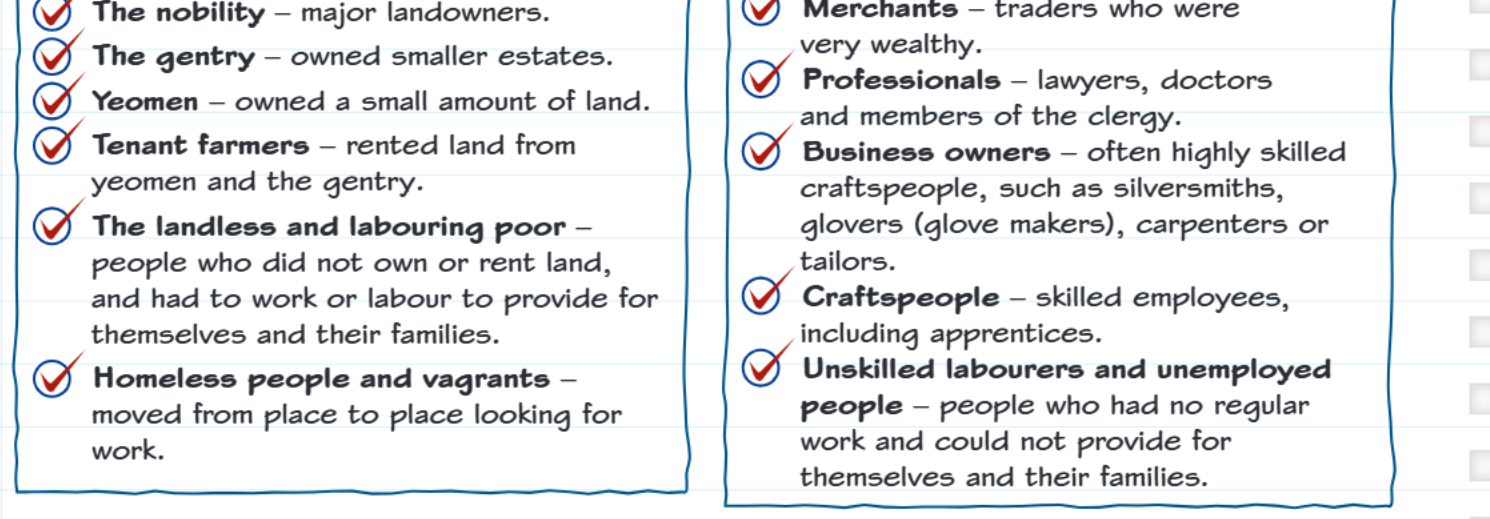
The countryside had a clear social pyramid with distinct layers. At the very top were the nobility - these were major landowners who possessed vast estates and held significant political power. They were born into their positions and formed the elite of English society.
Below them came the gentry, who owned smaller but still substantial estates. While not as wealthy or powerful as the nobility, the gentry were important local leaders who often served as justices of the peace and managed local affairs.
The yeomen represented a middle layer of rural society. These were small landowners who farmed their own plots and had achieved a degree of independence and respectability through hard work and careful management of their resources.
Further down were the tenant farmers, who rented land from the yeomen and gentry. They worked the land but did not own it, making them dependent on their landlords for their livelihood.
At the bottom of rural society were the landless labouring poor - people who owned no property and had to work for others to survive. Many struggled to provide adequately for their families. Even lower were the homeless people and vagrants who moved from place to place seeking work and often faced suspicion and harsh treatment from authorities.
Important
The countryside social structure was essentially a pyramid of dependency - each level depended on those above for land, work, or protection, while those at the top depended on those below for labour and agricultural production. This created a stable but inflexible system where social mobility was extremely limited.
The social structure of towns
Urban society had a different but equally rigid structure. At the top were wealthy merchants and traders who had built fortunes through commerce. These businesspeople often rivalled rural landowners in terms of wealth and influence.
Professionals formed an important educated class, including lawyers, doctors, and members of the clergy. Their education and specialised knowledge gave them status and respect in urban communities.
Business owners included highly skilled craftspeople such as silversmiths, glovers (glove makers), carpenters, and tailors. These skilled artisans often ran their own workshops and had achieved economic independence through their expertise.
Below them were ordinary craftspeople and apprentices - skilled workers and young people learning trades. Apprentices were bound to their masters for several years while learning their craft.
At the bottom were unskilled labourers and unemployed people who had no regular work and struggled to support themselves and their families. Like their rural counterparts, they faced constant economic uncertainty.
Note
Unlike the countryside where land ownership determined status, urban society was more fluid and allowed for greater social mobility through trade, craftsmanship, and education. However, it was still highly structured and most people remained in the social class they were born into.
Obedience and care in Elizabethan society
Elizabethan society operated on principles of mutual obligation that bound different social groups together. Everyone was expected to show respect and obedience to those above them in the social hierarchy. At the same time, those with higher status had duties of care towards those below them.
Landowners were expected to manage their estates responsibly and look after their tenants, especially during times of hardship such as bad harvests. This system created a network of social relationships based on duty and dependence.
Within households, similar principles applied. The head of the household - typically the husband and father - held authority over his wife, children, and any servants. Everyone in the household was expected to be obedient to him, but he also had responsibilities to provide for and protect them.
Important
This system of mutual obligations was what held Elizabethan society together. Without modern welfare systems or democratic institutions, these personal relationships of duty and care were essential for maintaining social stability and ensuring that the most vulnerable had some protection during difficult times.
Remember!
Summary
Key Points to Remember:
- 90% of people lived in the countryside - England was overwhelmingly rural in 1558
- Social hierarchy was rigid and based on land ownership - your birth largely determined your life prospects
- Mutual obligations bound society together - respect flowed upward while care was expected to flow downward
- Both rural and urban areas had clear social pyramids - from nobility/merchants at the top to vagrants/unemployed at the bottom
- Everyone "knew their place" - social mobility was limited and people understood their expected role in society