The Catholic challenge abroad (Edexcel GCSE History): Revision Notes
📚Revision Notes
The Catholic challenge abroad
The threat facing Elizabeth
When Elizabeth I became queen in 1558, she faced serious challenges from powerful Catholic rulers across Europe. Many of these monarchs, encouraged by the Pope, viewed Elizabeth as an illegitimate Protestant ruler who had no right to the English throne. They represented a real threat to remove her and replace her with a Catholic monarch who would restore England to the Catholic faith.
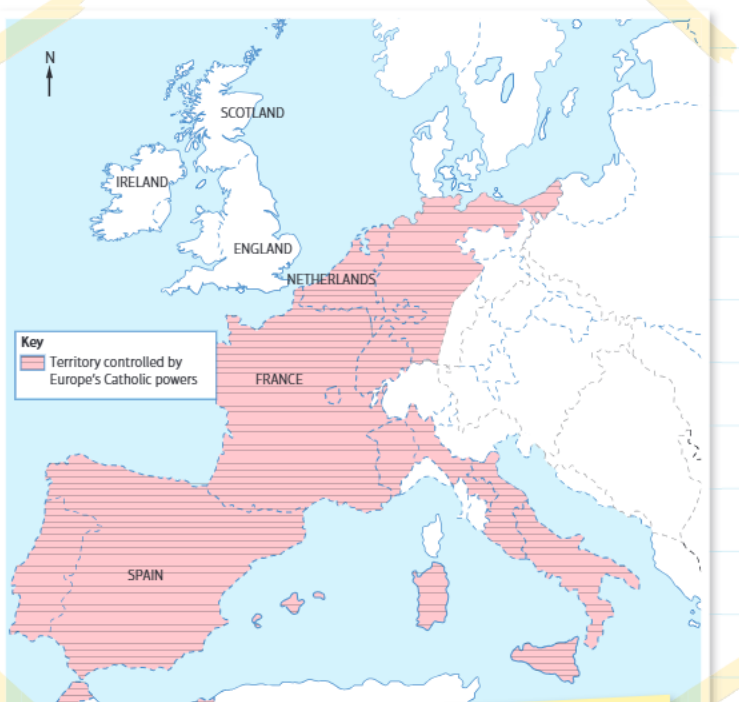
By 1570, Elizabeth found herself surrounded by hostile Catholic powers who controlled vast territories across Europe and had the resources to potentially invade England.
Note
Understanding the Map
The map above shows just how isolated Protestant England had become by 1570. Catholic powers controlled Spain, France, large parts of the Low Countries (modern-day Netherlands and Belgium), and significant portions of Italy. This geographical reality meant that Elizabeth could not afford to upset both France and Spain simultaneously, as this would dramatically increase the threats to her throne and England's security.
The Spanish threat
Spain posed the most serious and sustained threat to Elizabeth's rule. Under King Philip II, Spain was the most powerful nation in Europe, and several major conflicts developed between England and Spain during this period.
The Dutch revolt (1566)
Example
Strategic Dilemma: The Dutch Revolt Crisis
The Situation: In 1566, Protestant rebels in the Dutch territories rose up against their Spanish Catholic rulers. These rebels, known as the 'Sea Beggars', faced brutal suppression from Spanish forces.
Elizabeth's Challenge: She found herself caught between two dangerous options:
- Publicly support the Dutch rebels → Risk provoking Spanish invasion
- Abandon fellow Protestants → Allow Spanish Catholic power to grow unchecked
Her Solution: Elizabeth chose a dangerous middle path - she publicly condemned the Dutch rebels to avoid provoking Spain, but secretly allowed many of them to take shelter in English ports and even permitted them to attack Spanish ships in the English Channel.
The Risk: This double-game angered Spain while not fully supporting the Protestant cause, creating the worst of both worlds.
The presence of Spanish troops in the occupied Dutch territories, so close to England's coast, created a constant fear that these forces could be used to launch an invasion of England.
The Genoese loan crisis (1568)
A major diplomatic incident occurred in 1568 when Elizabeth seized a large sum of money that Spanish ships were carrying through English ports. This money was actually a loan from Italian bankers in Genoa to the Spanish government, intended to pay Spanish troops fighting in the Netherlands.
Note
Elizabeth argued cleverly that since the money still technically belonged to the Italian bankers rather than Spain, she had the right to seize it. This demonstrated her willingness to use legal technicalities as weapons in international conflicts.
This action infuriated the Spanish government and significantly worsened relations between the two countries. It also demonstrated Elizabeth's willingness to take bold economic action against her enemies, even when it carried significant risks.
Mary, Queen of Scots
The presence of Mary, Queen of Scots in England from 1568 onwards created another major security threat. As a Catholic with a strong claim to the English throne, Mary represented an alternative monarch that Spain and other Catholic powers could potentially support. Spanish authorities actively encouraged plots against Elizabeth that would place Mary on the throne, seeing her as a way to restore Catholic rule in England.
Important
The Perfect Storm of 1570
By 1570, Spanish rule in the Netherlands appeared secure, and the Privy Council (Elizabeth's key advisors) genuinely feared that Spain might launch a full-scale invasion of England. The combination of Spanish military strength, their presence so close to England's shores, and their support for Mary's claim created a perfect storm of threats.
The French challenge
France presented a different but equally complex challenge for Elizabeth. The country was torn apart by religious civil wars between Catholics and Protestant Huguenots, which created both opportunities and dangers for England.
When religious war broke out in France in 1562, Elizabeth made the strategic decision to back the French Protestants, hoping that she could help them win and potentially reclaim the port of Calais (which France had captured from England in 1558) in return for her support.
Important
A Costly Strategic Mistake
This policy backfired spectacularly. The French Protestants made peace with the Catholics later that same year, leaving Elizabeth isolated and having achieved nothing. This experience taught Elizabeth an important lesson about the dangers of foreign military intervention and the unreliability of foreign allies.
The ongoing instability in France meant that Elizabeth had to carefully balance her relationships with both French Catholics and Protestants. She could not afford to completely alienate France because this would leave her facing the combined hostility of both Spain and France - a situation that would be impossible to defend against.
The Papal threat
The Catholic Church itself, led by the Pope, represented a significant ideological and political challenge to Elizabeth's rule. The Counter-Reformation was the Catholic Church's organised campaign to reverse the spread of Protestantism and restore Catholic dominance in Europe.
As part of this campaign, the Pope was prepared to take direct action to end Protestant rule in England. The most dramatic example of this came in 1570, when Pope Pius V formally excommunicated Elizabeth.
Important
Understanding Excommunication
Excommunication means being formally excluded from the Catholic Church and unable to receive its sacraments - but its political implications were far more serious.
By excommunicating Elizabeth, the Pope was essentially declaring that she was not the legitimate queen and encouraging Catholic powers like France and Spain to take action against England. This papal bull (official proclamation) gave religious justification for any Catholic ruler who wanted to invade England and remove Elizabeth from power.
The timing of the excommunication in 1570 was particularly significant because it came after Elizabeth had already dealt with several internal Catholic plots and challenges. It represented an escalation in the international Catholic campaign against her rule.
Timeline of key events
- 1562: Religious wars begin in France; Elizabeth backs French Protestants but fails to regain Calais
- 1566: Dutch Protestant rebels rise against Spanish rule; 'Sea Beggars' begin their resistance
- 1568: Elizabeth seizes the Genoese loan intended for Spanish troops; Mary, Queen of Scots flees to England
- 1570: Pope Pius V excommunicates Elizabeth; Spanish control in Netherlands appears secure; Privy Council fears Spanish invasion
Summary
Key Points to Remember:
- Elizabeth faced a coordinated Catholic challenge from Spain, France, and the Pope, all of whom questioned her legitimacy as a Protestant ruler
- Spain was the most dangerous threat due to its military power, presence in the nearby Netherlands, and support for Mary, Queen of Scots
- Elizabeth's foreign policy had to carefully balance relationships to avoid facing the combined hostility of both Spain and France
- The Pope's excommunication in 1570 gave religious justification for Catholic powers to attack England
- Economic warfare, like seizing the Genoese loan, was an important weapon in these international conflicts