The Puritan challenge (Edexcel GCSE History): Revision Notes
📚Revision Notes
The Puritan challenge
What was the Puritan challenge?
The Puritan challenge emerged as a significant threat to Elizabeth I's religious settlement established in 1559. This challenge came from devout Protestants who felt that Elizabeth's religious reforms hadn't gone far enough in removing Catholic influences from the Church of England. By the late 1560s, many Protestant clergy were pushing for more radical changes to religious practices.
Note
The timing of the Puritan challenge was crucial - it emerged nearly a decade after Elizabeth's settlement, showing that initial religious reforms had failed to satisfy all Protestant factions within England.
Who were the Puritans?
Puritans represented a group of deeply committed Protestants who sought to cleanse Christianity by removing elements they believed weren't found in the Bible. They wanted to create what they saw as a purer form of Christian worship and practice.
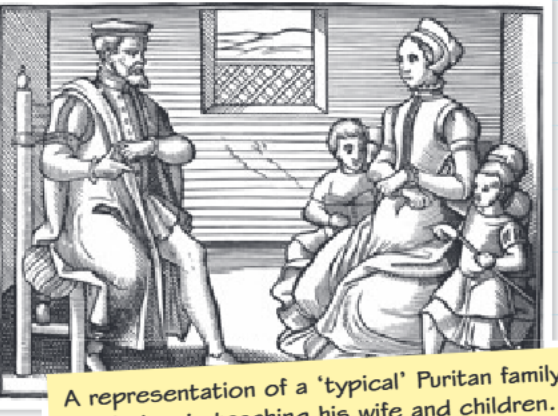
Key Puritan beliefs and practices
Church structure and leadership: Puritans envisioned establishing their own independent churches, free from royal control. They rejected the traditional hierarchy of bishops and wanted priests to abandon special ceremonial clothing called vestments during religious services.
Note
The Puritan desire for independent churches directly challenged the monarch's supreme authority over the Church of England, making this a political as well as religious issue.
Moral reform: These religious reformers aimed to create a more morally upright society by prohibiting activities they considered sinful, including gambling and violent sports like cock fighting.
Simplified worship: Puritans preferred plain, undecorated churches without elaborate religious artwork or 'graven images' such as crucifixes and statues. They viewed these decorative elements as too Catholic in nature and therefore ungodly.
Political views: While most Puritans accepted Elizabeth's rule, a minority believed the monarch could be challenged or even removed under certain circumstances, particularly if the ruler was Catholic.
Religious extremism: Many Puritans held strong anti-Catholic views, with some believing the Pope was the 'anti-Christ.' A subset called millenarians were convinced that the world was approaching its end and that Christians needed to prepare for Jesus Christ's second coming.
The nature of the Puritan challenge
The Puritan challenge to Elizabeth's religious settlement focused on two main areas of disagreement:
The crucifix controversy
Important
Elizabeth, wanting to avoid upsetting her Catholic subjects, ordered that a crucifix should be displayed in every church. However, Puritans strongly opposed this requirement. When some Puritan bishops threatened to resign in protest, Elizabeth retreated from her position. She recognised that she couldn't easily replace these educated Protestant clergy with equally qualified candidates who shared her views.
The vestments dispute
Elizabeth expected clergy to wear traditional ceremonial vestments during church services, as outlined in the Royal Injunctions. Puritans resisted this requirement, arguing that priests should wear either no special clothing or only simple garments.
Example
The Parker Enforcement Action of 1566
In 1566, Thomas Parker, the Archbishop of Canterbury, attempted to resolve this conflict by requiring priests to attend exhibitions demonstrating the proper vestments they must wear. This enforcement action resulted in 37 Puritan priests losing their positions because they refused to comply with the church attendance requirement and vestment regulations.
The extent of the Puritan challenge
Geographic and social spread
Puritans formed an active and vocal minority within English society. Prominent Puritan leaders included John Foxe, Thomas Cartwright, and John Field, who openly criticised Catholic practices and opposed traditional bishops. While Puritans gained significant influence in major cities like London, Cambridge, and Oxford, as well as throughout East Anglia, their impact remained limited in northern England, where Catholic sympathies persisted more strongly.
Political limitations
Despite their vocal opposition, the Puritan movement faced significant political constraints. The government largely ignored most Puritan demands for reforming the Church of England. When Puritans presented their concerns to Parliament through the Admonition to Parliament in 1572, it received little support, demonstrating that Puritanism's political influence remained quite restricted during this period.
Note
The limited success of the Admonition to Parliament revealed that while Puritans were vocal, they lacked the broad political support needed to force major changes to Elizabeth's religious settlement.
Timeline of key events
- 1559: Elizabeth's religious settlement established
- 1566: Archbishop Thomas Parker's Book of Advertisements requires proper vestments; 37 Puritan priests lose their positions
- 1572: Admonition to Parliament presented but gains limited support
Summary
Key Points to Remember:
- Puritans were strict Protestants who wanted to 'purify' Christianity by removing non-Biblical elements, particularly Catholic influences
- The main Puritan challenges focused on two key issues: the use of crucifixes in churches and the requirement for clergy to wear traditional vestments
- While Puritans were vocal and influential in certain areas like London and East Anglia, their political power remained limited throughout Elizabeth's early reign
- Elizabeth had to compromise on some issues (like crucifixes) but stood firm on others (like vestments), showing her pragmatic approach to religious governance
- The Puritan challenge demonstrated the ongoing religious tensions in Elizabethan England, even after the 1559 settlement