Anne of Cleves (Edexcel GCSE History): Revision Notes
📚Revision Notes
Anne of Cleves
Introduction
Anne of Cleves became Henry VIII's fourth wife in January 1540, but their marriage was a political disaster that lasted only four months. This failed union had serious consequences, not just for Anne, but particularly for Thomas Cromwell, who had orchestrated the match and saw his career destroyed as a result.
Background to Anne of Cleves
Anne was born around 1515, making her the second daughter of the Duke of Cleves, a small state in the northern part of the Holy Roman Empire. When she arrived in England in 1539, she was 24 years old and spoke very little English, which immediately created communication barriers with Henry VIII.
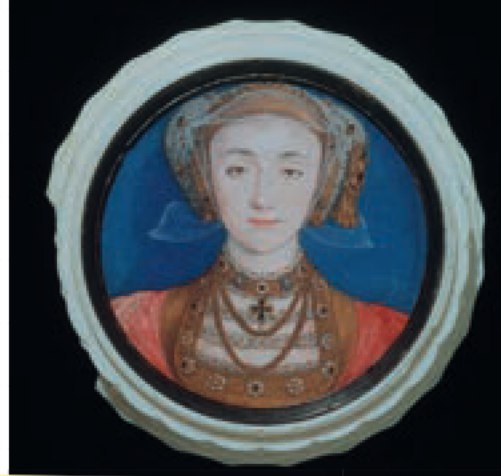
Note
The portrait miniature painted by Hans Holbein the Younger presents Anne as an attractive and dignified woman, which is why Henry initially found the representation appealing. However, this artistic representation would prove misleading when Henry met Anne in person.
When Henry met Anne in person, he took an immediate dislike to her, cruelly referring to her as a "Flanders mare." This harsh judgement would have devastating consequences for the political alliance that the marriage was meant to secure.
Political reasons for the marriage
By 1539, England faced a significant threat from Catholic powers in Europe. Several key factors made this marriage politically attractive to Henry and his advisers:
The Catholic threat
Charles V, the Holy Roman Emperor, and Francis I of France seemed to be planning a combined Catholic crusade against Protestant England. This potential alliance posed a serious military threat that required England to seek new allies quickly.
The Protestant alliance
Unlike many other European rulers, the Duke of Cleves was sympathetic to Protestant ideas and happy to marry his daughter to Henry VIII. This marriage would provide England with a valuable European ally who could potentially persuade other German states to support England if Catholic powers attacked.
Important
Henry's strategic thinking was clear: if Catholic Europe united against England, Protestant allies in Germany could provide crucial military and diplomatic support to prevent England's isolation.
Henry's succession concerns
Henry still had only one male heir - Prince Edward. The risk of Edward dying young meant Henry needed to secure his dynasty by producing more male heirs through another marriage.
The break from Rome
The Duke of Cleves had also broken from Rome, suggesting that Henry had found a kindred spirit in his opposition to papal authority. This shared rejection of Catholic authority made the alliance seem even more natural.
Cromwell's role in the marriage
Thomas Cromwell, as Henry's chief minister, was a strong supporter of Protestant ideas and saw this marriage as crucial for England's future. He believed that strengthening the Protestant cause at court would secure England's religious reformation.
Cromwell actively encouraged Henry to pursue this match, and marriage negotiations began with his full support. The marriage treaty was officially signed in October 1539, showing how quickly Cromwell moved to secure this alliance.
However, Cromwell's enthusiasm proved problematic. When Anne arrived in England in December 1539, Henry met her and immediately expressed his dissatisfaction, reportedly shouting at Cromwell: "I like her not! I like her not!" Despite Henry's obvious reluctance, Cromwell persuaded the king that the marriage should proceed as planned.
Important
Cromwell's decision to push forwards with the marriage despite Henry's clear displeasure was a critical political miscalculation that would ultimately cost him his life.
The wedding eventually took place on 6 January 1540, but it was clear from the start that Henry was deeply unhappy with his new wife.
The failure of the marriage and downfall of Cromwell
The marriage quickly became a disaster on multiple levels, with far-reaching consequences for English politics.
Personal failure
The marriage was annulled after just four months on the grounds of non-consummation. Anne was granted extensive estates by Henry and became known as the king's "sister," suggesting that while the personal relationship failed, they maintained a cordial political arrangement.
Political consequences
By the summer of 1540, the international situation had changed dramatically. The threat of invasion from France and the Holy Roman Empire had declined, meaning Henry no longer needed an alliance with the Duke of Cleves. This made Anne's presence at court more of a liability than an asset.
Impact on religious policy
The failure of this Protestant marriage weakened the Protestant cause at court. Henry became increasingly attracted to Catherine Howard, who came from the powerful Catholic Howard family. This shift marked a return towards more traditional Catholic values and practices.
Note
The religious implications were profound: what began as an attempt to strengthen Protestantism in England actually resulted in a Catholic resurgence under the Howard family's influence.
Cromwell's vulnerability
Henry blamed Cromwell entirely for the marriage failure, making Cromwell vulnerable to his enemies at court. The Duke of Norfolk, Catherine Howard's uncle and a leading Catholic, seized this opportunity to remove Cromwell from power permanently.
This blame placed on Cromwell ultimately led to his execution in July 1540, marking the end of one of the most significant periods of religious and political reform in Henry's reign.
Timeline of key events
- October 1539: Marriage treaty between Henry VIII and Anne of Cleves signed
- December 1539: Anne of Cleves arrives in England; Henry meets her and expresses immediate dislike
- 6 January 1540: Henry VIII marries Anne of Cleves despite his reluctance
- Summer 1540: International Catholic threat declines, reducing need for Cleves alliance
- July 1540: Marriage annulled after four months; Thomas Cromwell executed
- Later 1540: Henry begins courtship of Catherine Howard
Summary
Key Points to Remember:
- Political marriage: Anne of Cleves was chosen to create a Protestant alliance against Catholic Europe, not for personal compatibility
- Cromwell's gamble: Thomas Cromwell's career depended on this marriage succeeding, and its failure led directly to his execution in 1540
- Short duration: The marriage lasted only four months (January to July 1540) before being annulled on grounds of non-consummation
- Religious shift: The marriage failure weakened Protestant influence at court and paved the way for Catherine Howard and renewed Catholic influence
- International context: The marriage became unnecessary when the Catholic threat from Europe declined in 1540, leaving Anne and Cromwell politically isolated