Attempts to gain an annulment (Edexcel GCSE History): Revision Notes
📚Revision Notes
Attempts to gain an annulment
The annulment problem
By the mid-1520s, Henry VIII had become increasingly concerned about his marriage to Catherine of Aragon. After nearly two decades of marriage, Catherine had failed to produce a surviving male heir, which Henry believed was essential for the stability of the Tudor dynasty. Henry became convinced that his marriage was cursed by God because Catherine had previously been married to his deceased brother Arthur, which he believed violated biblical scripture.
Important
Henry sought an annulment rather than a divorce. An annulment would declare that the marriage had never been valid in the first place, which was crucial for legitimising any future children and maintaining Henry's standing as a devout Christian king.
Wolsey's initial attempts (1527-1528)
In 1527, Henry instructed his chief minister, Cardinal Wolsey, to secure an annulment of his marriage. This presented enormous challenges because the original marriage had been permitted through a papal dispensation, meaning the Pope had already ruled that the marriage was valid despite Catherine's previous marriage to Arthur.
Note
A papal dispensation was a special permission from the Pope that allowed something that would normally be forbidden by Church law. In this case, it had permitted Henry to marry his brother's widow, which was typically prohibited.
Wolsey faced a particularly difficult political situation. Pope Clement VII was reluctant to grant the annulment because he feared offending Charles V, the Holy Roman Emperor, who was Catherine's nephew and commanded powerful armies that were close to Rome. The Pope simply could not risk Charles V's wrath by declaring his aunt's marriage invalid.
In 1528, Wolsey attempted a clever solution. He proposed that he should act as Papal Legate (the Pope's representative) and rule on the case alongside Cardinal Campeggio, who would represent the Pope's interests. This approach would theoretically allow the case to be decided in England while still maintaining papal authority. However, this strategy also failed when the case was adjourned in July 1529 without reaching any decision.
The Blackfriars court case (1529)
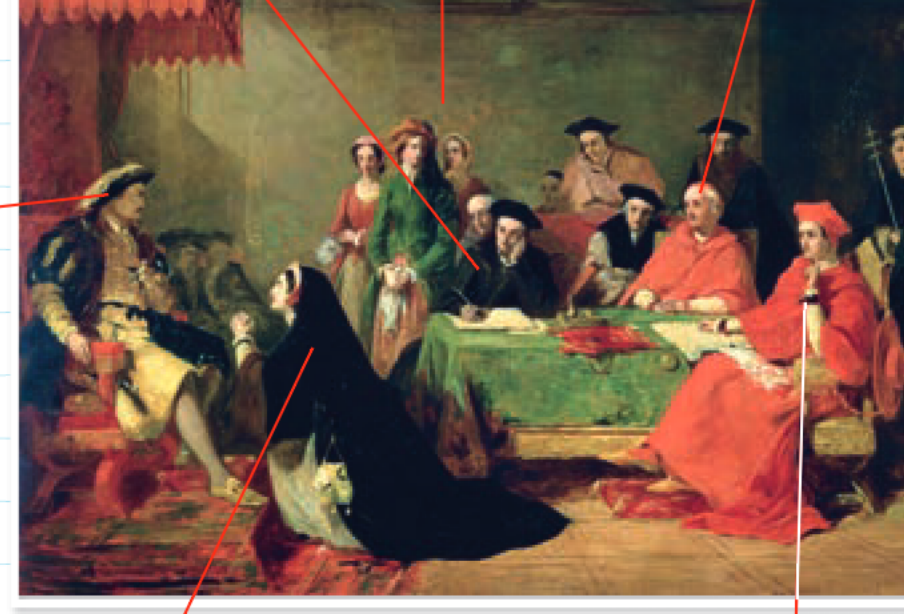
The most significant attempt to resolve the annulment took place at Blackfriars court in London between June and July 1529. This was a formal ecclesiastical court designed to examine the validity of Henry and Catherine's marriage.
Example
The Blackfriars Court Proceedings (June-July 1529)
The Setup: A formal ecclesiastical court was established with Cardinal Campeggio representing papal interests and Wolsey representing Henry's case.
Catherine's Response: She appeared before the court to defend her marriage, demonstrating remarkable courage by arguing that her marriage to Henry was legitimate and valid.
The Political Problem: Cardinal Campeggio faced impossible pressures - he could not rule against Catherine without offending Charles V, but could not support her without angering Henry.
The Outcome: Rather than making a decisive ruling, Campeggio used delaying tactics and eventually declared the matter should be referred back to Rome, leading to the case being adjourned without resolution.
Important
What does "adjourned" mean?
A case is adjourned when it is stopped without a decision being reached. This is exactly what happened at Blackfriars in July 1529 - the court proceedings ended without any ruling on whether Henry's marriage was valid or not.
The court proceedings revealed the deep divisions surrounding the annulment. Catherine demonstrated remarkable courage and dignity throughout the process, appearing before the court to defend her marriage. She had gained the support of several important figures, including Thomas More (Henry's trusted adviser) and John Fisher (Bishop of Rochester), who believed her marriage to Henry was legitimate and valid.
Opposition to the annulment
Catherine faced tremendous pressure to accept the annulment voluntarily, but she remained absolutely opposed to ending her marriage. Her resistance was strengthened by several factors:
Note
Catherine's Sources of Strength:
Popular support: Catherine was genuinely popular with ordinary English people due to her charitable work and dignified behaviour. This made it politically difficult for Henry to simply cast her aside without appearing tyrannical.
Religious conviction: Catherine firmly believed that her marriage to Henry was valid in God's eyes and that accepting an annulment would be sinful.
Political backing: Her nephew Charles V's influence over Pope Clement VII meant that any papal decision would likely favour Catherine's position.
Skilled advisers: Catherine received excellent legal and political advice from figures like Thomas More, who helped her navigate the complex proceedings.
Pressure tactics and threats
Henry and Wolsey employed increasingly desperate measures to force Catherine's compliance. They suggested she should renounce her marriage voluntarily and become a nun, which would have solved Henry's problem without requiring papal approval. When Catherine refused, Henry escalated his threats.
Most seriously, Henry threatened to exclude their daughter Princess Mary from the royal succession if Catherine continued to resist the annulment. This was an attempt to use Catherine's maternal instincts to break her resolve, but it ultimately failed because Catherine remained convinced that accepting the annulment would harm Mary's legitimacy even more.
Note
These pressure tactics reveal the desperation of Henry's position. By threatening Princess Mary's inheritance, Henry was essentially admitting that he could not achieve his goal through legal means alone and had to resort to emotional blackmail.
Timeline of key events
- 1527: Henry instructed Wolsey to seek an annulment from Pope Clement VII
- 1528: Wolsey proposed acting as Papal Legate to decide the case in England
- June-July 1529: Blackfriars court case held in London
- July 1529: Case adjourned without reaching a decision
Why Wolsey failed
Wolsey's attempts to secure Henry's annulment failed for several interconnected reasons:
- International politics: Pope Clement VII could not risk offending Charles V, whose armies threatened papal territories
- Catherine's resistance: Catherine refused to accept the annulment and fought it at every stage
- Legal complications: The original papal dispensation made it very difficult to argue that the marriage had been invalid from the start
- Popular opinion: Catherine's popularity with the English people made it politically risky to proceed against her wishes
- Religious opposition: Influential churchmen like Thomas More and John Fisher supported Catherine's position
Important
The Fatal Flaw in Wolsey's Approach
Wolsey's fundamental problem was that he was trying to work within the existing Church system, but that very system was controlled by political forces beyond his influence. As long as Charles V held power over the Pope, no papal decision would favour Henry's case.
Summary
Key Points to Remember:
- Henry sought an annulment (not divorce) of his marriage to Catherine of Aragon, believing it violated biblical law
- Wolsey tried multiple approaches between 1527-1529 but failed due to papal reluctance and political pressure from Charles V
- The Blackfriars court case (June-July 1529) was adjourned without reaching a decision, representing Wolsey's final failure
- Catherine successfully resisted tremendous pressure to accept the annulment, gaining support from advisers and popular opinion
- Wolsey's failure ultimately led to his downfall and Henry's break with Rome