Henry and the Catholic Church (Edexcel GCSE History): Revision Notes
📚Revision Notes
Henry and the Catholic Church
Henry's changing relationship with Rome
In the early years of his reign, Henry VIII was a devoted Catholic who strongly opposed the growing Protestant movement in Europe. However, this relationship dramatically changed by 1534 when Henry made the momentous decision to reject papal authority and break away from Rome entirely. This transformation marked one of the most significant religious and political shifts in English history.
The European Reformation context
The Protestant Reformation began when Martin Luther, a German priest, challenged the Catholic Church's authority and practices. This religious revolution split European Christianity into two major camps, creating fundamental divisions that would influence Henry's later decisions about England's religious future.
Note
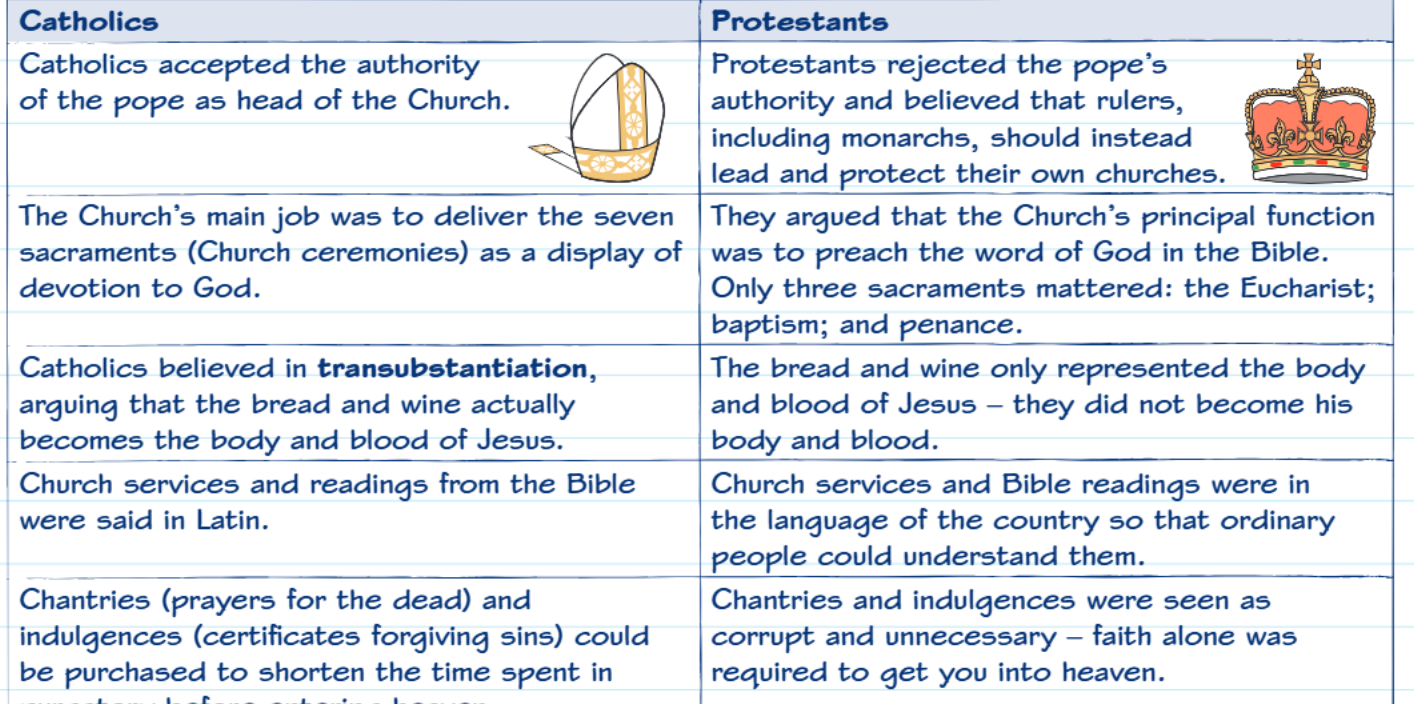
The differences between Catholics and Protestants were profound and touched every aspect of religious life. Understanding these fundamental divisions helps explain why Henry's break with Rome was so significant for both religious and political reasons.
The differences between Catholics and Protestants were profound and touched every aspect of religious life. Catholics maintained that the Pope held supreme authority over all Christian churches, while Protestants believed that secular rulers, including monarchs, should lead their own national churches instead.
These religious groups also disagreed about sacraments - the sacred ceremonies that Catholics considered essential for salvation. While the Catholic Church recognised seven sacraments as displays of devotion to God, Protestants accepted only three sacraments, focusing primarily on the Eucharist, baptism, and penance.
One of the most significant theological disputes concerned transubstantiation - the Catholic belief that communion bread and wine literally transformed into Christ's actual body and blood during mass. Protestants rejected this concept, viewing the bread and wine merely as symbolic representations rather than physical transformations.
The language of worship also divided these groups. Catholics conducted church services and read scripture in Latin, the traditional language of the Church, while Protestants insisted on using local languages so ordinary people could understand religious teachings directly.
Finally, Catholics supported practices like chantries (prayers for the dead) and indulgences (certificates that could reduce punishment for sins), along with the veneration of religious images and statues. Protestants condemned these practices as corrupt and unnecessary, arguing that faith alone was sufficient for salvation.
Henry as 'Defender of the Faith'
Initially, Henry was one of Catholicism's most vocal supporters and a fierce opponent of Protestant ideas. His commitment to the Catholic cause was so strong that Pope Leo X officially recognised him with the prestigious title "Defender of the Faith" in 1521.
Henry demonstrated his Catholic loyalty through both words and actions. He authored a book called "In Defence of the Seven Sacraments," which directly attacked Protestant theology and defended traditional Catholic practices. To show his opposition to Lutheran ideas, Henry organised a public burning of Martin Luther's writings at St Paul's churchyard in London, using this dramatic event to demonstrate his rejection of Protestant reform.
Example
Historical Example: Henry's Early Catholic Devotion
Henry's transformation from devoted Catholic to Church reformer can be seen through his actions:
As a Catholic (pre-1529):
- Wrote "In Defence of the Seven Sacraments" attacking Protestant ideas
- Organised public book burnings of Lutheran texts
- Received papal recognition as "Defender of the Faith"
After the break (1534 onwards):
- Rejected papal authority completely
- Established royal supremacy over English Church
- Dissolved monasteries and seized Church lands
Reasons for Henry's campaign against the Catholic Church
Despite his early devotion to Catholicism, Henry eventually launched a campaign against the very Church he had once defended. This dramatic reversal occurred for three primary reasons that combined personal, political, and religious motivations.
Important
The Three Key Reasons for Henry's Break with Rome:
-
Marriage Annulment Crisis - The Pope's refusal to annul Henry's marriage to Catherine of Aragon blocked his path to a male heir
-
Protestant Influence - Advisers like those inspired by William Tyndale convinced Henry that kings should rule their own churches
-
Allegations of Church Corruption - Claims of Catholic corruption provided moral justification for breaking away from Rome
The most immediate cause was the Pope's refusal to annul Henry's marriage to Catherine of Aragon. When the Catholic Church denied Henry the divorce he desperately wanted to secure a male heir, the king began to see papal authority as an obstacle to his royal needs and England's stability.
Protestant ideas also significantly influenced Henry's thinking, particularly through advisers who sympathised with reform movements. William Tyndale's suggestion that kings should rule their own churches rather than submit to papal authority especially appealed to Henry, as it offered a religious justification for increasing royal power over English religious affairs.
Additionally, Henry used allegations of corruption within the Catholic Church to justify his break with Rome. These charges provided moral and political cover for his actions, allowing him to present his campaign as necessary reform rather than purely personal ambition.
Timeline of key events
- 1521: Pope Leo X grants Henry the title "Defender of the Faith" for his book defending Catholic sacraments
- 1529: The Reformation period begins in England
- 1534: Henry officially renounces papal authority and breaks with Rome
- 1540: The English Reformation period concludes with Henry's religious settlement
Summary
Key Points to Remember:
- Henry VIII initially supported the Catholic Church and earned the title "Defender of the Faith" in 1521 for opposing Protestant ideas
- The European Reformation, led by Martin Luther, created fundamental divisions between Catholic and Protestant Christianity
- Catholics and Protestants disagreed on papal authority, the number of sacraments, transubstantiation, worship language, and religious practices
- Henry broke with Rome in 1534 due to the Pope's refusal to annul his marriage, Protestant influence from advisers, and allegations of Church corruption
- This religious transformation had profound political implications, establishing royal supremacy over the English Church