The impact of the Reformation on the Church (Edexcel GCSE History): Revision Notes
📚Revision Notes
The impact of the Reformation on the Church
The transformation of the English Church (1534)
The year 1534 marked a revolutionary turning point for the English Church when Henry VIII established his religious authority through the Act of Supremacy. This groundbreaking legislation made Henry the head of the English Church, effectively replacing the Pope's authority in England. This dramatic shift gave the king unprecedented power to reshape religious beliefs and practices according to his wishes, setting the stage for decades of religious transformation.
Important
The Act of Supremacy created immediate tensions within the English Church. On one side stood those who embraced Protestant ideas and wanted to modernise the Church by removing what they saw as corrupt Catholic practices. On the other side were traditionalists who wished to preserve established Catholic beliefs and ceremonies, even while accepting Henry's supremacy over the Pope.
The religious divide: reformers versus traditionalists
The English Church became a battleground between two distinct groups, each trying to influence Henry's religious policies while navigating the dangerous waters of Tudor politics.
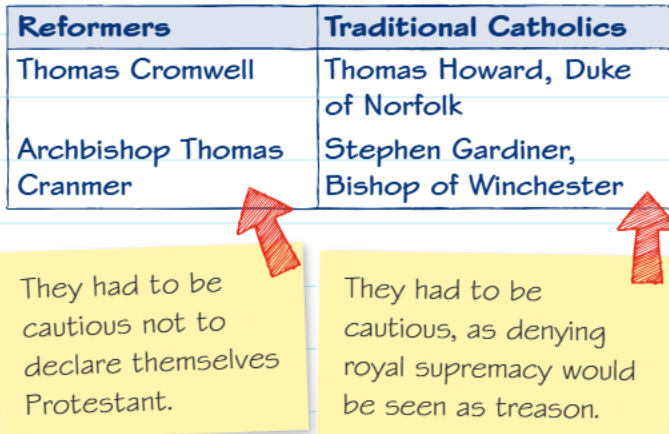
The reformers, led by Thomas Cromwell and Archbishop Thomas Cranmer, pushed for Protestant changes but had to be extremely careful not to openly declare themselves Protestant, as this could be seen as challenging royal authority. Meanwhile, the traditional Catholics, including Thomas Howard (Duke of Norfolk) and Stephen Gardiner (Bishop of Winchester), worked to preserve Catholic practices while being cautious not to deny royal supremacy, which would constitute treason.
Note
This delicate political balance meant that both sides had to moderate their positions, leading to a gradual and often contradictory approach to religious reform throughout the 1530s.
Cromwell and Cranmer's gradual Protestant reforms
Working together as a powerful partnership, Thomas Cromwell and Thomas Cranmer implemented a series of carefully planned reforms designed to move the English Church slowly towards Protestantism. Their strategy involved introducing changes through a sequence of important legislative acts and religious guidelines.
Example
The Ten Articles (1536) represented the first major step in defining Henry's new church. This document significantly reduced the traditional seven Catholic sacraments to just three: the Eucharist (Communion), baptism, and penance. This change struck at the heart of Catholic religious practice and moved England closer to Protestant beliefs.
The Royal Injunctions (1536) focused on ensuring religious uniformity throughout the country. These instructions required all priests to speak favourably about royal supremacy while discouraging traditional Catholic practices like pilgrimages to holy sites. The number of religious holidays was also reduced, further distancing England from Catholic traditions.
The Bishops' Book (1537) continued this reformist agenda by requiring every church to possess an English Bible, making Scripture accessible to ordinary people. Additionally, it mandated the destruction of religious relics, statues, and images, as well as pilgrimage sites that had been central to Catholic worship for centuries.
The Royal Injunctions (1538) represented another significant step towards Protestant practices by further reducing the importance of many Catholic beliefs and emphasising that a priest's primary duty was preaching rather than performing traditional Catholic ceremonies.
Henry's resistance to full Protestant change
Despite the reformist pressure from Cromwell and Cranmer, Henry VIII demonstrated his continued attachment to certain Catholic beliefs through the publication of the Six Articles in 1539. This document revealed the king's reluctance to embrace full Protestant theology and his desire to maintain a middle path between Catholicism and Protestantism.
Important
The Six Articles reaffirmed several traditional Catholic doctrines, including transubstantiation (the belief that bread and wine literally become Christ's body and blood during Mass), clerical celibacy (priests remaining unmarried), and the importance of purgatory. Henry made it clear that anyone who disagreed with these beliefs would face severe consequences, including imprisonment, property confiscation, and even death.
This religious legislation highlighted the complex nature of the English Reformation. While Henry had broken with Rome and accepted Protestant reforms in some areas, he was not willing to abandon all Catholic teachings. Many Protestant ideas had indeed taken root in England, but Henry's personal beliefs and political calculations meant that the Reformation remained incomplete.
Timeline of key religious changes
- 1534: Act of Supremacy establishes Henry as head of the English Church
- 1536: Ten Articles reduce sacraments from seven to three
- 1536: First Royal Injunctions promote royal supremacy and discourage pilgrimages
- 1537: Bishops' Book requires English Bibles and destroys religious images
- 1538: Second Royal Injunctions further emphasise preaching over Catholic ceremonies
- 1539: Six Articles reaffirm key Catholic beliefs, showing Henry's limits on reform
England's religious identity by 1540
By 1540, England found itself in a unique religious position that defied easy categorisation. The country had certainly moved away from papal authority and had adopted several Protestant practices, leading some to argue that England had become a Protestant nation. However, the persistence of Catholic beliefs and ceremonies, particularly those endorsed by Henry's Six Articles, meant that England retained significant Catholic characteristics.
Note
This religious ambiguity reflected the complex political and personal forces shaping the English Reformation. The death of Thomas Cromwell in 1540 further weakened the Protestant cause, leaving traditional Catholics in a stronger position to influence future religious policy.
The English Church had been transformed from its mediaeval Catholic origins, but it remained a hybrid institution that would continue to evolve throughout Henry's reign and beyond.
Summary
Key Points to Remember:
- The Act of Supremacy (1534) made Henry head of the English Church, replacing papal authority and creating the foundation for all subsequent religious changes.
- Religious reformers like Cromwell and Cranmer had to balance their Protestant beliefs with political survival, while traditional Catholics had to accept royal supremacy despite their Catholic convictions.
- Protestant reforms were introduced gradually through legislation: Ten Articles (1536), Royal Injunctions (1536, 1538), and the Bishops' Book (1537), each moving England further from Catholic practices.
- Henry's Six Articles (1539) demonstrated his continued attachment to key Catholic beliefs like transubstantiation and clerical celibacy, showing the limits of English Protestant reform.
- By 1540, England occupied a unique religious middle ground - no longer fully Catholic due to the break with Rome and Protestant reforms, but not completely Protestant due to Henry's preservation of certain Catholic doctrines.