Chateau Gaillard (Edexcel GCSE History): Revision Notes
📚Revision Notes
Chateau Gaillard
Background and construction
King Richard I constructed Chateau Gaillard as a crucial part of his strategy to secure control over Normandy. The fortress was considered to have some of the most advanced defensive features in Europe, though it came at an extraordinary cost.
Note
The construction of Chateau Gaillard represented a significant shift in mediaeval castle design, incorporating lessons learned from decades of crusader warfare in the Holy Land.
Why Richard built the castle
Richard needed to strengthen his position in Normandy against French attacks. The castle served multiple purposes - it protected the important city of Rouen (Normandy's capital) and provided an excellent base from which to launch military campaigns into the contested Vexin region.
Important
The strategic dual function of Chateau Gaillard - both defensive and offensive - was crucial to Richard's overall military strategy in maintaining control over his French territories.
Design influences
Richard and his military advisers drew upon their extensive experience gained from constructing crusader fortifications in the Holy Land. This knowledge was applied to create innovative defensive features that would make the castle extremely difficult to capture.
Location and strategic advantages
Position on the River Seine
The fortress was constructed on the River Seine, positioned on the border between Normandy and the Vexin region. This location was carefully chosen because it was close enough to Rouen to defend the city effectively, while also being accessible by road for supplies and reinforcements.
Note
The River Seine provided not only a natural defensive barrier but also a crucial supply route, allowing the castle to maintain communication and receive reinforcements from other Angevin territories.
Defensive terrain
The castle occupied a commanding position on a narrow plateau, approximately 600 feet in length and 200 feet in width. The site was naturally protected by deep ravines that surrounded it on multiple sides, making any attack extremely challenging for enemy forces.
Important
The combination of natural terrain features with artificial fortifications created what military experts consider one of the most defensible positions in mediaeval Europe.
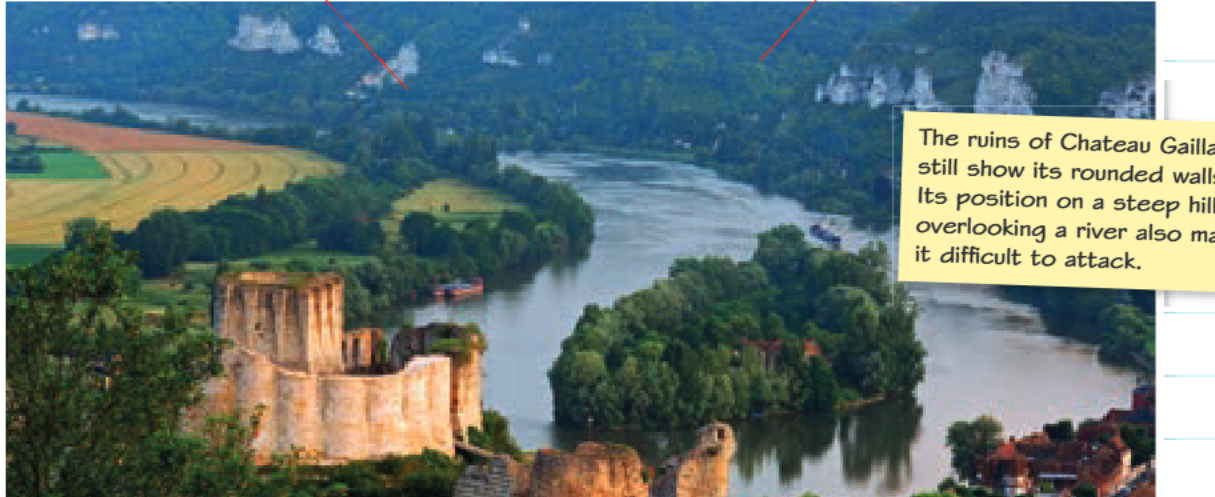
The aerial view demonstrates how the castle's hilltop position and the winding river below created natural defensive barriers that complemented the man-made fortifications.
Architectural features
Advanced defensive design
The castle incorporated several revolutionary defensive elements borrowed from crusader architecture. The central keep was surrounded by multiple thick walls featuring massive towers for additional protection. One of the most innovative aspects was the use of curved walls rather than straight ones - this prevented catapult stones from finding weak corner points where they could cause maximum damage.
Example
Defensive Innovation: Curved Walls
Traditional castle walls were built straight, creating vulnerable corner points where siege weapons could concentrate their attack. Richard's curved wall design deflected projectiles away from the walls, significantly reducing the effectiveness of catapult attacks and making the fortress much more difficult to breach.
Construction materials and methods
The fortress was built using high-quality stone construction techniques that had been perfected during the crusades. The walls were exceptionally thick and the towers were designed to provide overlapping fields of fire to eliminate blind spots.
Cost and construction timeline
The construction of Chateau Gaillard required enormous financial resources. The total cost reached £12,000, which was nearly double what Richard had previously spent on all castle construction projects in England combined. Despite this massive investment, the project took approximately two years to complete, though some historians believe it was never fully finished.
Important
The £12,000 cost represents one of the most expensive castle construction projects of the mediaeval period. To put this in perspective, this amount could have funded the construction of multiple standard castles across England.
The huge expense placed considerable strain on England's royal finances, but most nobles accepted that the cost was justified given the castle's vital role in defending Normandy.
Political and military significance
Defending Normandy's heartland
Chateau Gaillard served as the primary defence for Normandy's capital city of Rouen, and by extension, the entire duchy. Its position made it nearly impossible for French forces to advance towards Rouen without first dealing with this formidable obstacle.
Offensive capabilities
The castle wasn't just defensive - it provided an excellent base for launching attacks against King Philip II of France's territories. By January 1199, Richard had used the castle so effectively as a staging ground that he had almost completely recaptured the Vexin region from French control.
Symbol of royal power
Beyond its military functions, Chateau Gaillard served as a magnificent demonstration of Angevin wealth and engineering capability. The impressive fortress sent a clear message to both allies and enemies about Richard's commitment to maintaining control over his French territories.
Note
The castle's impressive architecture and commanding position made it visible from great distances, serving as a constant reminder of Angevin power to both local populations and potential invaders.
Timeline of key events
- 1196-1198: Construction of Chateau Gaillard takes place over approximately two years
- 1199 (January): Richard uses the castle as a base to almost completely retake the Vexin region from French control
- 1204: The castle would later fall to Philip II during John's reign, marking a significant shift in Anglo-French territorial control
Summary
Summary
Key Points to Remember:
-
Strategic location: Chateau Gaillard was built on the River Seine to defend Rouen while providing a base to attack French territories in the Vexin
-
Enormous cost: The castle cost £12,000 - nearly twice Richard's total previous spending on English castles - but was considered worth the expense
-
Advanced design: Richard applied crusader castle knowledge, including thick walls, multiple towers, and curved defensive walls to deflect siege weapons
-
Military success: The fortress enabled Richard to almost completely recapture the Vexin region by January 1199, demonstrating its strategic value
-
Symbol of power: Beyond military functions, the magnificent castle showcased Angevin wealth and engineering expertise to allies and enemies alike