Competing aims in Normandy (Edexcel GCSE History): Revision Notes
📚Revision Notes
Competing aims in Normandy
Introduction
Between 1189 and 1216, Normandy became the centre of fierce competition between the Angevin rulers Richard I and John, and Philip II of France. This struggle was not just about one region - it would determine the future of the entire Angevin Empire. For Philip II, conquering Normandy represented a vital step towards his ultimate goal of controlling all French territory. For Richard and John, Normandy was the cornerstone that held their continental empire together.
Why was Normandy so strategically important?
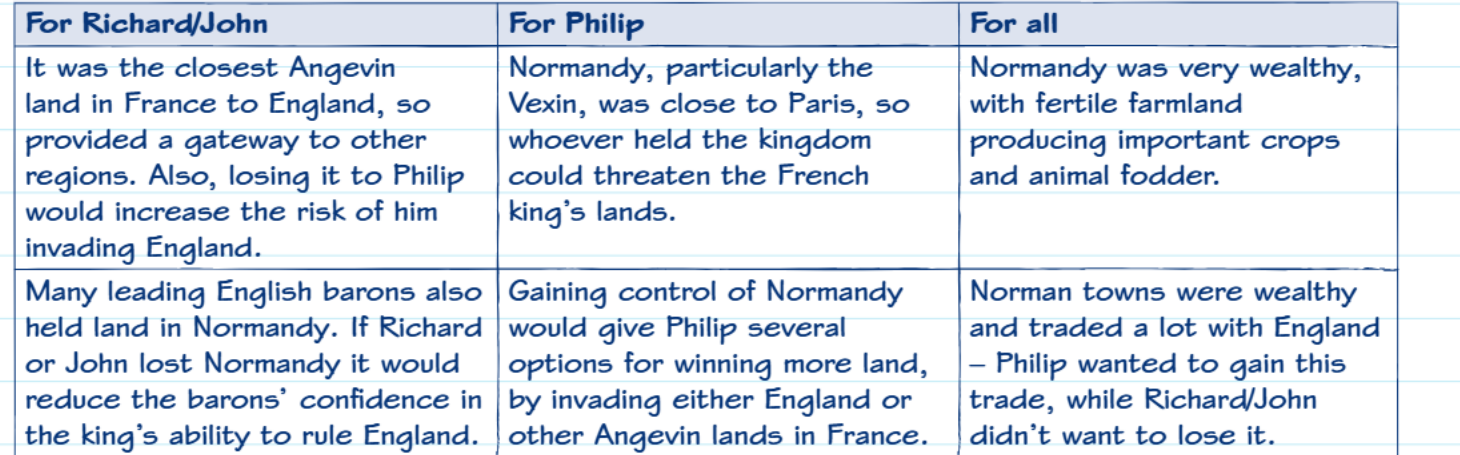
The importance of Normandy can be understood by examining what each party stood to gain or lose from controlling this crucial region.
Note
Understanding Normandy's strategic value requires examining it from multiple perspectives - geographic, political, military, and economic. Each ruler had different but equally compelling reasons for wanting to control this vital region.
Value for Richard and John
Normandy's geographic position made it indispensable to the Angevin rulers. As the closest Angevin territory to England, it functioned as the essential link connecting their English kingdom with their other French possessions. Without control of Normandy, maintaining communication and moving armies between England and their continental territories would become extremely difficult.
The region also held deep political significance within the Angevin system. Many prominent English barons owned extensive lands in Normandy, creating strong personal and economic ties between the two regions. Losing Normandy would not only cost these nobles their property but would also severely damage their confidence in royal leadership, potentially destabilising the entire political structure.
From a military perspective, Normandy served as a crucial defensive barrier. If Philip II gained control of the region, he would be positioned to launch invasions of England itself, bringing French forces dangerously close to English shores.
Strategic advantages for Philip II
For the French king, Normandy offered compelling strategic benefits. The Vexin region, in particular, lay uncomfortably close to Paris, meaning that whoever controlled this area effectively controlled the approaches to the French capital. This proximity made Norman control a pressing security concern for Philip.
Additionally, conquering Normandy would provide Philip with multiple options for further expansion. He could use Norman territory as a base for invading England directly, or alternatively, launch attacks against other Angevin territories in France from this strategic position.
Economic benefits for all parties
Beyond military considerations, Normandy was exceptionally prosperous. The region boasted fertile farmland that produced valuable crops and supported extensive livestock farming, generating substantial agricultural wealth for whoever controlled it.
Norman towns were particularly wealthy, maintaining profitable trading relationships with England. Both Philip II and the Angevin rulers understood that controlling this lucrative trade would bring significant financial advantages, while simultaneously denying these economic benefits to their enemies.
The critical situation in 1194
When Richard I returned from his imprisonment and captivity, he discovered that the situation in Normandy had deteriorated dramatically during his absence.
Important
Richard's prolonged absence had created a crisis that threatened the very survival of the Angevin Empire. The problems he faced in 1194 were so severe that many contemporaries doubted whether Angevin rule in Normandy could be restored.
Richard's first priority was securing England before crossing to Normandy, but the problems awaiting him there were severe. His prolonged absence had allowed several critical issues to develop that threatened Angevin control entirely.
Most seriously, key Norman barons had switched their allegiance from Richard to Philip II during the king's captivity. This loss of noble support undermined the loyalty networks that were essential for effective mediaeval rule.
Philip had skillfully exploited Richard's absence to seize control of most of western Normandy, including the strategically vital Vexin region. French forces now controlled important castles and defensive positions that had previously protected Angevin interests.
The French king had also gained control of crucial harbours, enabling potential naval attacks while preventing Richard from easily receiving reinforcements by sea. Perhaps most threateningly, Philip's forces were positioned near Rouen, Normandy's capital, putting the entire duchy at immediate risk.
How Richard achieved his aims
Despite facing these daunting challenges, Richard managed to regain control of almost all Norman territory by January 1199, when Philip II agreed to restore most conquered lands to Angevin rule. Only Gisors remained under French control. Richard's remarkable success resulted from his skilful combination of different strategies.
Note
Richard's recovery of Normandy is considered one of the most impressive military and diplomatic achievements of the mediaeval period. His success demonstrated how effective leadership could overcome seemingly impossible odds through strategic planning and flexible tactics.
Military expertise
Richard's reputation as an outstanding military commander proved crucial during the Norman campaigns. His forces demonstrated superior siege warfare capabilities, systematically recapturing castles that Philip had previously taken. They also proved highly effective in defensive operations, successfully holding their own strongholds against French attacks.
Most importantly, Richard's army won several significant battles that clearly demonstrated their superiority over Philip's forces. These victories helped restore confidence among Norman nobles who had been uncertain about supporting the Angevin cause.
Strategic use of financial incentives
Richard recognised that military force alone would be insufficient to regain stable control of Normandy. He systematically used bribery to persuade Norman nobles to abandon Philip II and return to Angevin allegiance.
This approach addressed one of the fundamental problems Richard faced - the erosion of noble loyalty during his imprisonment. By offering attractive financial terms and political concessions, he managed to rebuild the coalition of supporters necessary for effective rule.
Building crucial alliances
Richard also demonstrated considerable diplomatic skill by forging strategic alliances with important regional leaders, including the counts of Toulouse, Flanders, and Boulogne. These alliances proved invaluable because they meant Philip II was surrounded by potential enemies and could not concentrate all his military resources against Normandy.
The alliance strategy provided Richard with additional military support while creating multiple threats that forced Philip to divide his attention and resources across several fronts.
Timeline of major events
- 1194: Richard returns from imprisonment and begins systematic campaign to regain Norman territories
- 1194-1199: Period of intensive warfare and diplomatic manoeuvring as Richard gradually regains control
- January 1199: Philip II agrees to Richard's terms, acknowledging Angevin control over most disputed territories
- Outcome: Nearly complete Angevin success, with only Gisors remaining under French control
Summary
Key Points to Remember:
-
Normandy was the strategic key - its location made it the crucial gateway between England and continental Angevin territories, while its proximity to Paris made French control a security nightmare for Philip II
-
Economic wealth drove competition - Normandy's agricultural prosperity and trading connections made it financially valuable to whoever could control it
-
Richard's 1194 crisis was severe - his imprisonment had allowed Philip to conquer most of Normandy and win over crucial noble supporters
-
Success required multiple strategies - Richard's remarkable recovery combined military excellence, financial incentives, and diplomatic alliance-building rather than relying on force alone
-
The outcome reshaped the balance of power - by 1199, Richard had restored Angevin dominance in Normandy, securing the empire's survival for his successor John