Richard and the Third Crusade (Edexcel GCSE History): Revision Notes
📚Revision Notes
Richard and the Third Crusade
Background and Richard's decision to crusade
Richard I became one of the first princes to take the cross (agree to go on crusade) in autumn 1187, responding to the fall of Jerusalem to Saladin. Unlike many rulers who delayed their departure, Richard acted decisively, leaving England for the Holy Land in December 1189, just three months after his coronation. This quick departure demonstrated his commitment to the crusading cause and earned him the nickname "the Crusader King."
Note
The phrase "taking the cross" referred to the formal religious commitment to join a crusade, often marked by wearing a cross on one's clothing. Richard's swift action contrasted sharply with other European rulers who made excuses to delay their departure for years.
Richard's motivations for joining the crusade
Richard's decision to crusade stemmed from multiple interconnected factors that made this expedition both a religious duty and a political opportunity. As a deeply religious man, Richard strongly believed that participating in the crusade was his Christian duty, particularly after the shocking loss of Jerusalem to Muslim forces under Saladin.
His military background also played a crucial role in his decision-making. Richard was an experienced and skilled soldier who saw the crusade as an opportunity to achieve honour and glory on the battlefield. The prospect of leading Christian forces against Saladin appealed to his warrior instincts and desire for military renown.
Practically, Richard possessed the necessary resources to mount such an expensive expedition. The wealth and size of his Angevin Empire meant he had the financial means and manpower that many other rulers lacked. This gave him a significant advantage in organising and sustaining a long-distance military campaign.
Note
The Angevin Empire included England, Normandy, Anjou, Maine, Touraine, Poitou, and Aquitaine, making Richard one of the wealthiest rulers in Europe at the time.
Finally, Richard had a personal family connection to the crusading cause. His great-grandfather had been king of Jerusalem, creating both a family legacy and a legitimate claim that motivated Richard's desire to recapture the holy city.
The developing rivalry with Philip II of France
Even before the crusade began, tensions were escalating between Richard and Philip II of France, which would significantly impact the success of their joint expedition. This rivalry had deep roots in their territorial disputes and competing ambitions.
Philip had attempted to exploit Richard's absence by stirring up trouble between Richard, his brothers, and his father Henry II. Despite having a smaller empire than Richard's, Philip's resources were more concentrated, making his smaller territories potentially more effective than Richard's scattered domains.
Important
The rivalry between Richard and Philip would prove to be one of the most significant obstacles to the crusade's success, often causing more problems than the actual military challenges they faced.
The dispute over the Vexin region in France created particular friction between the two kings. Philip had given Richard this territory as a dowry for marrying his sister, but Richard never went through with the marriage, creating ongoing diplomatic tension and territorial uncertainty.
The journey to the Holy Land and early conflicts
The Third Crusade faced an early setback when Frederick Barbarossa, the Holy Roman Emperor and third major leader, drowned while crossing into Asia Minor in June 1190. Many of his troops returned home, reducing the crusading army's strength and increasing the rivalry between Richard and Philip as both wanted to lead the remaining forces.
Note
Frederick Barbarossa's death was particularly devastating because he had been leading the largest and most organised contingent of crusaders. His loss left the expedition significantly weakened before it even reached the Holy Land.
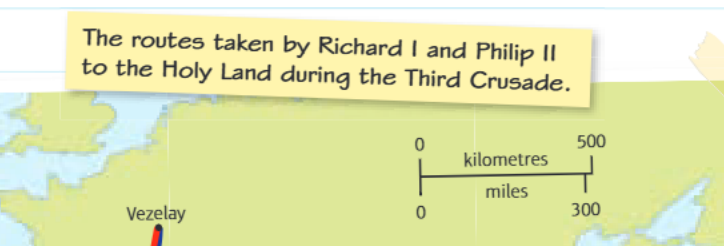
Richard and Philip took different routes to the Holy Land, which created both strategic advantages and new sources of conflict. In September 1190, Richard received a grand ceremonial welcome upon his arrival in Messina, Sicily. However, Philip, arriving separately, felt humiliated by the contrast in their receptions. After fighting erupted in the city, Richard successfully conquered Messina, but Philip was annoyed by Richard's dominant role in securing the peace agreement with Sicily's ruler.
Strategic disagreements and the conquest of Cyprus
The crusade revealed fundamental strategic disagreements between the two kings about how to conduct the campaign. They disagreed over who should be king of Jerusalem, with Richard supporting Guy de Lusignan and Philip backing Conrad de Montferrat. They also quarrelled over how much their professional soldiers should be paid, with Richard willing to pay more to secure better quality troops.
In May 1191, Richard invaded and conquered Cyprus, demonstrating his tactical brilliance but also his willingness to act independently. Rather than giving Philip a share of Cyprus's value, Richard refused to share the proceeds, keeping 100,000 gold coins and securing grain supplies for his army. This decision further strained their relationship and highlighted Richard's prioritisation of practical military needs over diplomatic cooperation.
Important
Richard's refusal to share the wealth from Cyprus with Philip was a critical mistake that deepened their rift. This selfish decision prioritised short-term military advantage over the long-term unity needed for crusading success.
While in Cyprus, Richard married Berengaria of Navarre, going back on his previous agreement to marry Philip's sister. This marriage alliance with Navarre was strategically valuable but represented another betrayal of his commitments to Philip.
Victory at Acre and Philip's departure
Despite their personal conflicts, Richard and Philip achieved a significant military success with their victory at Acre in July 1191. This triumph demonstrated what the crusading forces could accomplish when working together effectively.
However, Philip's decision to return home in August 1191 marked a turning point in the crusade. Officially, Philip claimed illness as his reason for leaving, but the reality was more complex. He had grown frustrated with Richard's dominance, was unwell, and had received reports that the Count of Flanders had died, creating an opportunity to expand his territories in France while Richard remained absent.
Important
Philip's departure significantly weakened the crusading army and left Richard as the undisputed leader of the remaining forces. However, it also freed Richard from the constant diplomatic tensions and strategic disagreements that had hampered their joint leadership.
Timeline of key events
- Autumn 1187: Richard takes the cross, committing to join the crusade
- December 1189: Richard departs England for the Holy Land
- June 1190: Frederick Barbarossa drowns, reducing crusading forces
- September 1190: Richard's ceremonial arrival and conquest of Messina
- May 1191: Richard invades and conquers Cyprus
- May 1191: Richard marries Berengaria of Navarre in Cyprus
- July 1191: Joint victory at Acre by Richard and Philip's forces
- August 1191: Philip returns to France, leaving Richard in command
Summary
Key Points to Remember:
- Richard joined the Third Crusade quickly after taking the cross in 1187, motivated by religious duty, military ambition, imperial resources, and family connections to Jerusalem
- The rivalry between Richard and Philip II severely hampered the crusade's effectiveness, stemming from territorial disputes, strategic disagreements, and personal conflicts over leadership
- Richard's conquest of Cyprus in 1191 demonstrated his military skills but worsened relations with Philip by refusing to share the valuable proceeds
- Philip's departure in August 1191 left Richard as sole leader but weakened the overall crusading force at a critical moment
- The personal conflicts between Christian leaders proved as significant an obstacle to crusading success as the military challenges they faced against Saladin