Victories at Acre and Arsuf (Edexcel GCSE History): Revision Notes
📚Revision Notes
Victories at Acre and Arsuf
Richard I's military successes at Acre and Arsuf during the Third Crusade established his reputation as one of mediaeval Europe's greatest military commanders. These victories demonstrated his tactical brilliance, though they were also marked by controversial decisions that would define his complex legacy.
Note
The Third Crusade (1189-1192) was launched in response to Saladin's recapture of Jerusalem in 1187. Richard I of England, Philip Augustus of France, and Frederick Barbarossa of the Holy Roman Empire led this major European military expedition to the Holy Land.
The siege of Acre (1189-1191)
Strategic importance and early stages
Acre held crucial strategic value as the main port serving the Kingdom of Jerusalem. Control of this coastal city meant controlling vital supply routes to Jerusalem itself. The city had been under siege by Crusader forces since 1189, but the siege had become a lengthy stalemate.
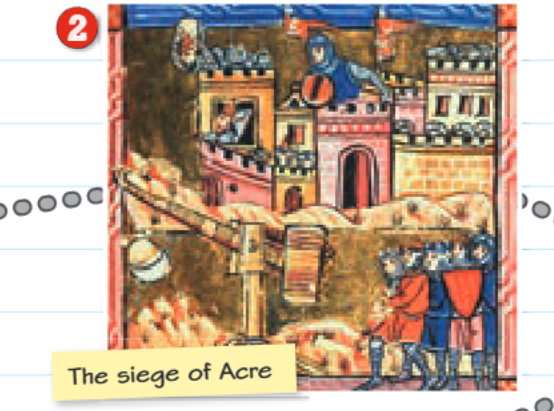
The situation began to change when Philip Augustus of France arrived with his forces in January 1191. However, it was Richard's arrival at Acre on 8 June 1191 that truly transformed the siege. His forces immediately joined the assault on the city walls, bringing fresh energy and resources to the Crusader campaign.
The breakthrough and victory
Richard's military engineering expertise proved decisive. The walls of Acre were eventually breached through the combined efforts of catapults and Philip's miners on 12 July 1191. This breakthrough came after only about a month of Richard's direct involvement, highlighting his effectiveness as a military leader.
Following the successful breach, Saladin's forces defending the city surrendered. This victory marked a significant turning point in the Third Crusade, giving the Crusaders their first major success and providing them with a crucial port for future operations.
Controversial aftermath
The aftermath of Acre's capture revealed the ruthless side of mediaeval warfare. Richard negotiated with Saladin for the release of Muslim soldiers, demanding 200,000 gold coins, the release of Christian prisoners, and fragments believed to be from the True Cross (which Saladin had captured in 1187).
Important
When Saladin failed to meet these demands fully, Richard made the controversial decision to execute 2,700 Muslim prisoners on 20 August. This act, while shocking by modern standards, was seen by some contemporaries as a tactical decision to prevent the prisoners from rejoining Saladin's army. This event remains one of the most debated aspects of Richard's military career.
The march to Jaffa and Battle of Arsuf (1191)
Strategic movement
On 25 August, the Crusader army departed Acre and began the challenging march towards Jaffa, which would serve as their route to Jerusalem. Richard demonstrated exceptional tactical planning during this march, organising his forces to protect against the constant threat of attack from Saladin's mobile forces.
The Crusader fleet sailed alongside the army, providing essential supplies of water, food, and rest areas. This coordination between land and sea forces showed Richard's understanding of logistics in desert warfare. Despite frequent harassment from Saladin's skilled horsemen, Richard maintained formation and continued the advance.
Saladin's major assault
On 7 September 1191, Saladin launched a major attack against the Crusaders on the plain of Arsuf with an enormous army of 300,000 men. This represented Saladin's attempt to destroy the Crusader army before it could reach Jerusalem.
Saladin recognised that allowing the Crusaders to reach Jaffa would give them a secure base for attacking Jerusalem. The battle at Arsuf was therefore crucial for both sides - Saladin needed to stop the Crusade in its tracks, while Richard needed to prove that his army could defeat Saladin in open battle.
Richard's tactical mastery
Richard's response to Saladin's attack demonstrated his exceptional military leadership. At the crucial moment of the battle, he courageously led his knights in a decisive cavalry charge against Saladin's forces. This personal leadership from the front inspired his troops and turned the tide of battle.
Example
Tactical Formation at Arsuf:
Richard employed a sophisticated defensive formation during the march:
- Sea flank: Protected by the Crusader fleet providing supplies and security
- Land flank: Defended by coordinated archers and infantry soldiers
- Mobile reserve: Heavy cavalry held ready for decisive counterattack
- Communications: Coordinated signals between land and sea forces
This disciplined formation allowed the Crusaders to respond effectively when Saladin's attack came, demonstrating mediaeval military planning at its finest.
After intense fighting, Saladin's army was forced to flee the battlefield, and the Crusader army continued its march towards Jaffa. This victory established Richard as a military commander capable of defeating the famous Saladin in open battle.
Timeline of key events
- 1189: Siege of Acre begins
- January 1191: Philip Augustus arrives at Acre with French forces
- 8 June 1191: Richard I arrives at Acre
- 12 July 1191: Acre's walls breached, city surrenders
- 20 August 1191: Richard executes 2,700 Muslim prisoners
- 25 August 1191: Crusader army begins march from Acre to Jaffa
- 7 September 1191: Battle of Arsuf - Richard defeats Saladin's 300,000-strong army
Summary
Key Points to Remember:
-
Strategic thinking: Richard understood that controlling ports like Acre was essential for maintaining Crusader supply lines and communications with Europe
-
Tactical excellence: His victory at Arsuf demonstrated superior battlefield leadership, using coordinated infantry, archers, and cavalry formations effectively
-
Controversial decisions: The execution of prisoners at Acre showed the brutal realities of mediaeval warfare and Richard's willingness to make harsh decisions
-
Personal leadership: Richard's courage in leading cavalry charges personally inspired his troops and contributed directly to victory
-
Combined operations: The coordination between the Crusader fleet and army during the march to Jaffa showed sophisticated military planning for the period