Medieval towns (Edexcel GCSE History): Revision Notes
📚Revision Notes
Mediaeval towns
Introduction to mediaeval towns in England
During the reign of King Richard I and King John (1189-1216), mediaeval towns played an increasingly important role in English society. Although only a small percentage of England's population lived in towns, by 1189 these settlements were experiencing significant growth. This expansion was driven by increasing trade and growing prosperity, making towns vital centres of economic activity and essential sources of revenue for the monarchy.
Note
While the majority of England's population remained rural, the growing influence of towns during this period marked a significant shift in mediaeval society and economics.
The growth and importance of towns
Towns developed into crucial economic hubs because they served as centres of trade and commerce. Unlike rural villages where most people lived as peasants tied to the land, towns offered opportunities for free people to engage in various forms of business and craft work. The king recognised their value as they provided substantial income through taxes and trade duties.
Life in mediaeval towns
Social structure and freedom
Town life offered a different social structure compared to rural areas. All town residents were free people who did not belong to a lord, giving them the freedom to choose their own employment and way of life. This attracted people seeking better opportunities and social mobility.
The population of mediaeval towns included various groups with different roles and social standings. Some residents were skilled tradesmen such as blacksmiths, carpenters, and bakers who provided essential services and goods. Others worked as merchants, engaging in larger-scale trade operations. Many townspeople lived in poverty and worked as servants or labourers, while some earned their living through small-scale trading activities.
Note
Social Mobility in Mediaeval Towns
The freedom offered by town life was revolutionary for its time. Unlike rural peasants who were bound to their lord's land, town dwellers could pursue different occupations and even change their social status through successful business ventures.
The central role of the church
Just as in villages, the church remained central to town life and community organisation. All residents were expected to attend church services on Sundays, and religious festivals and ceremonies marked important moments in the community calendar. People often visited the market after church services, combining their religious and commercial activities.
Town layout and key features
Mediaeval towns had distinctive physical characteristics that reflected their economic and social functions.
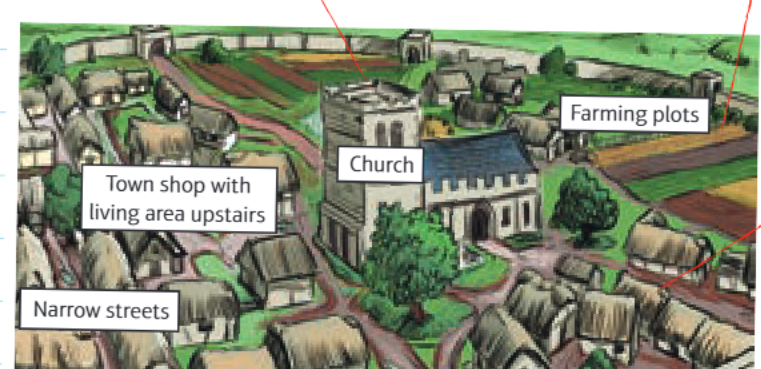
Towns were typically surrounded by strong stone walls that served multiple purposes. These defensive structures protected residents from thieves and attacks while also controlling access through gateways. Watchmen patrolled these walls at night to maintain security and monitor who entered or left the town.
Within the walls, towns featured narrow winding streets that connected different areas and buildings. The church usually occupied a central position, emphasising its importance in community life. Multi-story buildings were common, with shops operating on the ground floor and living quarters located upstairs, maximising the use of valuable urban space.
Important
Town Defence and Security
Mediaeval town walls weren't just for show - they were essential for survival. The combination of stone walls, controlled gateways, and night watchmen created a comprehensive security system that protected both residents and valuable trade goods.
Markets and trade
Towns contained plots of land where people grew food for themselves and produced surplus crops to sell in local markets. These markets were essential features of town life, typically held on specific days of the week, often on Sundays after church services.
Local villagers and townspeople would bring their surplus food and goods to sell in the town's market. Some houses had shops at the front where traders could rent space or set up stalls. Larger towns obtained royal licenses to hold annual fairs, which attracted merchants and buyers from across the region. During these events, people could buy and sell goods, enjoy entertainment such as drinking and sports, and socialise with visitors from other areas.
The buying and selling activities that took place in towns daily generated significant tax revenue for the king through sales taxes and purchase duties.
Example
A Typical Market Day
Step 1: Sunday morning church service attendance Step 2: After service, villagers and townspeople gather in the market square Step 3: Traders set up stalls selling surplus crops, crafted goods, and imported items Step 4: Buyers browse and negotiate prices Step 5: Tax collectors record sales for royal taxation
Key groups in mediaeval towns
Tradesmen
Tradesmen formed an important part of the urban economy and social structure. These skilled craftsmen learned their trades through apprenticeship systems, training under experienced master craftsmen for several years. Common trades included blacksmithing (making metal tools and horseshoes), carpentry (building and woodwork), and baking (producing bread and other baked goods).
Many tradesmen belonged to guilds, which were professional organisations that controlled trade practices in their respective crafts. Guild membership gave tradesmen the right to trade in the town, but also required them to pay membership fees and taxes to maintain their status.
Example
The Apprenticeship System
Training Path for a Blacksmith:
Step 1: Young person (usually aged 12-14) becomes an apprentice Step 2: Lives with master craftsman for 7 years, learning skills Step 3: Provides free labour in exchange for food, shelter, and training Step 4: After completing apprenticeship, becomes a journeyman Step 5: May eventually become a master and train their own apprentices
Merchants
Merchants operated on a larger scale than tradesmen, dealing in food, raw materials, and textiles. They conducted business not only within England but also traded with other European countries, particularly the Low Countries (modern-day Netherlands and Belgium).
Some merchants achieved considerable wealth through their trading activities. However, they faced significant costs including customs duties on all imports and exports, which were paid directly to the king. This made international trade profitable but expensive, limiting it to those with substantial capital.
Important
The High Cost of Mediaeval Trade
International merchants faced substantial financial barriers. Customs duties, transportation costs, and the risks of long-distance travel meant that only wealthy individuals could afford to engage in large-scale international commerce.
Economic importance of towns
Mediaeval towns contributed to the national economy in several crucial ways. They served as centres where agricultural surplus from surrounding villages could be sold and distributed. The concentration of craftsmen and merchants in towns created networks of trade that connected different regions of England and linked the country to international markets.
Towns also generated substantial tax revenue for the monarchy through various means. Residents paid tallage (a form of land tax) to the king, while merchants contributed through customs duties on traded goods. The licensing of markets and fairs provided additional income, and the daily commercial activities generated ongoing tax revenue.
Note
Multiple Revenue Streams
Mediaeval kings were clever about taxation. They collected money from towns through land taxes (tallage), trade duties (customs), market licenses, and daily commercial taxes - creating a steady income from urban economic activity.
Timeline of key developments
- 1189: Towns were already growing significantly due to increased trade and prosperity
- 1189-1216: Continued urban development during the reigns of Richard I and John
- Throughout the period: Towns established as vital centres of trade and royal revenue
Remember!
Summary
Key Points to Remember:
- Mediaeval towns were growing rapidly by 1189 due to increasing trade and economic opportunities
- Town dwellers were free people who could choose their own occupations, unlike rural peasants tied to lords
- Churches remained central to town life, with residents expected to attend Sunday services
- Towns featured distinctive layouts with stone walls, narrow streets, central churches, and mixed-use buildings
- Tradesmen and merchants formed the backbone of the urban economy, with tradesmen learning through apprenticeships and merchants engaging in regional and international trade
- Towns contributed significantly to the national economy through tax revenue, trade networks, and as centres for distributing agricultural surplus