Role and influence of the Church (Edexcel GCSE History): Revision Notes
📚Revision Notes
Role and influence of the Church (1189-1216)
During the mediaeval period from 1189-1216, the Catholic Church wielded tremendous power and authority throughout English society. The Church was not merely a religious institution but a dominant force that shaped every aspect of daily life, from spiritual beliefs to economic practices and political decisions.
The importance of religion in mediaeval life
Mediaeval people held deep religious convictions that influenced their entire worldview. Most individuals believed that God had complete control over all earthly events and would ultimately determine their eternal fate - whether they would spend eternity in heaven or hell. This fundamental belief made pleasing God absolutely essential, and the Church positioned itself as the sole guide for achieving salvation.
Note
The Church's authority extended far beyond spiritual matters. As an international organisation with its headquarters in Rome, the Church operated according to a strict hierarchical structure that mirrored the feudal system governing secular society.
This parallel structure meant that religious and political power often intersected and sometimes conflicted, creating a complex web of authority that would define mediaeval English society.
The structure of the Church
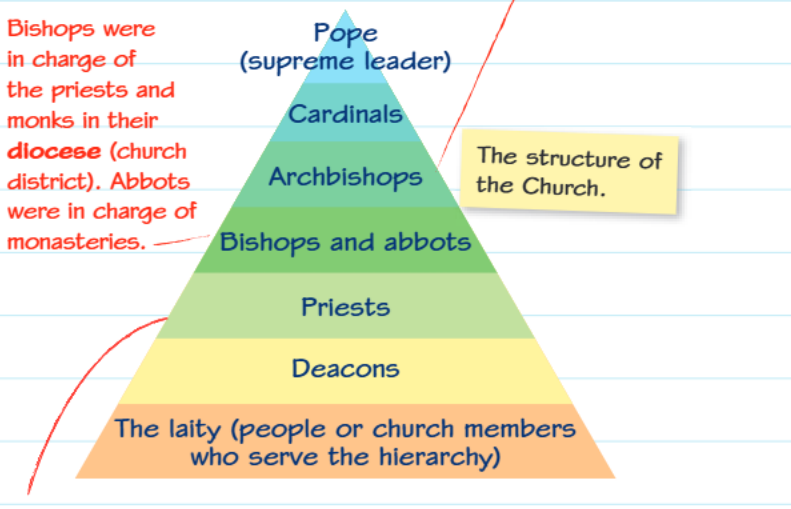
The Catholic Church maintained a rigid hierarchy that established clear lines of authority from the highest religious officials down to ordinary church members.
Important
At the apex of this system sat the Pope in Rome, who served as God's representative on Earth and held supreme authority over all Christians. The Pope possessed extraordinary power, including the ability to influence kings and authorise the appointment of high-ranking church officials like archbishops.
Below the Pope, Cardinals advised on important church matters, while Archbishops oversaw large geographical regions. In England, the Archbishop of Canterbury held the most prestigious position as head of the English Church, though he received support from the Archbishop of York. These archbishops had significant political influence and often served as royal advisors.
The hierarchy continued with clear divisions of responsibility:
- Bishops managed priests and monks within their dioceses (church districts)
- Abbots held similar authority over monasteries
- Priests served individual parishes, with each parish priest taking responsibility for both his church building and the spiritual welfare of his community
- Deacons assisted priests in their duties
- Laity - ordinary church members who participated in religious life but held no official church positions
Areas of Church influence
The Church's power manifested in four distinct but interconnected ways, each contributing to its overall dominance in mediaeval society.
Spiritual influence
The clergy dedicated their entire lives to serving God and provided spiritual guidance to all levels of society. They taught people how to live according to Church teachings, which included accepting the principles of feudalism as part of God's natural order. This spiritual authority helped maintain social stability by encouraging people to accept their position in society.
Church officials performed essential religious services throughout England. They conducted Mass in villages and towns across the country, administered baptisms for newborns, officiated at marriages, and conducted funeral services. These ceremonies marked the most important moments in people's lives and reinforced the Church's central role in the community.
Note
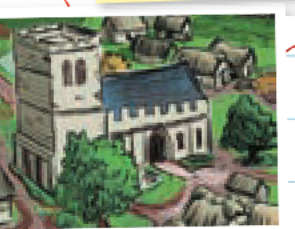
Every parish maintained a local church where community members gathered for worship and received religious instruction. Parish priests served as moral authorities and spiritual counsellors, making them influential figures in their local communities.
Economic influence
The Church accumulated vast wealth through multiple revenue streams, making it one of the most financially powerful institutions in mediaeval England. This economic strength came primarily from extensive land ownership, as people frequently donated property and money to the Church, either during their lifetimes or through their wills after death.
Important
All Christians were required to pay tithes - exactly one-tenth of their annual produce - to support the Church. This created a steady and substantial income stream that flowed from every agricultural community directly to Church coffers.
The Church also functioned as a major landowner and employer. Many people depended on Church-owned lands for their livelihood, working as farmers, craftspeople, or servants on Church property. The institution maintained numerous vassals and employees, creating an extensive network of economic dependence.
As a significant source of royal revenue, the Church paid taxes to the king based on income generated from its lands. However, this financial relationship also gave the Church considerable leverage over royal policies and decisions, as kings relied on Church wealth to fund their activities.
Political influence
Members of the clergy provided essential services to the monarchy, serving as trusted advisors and skilled administrators. Many clergy members received excellent educations, making them valuable assets for kings who needed literate and capable officials to help govern the kingdom.
Important churchmen, particularly archbishops, held positions as leading members of the royal government and regularly advised the king on both domestic and foreign policy matters. Their education and international connections through the broader Catholic Church made them particularly valuable for diplomatic negotiations and policy development.
Important
The Church's political influence created potential conflicts with royal authority. Since the king operated under the Pope's spiritual authority like all Catholics, disagreements between papal and royal policies could create serious tensions. Clergy members sometimes faced difficult choices between loyalty to their king and obedience to papal directives.
Social influence
The Church played a crucial educational and cultural role in mediaeval society. Priests and monks provided literacy education to both children and adults, and some church buildings housed extensive collections of books and manuscripts.
Note
Monasteries, nunneries, and parish priests served as centres of learning and preserved important knowledge during a period when few people outside the Church could read or write.
Many churchmen participated actively in legal proceedings, serving important roles in law courts throughout England. The Church maintained its own legal system and kept detailed records of laws and legal precedents, making clergy members valuable contributors to the broader legal system.
The Church also provided essential social services, caring for the elderly, poor, and sick members of society. Monasteries and parish churches often served as centres for charitable activities, distributing food and providing shelter for those in need.
Timeline of key events
- 1189: Richard I becomes king; Church continues its influential role in English government
- 1199: John becomes king, beginning tensions with Church authority
- 1207-1214: Interdict placed on England due to disputes between King John and Pope Innocent III
- 1213: John submits to papal authority, making England a papal fief
- 1215: Magna Carta signed, with Church influence evident in its provisions
- 1216: John dies; Church remains central to English political and social life
Remember!
Summary
Key Points to Remember:
- The Catholic Church operated as a hierarchical organisation parallel to the feudal system, with the Pope at the top and ordinary believers (the laity) at the bottom
- Church influence extended into four major areas: spiritual guidance, economic power through land ownership and tithes, political advisory roles, and social services including education and law
- The Church's immense wealth came from land donations, tithes (one-tenth of produce), and its role as a major landowner and employer
- Potential conflicts existed between royal and papal authority, as both claimed ultimate authority over different aspects of mediaeval life
- Every parish had a priest responsible for local spiritual welfare, making the Church's influence felt in even the smallest communities throughout England