The first Five-Year Plan (Edexcel GCSE History): Revision Notes
📚Revision Notes
The first Five-Year Plan (1953-1957)
Introduction
In the early 1950s, Chinese communist leaders recognised that China needed to undergo rapid industrial development. After debating different approaches and timelines, Mao Zedong decided in 1953 that it was time to take decisive action. This marked the beginning of China's first Five-Year Plan, which would run from 1953 to 1957 and fundamentally transform the country's economic structure.

Reasons for implementing the first Five-Year Plan
The Chinese Communist Party had three main motivations for launching this ambitious industrialisation programme in 1953:
Note
The timing of the first Five-Year Plan was influenced by both international events and domestic ideological commitments, making 1953 a critical turning point in Chinese economic policy.
Soviet industrial success as inspiration The remarkable achievements of Soviet five-year plans provided a compelling model for China to follow. Over just 20 years, Soviet planning had successfully transformed a largely agricultural peasant society into a major industrial power. This demonstration of rapid industrialisation convinced Chinese leaders that similar methods could work for China.
Korean War military concerns The Korean War (1950-1953) highlighted China's military vulnerabilities and made leaders deeply concerned about potential foreign invasion. China's military forces needed to become much stronger, which required the development of modern heavy industry capable of producing advanced weapons and military equipment.
Ideological commitment to industrialization Both Maoism and Marxism taught that socialism and eventually communism could only be achieved through a fully industrialised society. Chinese leaders believed that without complete industrial development, their revolutionary goals would remain impossible to accomplish.
Nature of the planned economy
The first Five-Year Plan established a comprehensive planned economy that differed dramatically from China's previous economic approach. This new system had several key characteristics that would define Chinese economic policy throughout the 1950s.
State control over industrial production The government took direct control of industries so it could determine what they produced rather than leaving these decisions to market forces. Mao believed this centralised approach meant China's limited resources could be used most efficiently, avoiding the waste and duplication that might occur under private ownership.
Important
The shift to a planned economy represented a fundamental departure from market-based decision making, with the state now determining all major production decisions rather than allowing market forces to guide economic activity.
Transformation into a planned economy Rather than allowing industries to produce whatever they thought would generate the most profit, the government created detailed plans specifying what each industry needed to produce and set specific targets for them to meet. This represented a fundamental shift from market-driven to state-directed economic development.
Heavy industry prioritization The state concentrated its investment heavily on industry, particularly focusing on heavy industries like iron, steel, and coal production. An impressive 90 percent of all state investment during this period went into these heavy industrial sectors, demonstrating the government's commitment to rapid industrial expansion.
Large-scale factory construction The plan called for building massive new industrial facilities because planners believed that large-scale factories would operate most efficiently and produce goods at the lowest cost. This emphasis on size and scale became a defining feature of Chinese industrial development.
Industrial targets and production goals
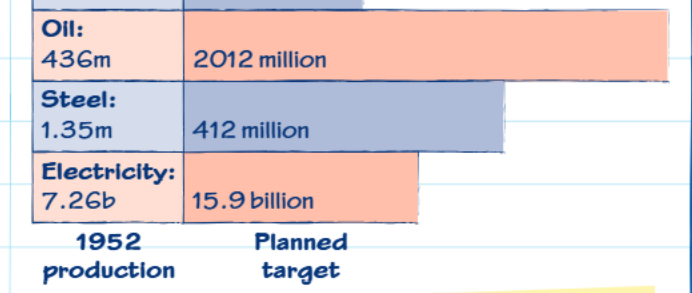
The first Five-Year Plan set extraordinarily ambitious targets for China's key industrial sectors, representing massive increases over 1952 production levels.
Example
Production Target Comparison: 1952 vs Plan Goals
The scale of industrial expansion planned was unprecedented:
Coal production expansion
- 1952: 60.5 million tonnes
- Target: 113 million tonnes (nearly double)
Oil production breakthrough
- 1952: 436 million
- Target: 2,012 million (more than 4x increase)
Steel production revolution
- 1952: 1.35 million
- Target: 412 million (massive expansion)
Electricity generation boost
- 1952: 7.26 billion kWh
- Target: 15.9 billion kWh (more than double)
Coal was essential for powering China's expanding industrial base and providing energy for steel production. The dramatic oil production increase was crucial for China's industrial machinery and transportation needs, while steel production targets reflected the critical importance of steel for heavy industry, construction, and military applications. Electricity generation expansion would provide the power necessary to run China's expanding industrial facilities.
Infrastructure development projects
Beyond industrial production, the first Five-Year Plan included major infrastructure improvements designed to connect different regions of China and support economic development.
The Wuhan bridge project One of the plan's most significant infrastructure achievements was the construction of a bridge across the Yangtze River at Wuhan. In 1953, there was no bridge spanning the Yangtze River, which created a major obstacle to China's development since everything had to be transported across the river by ferry. This bridge project was essential for connecting northern and southern China and facilitating the movement of goods and people across this natural barrier.
Note
The lack of a Yangtze River bridge in 1953 demonstrates how China's infrastructure lagged behind its industrial ambitions, making projects like the Wuhan bridge critical for economic integration.
Transportation network expansion The Communist Party also planned major improvements to China's roads, railways, bridges, and ports. These infrastructure developments were necessary to support the massive industrial expansion and ensure that raw materials could reach factories and finished products could reach markets.
Soviet economic aid and technical support
China's first Five-Year Plan relied heavily on assistance from the Soviet Union, formalised through the Treaty of Friendship, Alliance and Mutual Assistance signed by Mao and Stalin in February 1950.
Note
Soviet Support Package Details
The Soviet assistance came in multiple forms, each addressing different aspects of China's industrialisation needs:
Financial assistance package The USSR committed to providing $300 million in financial support, though this came as a loan with high interest rates rather than a grant. This financial assistance represented only about 3 percent of the total investment in the Five-Year Plan, meaning China had to fund the vast majority of the costs internally.
Technical expertise and training More valuable than the financial aid was the technical support the Soviets provided. They sent 11,000 experts to help establish and operate China's new factories, bringing crucial industrial knowledge and experience. Additionally, 28,000 Chinese technicians received training to develop the skills necessary to run modern industrial facilities.
Factory planning and design The Soviet Union provided detailed plans for constructing 156 new factories and supplied the complex machinery needed to equip these facilities.
Important
By 1957, fewer than half of the planned 156 factories had actually been completed, indicating some of the significant challenges China faced in implementing such an ambitious programme despite Soviet assistance.
Timeline of key events
- 1950: Treaty of Friendship, Alliance and Mutual Assistance signed between China and USSR
- 1950-1953: Korean War influences Chinese military and industrial priorities
- 1953: First Five-Year Plan officially begins
- 1953: No bridge exists across the Yangtze River, hampering north-south transportation
- 1957: First Five-Year Plan officially concludes
- 1957: Less than half of planned 156 factories completed
Summary
Key Points to Remember:
-
The first Five-Year Plan (1953-1957) marked China's commitment to rapid industrialisation using Soviet methods and focusing heavily on coal, oil, steel, and electricity production
-
Three main reasons drove the plan: Soviet industrial success as a model, Korean War military concerns, and ideological belief that industrialisation was necessary for achieving socialism
-
The plan created a state-controlled planned economy where the government directed industrial production and invested 90% of resources into heavy industry rather than consumer goods
-
Industrial targets were extremely ambitious, calling for production increases of several hundred percent across key sectors compared to 1952 baseline levels
-
Soviet support was crucial, providing technical expertise through 11,000 experts, training for 28,000 Chinese technicians, and factory designs, though only limited financial aid