The CCP (Edexcel GCSE History): Revision Notes
📚Revision Notes
The CCP and establishing communist control
The establishment of CCP control in China
When Mao Zedong founded the People's Republic of China in 1949, the new government initially appeared to follow democratic principles. However, this democratic facade was short-lived, as the Chinese Communist Party quickly established its dominance over all aspects of government and political life.
Note
The early government structure included several seemingly democratic features that suggested China would embrace political pluralism. These included provisions for equal rights, multi-party elections, and freedom of speech.
A parliament called the National People's Congress was established to create laws, while Provincial Congresses were set up to govern China's provinces and major cities. Additionally, a State Council was formed, elected by the National People's Congress, to handle government ministries and decision-making processes.
Important
Despite these democratic appearances, the CCP was strategically positioning itself to take complete control. By the end of 1952, the Party had successfully dominated all government decisions and actions, transforming China from a potentially multi-party democracy into a one-party communist state.
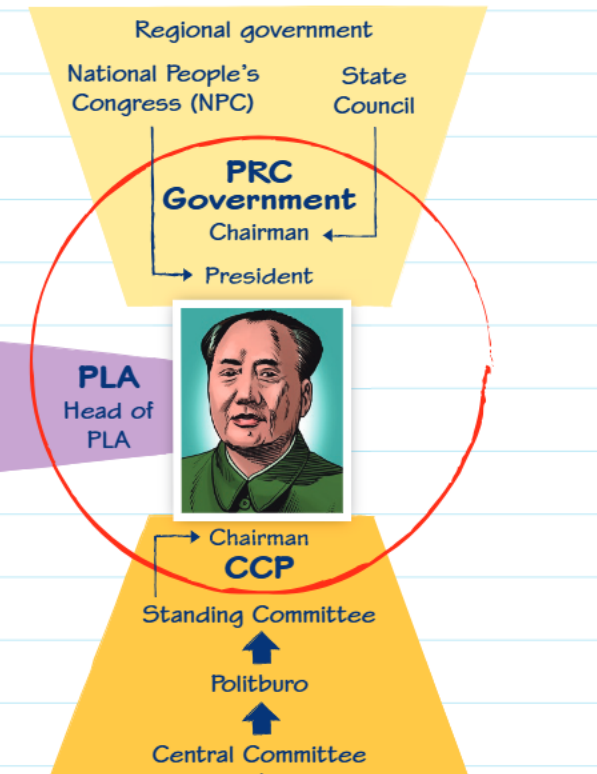
China's governmental structure under the 1954 constitution
The 1954 constitution established a complex governmental framework that appeared to distribute power across different institutions, but in reality concentrated control within the CCP hierarchy.
Note
The structure included regional government bodies such as the National People's Congress and State Council at the local level. At the national level, the PRC Government featured both a Chairman and President position, alongside leadership of the People's Liberation Army.
However, the most significant element was the CCP's organisational structure, which formed the true centre of power with the Standing Committee at its apex, followed by the Politburo and Central Committee.
This arrangement meant that while China had the appearance of a traditional government structure, real authority flowed through the Party hierarchy. Mao held multiple key positions simultaneously, allowing him to control both the government apparatus and the military through his various roles.
How the CCP gained control of government
The CCP's rise to power was not immediate but followed a deliberate strategy of gradual takeover. Initially, the Party was too small to govern China independently, which necessitated cooperation with other political parties and non-communist officials.
Important
This period of apparent collaboration masked the CCP's true intentions and allowed them to build strength while appearing moderate. The transformation was crucial because it established the foundation for China's communist system that would persist for decades.
As the Party grew stronger, it systematically eliminated other political voices and consolidated power. The CCP's control became so complete that by the early 1950s, it dominated all major government decisions and policy directions.
Growth of party membership and mass campaigns
The CCP experienced remarkable growth in its early years of power, expanding from 4.5 million members in 1949 to 6.5 million by 1953. This rapid increase was not accidental but resulted from deliberate recruitment strategies designed to extend Party influence throughout Chinese society.
Note
Mao utilised mass Party membership to organise large-scale political campaigns, particularly the "antis" movements. These campaigns were essential tools for helping the CCP secure control over China by mobilising ordinary citizens to support Party objectives and identify potential opponents.
The mass membership approach allowed the Party to penetrate all levels of society and ensure its policies reached every corner of the country.
Democratic centralism as a governing principle
The CCP operated according to a principle called democratic centralism, which created an apparent contradiction between democratic participation and authoritarian control.
Important
Common Misconception Alert: While labelled as "democracy" by the CCP, this system ensured that ultimate authority remained with the top leadership. The "democratic" element was limited to discussion phases only.
Example
How Democratic Centralism Worked in Practice:
Step 1: Discussion Phase
- Party members could debate and discuss proposed policies
- Members had the right to voice opinions and vote on issues
- This created the impression of democratic participation
Step 2: Decision Phase
- Central leadership made the final decision
- All discussion immediately ceased once the decision was announced
Step 3: Implementation Phase
- Every Party member had an obligation to support and implement the decision without question
- Unity was maintained through enforced compliance
The effectiveness of democratic centralism lay in its ability to maintain Party unity while appearing to respect member input. It prevented the emergence of serious opposition within the Party while creating a sense of participation that encouraged loyalty among members.
CCP organisational structure and leadership
The CCP developed a hierarchical organisational structure that concentrated power at the highest levels while creating the appearance of broader participation.
Example
CCP Organisational Hierarchy (Bottom to Top):
Level 1: Regional Congresses
- Base level where CCP members participated
- Representatives selected for higher positions
Level 2: National Congress
- Formed by regional delegates
- Theoretically elected the Central Committee
Level 3: Central Committee
- Appeared to be the main governing body
- Actually overseen by the Politburo
Level 4: Politburo
- Made crucial policy decisions for the entire Party
- Contained the Standing Committee
Level 5: Standing Committee
- Most powerful element in the structure
- Wielded practical authority over day-to-day operations
Note
Party elections were tightly controlled, ensuring that only approved candidates could advance through the system. Although the Politburo was technically more powerful, the Standing Committee held practical authority over operations.
Importantly, Mao retained the ability to make significant decisions independently when necessary, ensuring his personal dominance over the entire system.
Key leadership positions were filled by Mao's trusted allies. Zhou Enlai served as a senior member of both the Politburo and Standing Committee, taking responsibility for ensuring that Party policies were properly implemented. Liu Shaoqi became the first chairman of the Standing Committee, making him one of the most influential figures in the Party hierarchy after Mao himself.
Summary
Timeline of Key Events:
- 1949: Mao establishes the People's Republic of China with apparent democratic features
- 1949-1952: CCP gradually takes control of government institutions
- 1949-1953: Party membership grows from 4.5 million to 6.5 million members
- 1952: CCP achieves complete dominance over government decisions
- 1954: New constitution establishes formal governmental structure with CCP at its centre
Summary
Key Points to Remember:
- The CCP initially appeared democratic but quickly established single-party control over China by 1952
- Party membership grew rapidly from 4.5 to 6.5 million between 1949-1953, helping extend CCP influence throughout society
- Democratic centralism allowed discussion among Party members but ensured final authority remained with the top leadership
- The organisational structure concentrated real power in the Standing Committee and Politburo, while Mao held ultimate authority
- Key leaders like Zhou Enlai and Liu Shaoqi helped implement Mao's vision while the formal government structure masked true CCP control