Propaganda and censorship (Edexcel GCSE History): Revision Notes
📚Revision Notes
Propaganda and censorship in Mao's China
Introduction to communist media control
The Chinese Communist Party (CCP) maintained complete control over all forms of media in China from 1949 onwards. This total control allowed them to ensure that the Chinese population only received positive messages about communism while being completely cut off from alternative viewpoints or criticism of the government.
Note
The CCP's media control strategy was comprehensive and unprecedented in its scope, affecting every aspect of information dissemination in Chinese society.
The CCP used two main strategies to control information: censorship (removing unwanted content) and propaganda (promoting desired messages). Together, these tools helped the party maintain power and build support for communist policies.
How censorship worked
Censorship involved systematically removing any ideas or content that the CCP considered "undesirable" from all forms of media. The party implemented this through several key methods:
Book publishing and literature
Note
Scale of Book Censorship
The government controlled all book publication through the People's Publishing House. The Publications Administration Bureau had the power to ban any books they disapproved of. Between the founding of the People's Republic in 1949 and the start of major censorship campaigns, they banned an enormous number of books - 6,766 out of 8,000 books that had been published in China before 1949.
Important
During the Cultural Revolution (1965-68), censorship became even more extreme, with only books written by Mao being allowed for publication. Any books containing "old ideas" were systematically destroyed.
Film and entertainment
The Film Bureau took charge of censoring Western movies, either removing them entirely or dubbing over parts that were considered counter-revolutionary. This meant that Chinese audiences could not access films that might present different political viewpoints or Western cultural values.
Arts and music
Only artistic and musical works that actively supported communist ideals were permitted. The 1960 Congress of Artists established strict control over what could be produced, meaning that artists had no creative freedom to express ideas that didn't align with party doctrine.
Understanding propaganda techniques
Propaganda refers to information that is deliberately one-sided or false, used by governments or political groups to make people agree with their policies. The CCP employed thousands of people as propagandists, using newspapers like The People's Daily, radio broadcasts through Central People's Broadcasting, films, and books to spread their messages.
Note
Radio proved particularly effective since it could reach people who couldn't read, making it a crucial tool for reaching rural populations across China.
Agitation propaganda (agit-prop)
One particularly important form of propaganda was called agit-prop - agitation propaganda designed specifically to mobilise people into taking action. This type of propaganda used every available medium including posters, newspapers, school lessons, songs, and travelling theatrical performances.
Note
Agit-prop in Practice
Agit-prop plays toured around China's countryside, using simple storylines to teach audiences to abandon traditional ideas and embrace new, communist methods. These performances were designed to be easily understood and emotionally compelling to rural audiences.
The cult of Mao
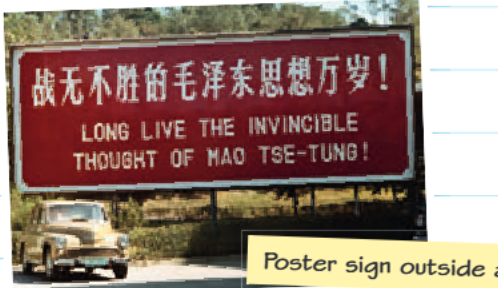
Propaganda played a crucial role in creating an almost religious devotion to Mao Zedong. The party portrayed Mao as a god-like leader whose ideas were never wrong and who lived only to serve the Chinese people.
The Little Red Book
The most important tool in building Mao's cult of personality was the Little Red Book, which was treated almost like a sacred religious text. Chinese people were expected to read this book regularly for guidance on problems in their daily lives.
Note
The Little Red Book's Influence
Studying and understanding Mao's writings became essential for any Communist Party member who wanted to advance their career. The book contained quotations from Mao that were meant to provide guidance for every aspect of life and work.
The Cultural Revolution and Red Guards
Important
During the Cultural Revolution (1965-68), the cult of Mao reached extreme levels. The Red Guards, mostly young people, worshipped Mao and made vows to protect "Mao Zedong Thought" against all opponents. This cult-like devotion was strategically important because it gave Mao the power to unleash social forces - particularly the enthusiasm of young people - to achieve his political goals.
Major propaganda campaigns
The CCP used propaganda as a central tool in several major political campaigns, demonstrating how effectively they could mobilise public opinion:
Example
Campaign Example: "Resist America, Aid Korea" (1950)
When China entered the Korean War, propaganda convinced approximately two million Chinese volunteers to fight for North Korea. The campaign successfully encouraged widespread public support for the war effort by portraying the conflict as China's heroic fight against capitalist enemies who threatened Chinese security.
Example
Campaign Example: Anti-Hu Feng Campaign (1955)
Hu Feng, who was himself a communist, made the mistake of criticising some of Mao's cultural policies in a report to the CCP. Propaganda immediately portrayed Hu as a dangerous CCP agent and encouraged people to search out and report his supporters. Hu's trial and sentencing to a labour camp served as a powerful warning to others about the consequences of criticising party policies, even from within the party itself.
Example
Campaign Example: The Cult of Lei Feng (1963)
Lei Feng was a People's Liberation Army soldier who died in 1962. The party created an extensive propaganda campaign celebrating his supposed good deeds and showing him constantly reading Mao's writings while expressing his love for the Chairman. Although much of Lei Feng's story was likely fabricated, the campaign proved very successful in promoting the image of the ideal Chinese communist citizen who was completely devoted to Mao.
Timeline of key events
- 1949: CCP establishes control over media; Publications Administration Bureau begins banning pre-1949 books
- 1950: "Resist America, Aid Korea" propaganda campaign mobilises support for Korean War
- 1955: Anti-Hu Feng campaign demonstrates consequences of criticising party policies
- 1960: Congress of Artists establishes strict control over artistic production
- 1962: Lei Feng dies, setting stage for 1963 propaganda campaign
- 1963: Lei Feng cult campaign promotes ideal of devotion to Mao
- 1965-68: Cultural Revolution intensifies censorship and Mao's personality cult reaches peak
Summary
Key Points to Remember:
-
Total media control: The CCP controlled every form of communication - books, films, radio, newspapers, and arts - to ensure Chinese people only received pro-communist messages
-
Dual strategy: Censorship removed unwanted ideas while propaganda actively promoted communist values and devotion to Mao
-
The Little Red Book: This became the most important propaganda tool, treated almost like a religious text that guided daily life
-
Successful mobilization: Propaganda campaigns effectively convinced millions of Chinese people to support major policies like the Korean War and to report on suspected enemies of the state
-
Extreme personality cult: By the Cultural Revolution, propaganda had created almost religious worship of Mao, giving him tremendous power to mobilise Chinese society