Thought control (Edexcel GCSE History): Revision Notes
📚Revision Notes
Thought control in Mao's China
Introduction to thought control
Mao's approach to controlling people's minds was rooted in Marxist theory about class struggle. According to Marxist beliefs, the working class needed to fight against the capitalist class that exploited them. Mao took this idea further, arguing that people's thoughts and ideas were also part of this class struggle. He believed that capitalist ideas acted like a poison in people's minds that needed to be removed and replaced with communist thinking.
The Chinese Communist Party developed a systematic approach to achieve this mental transformation, viewing thought control as essential for building a successful socialist society.
Note
Mao's genius lay in taking abstract Marxist theory and turning it into concrete policies that could control every aspect of people's daily lives and thoughts.
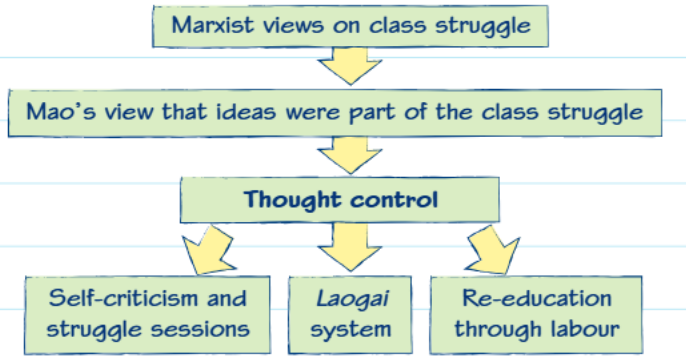
Methods of thought control
Self-criticism
Self-criticism became a fundamental tool for reshaping how people thought about themselves and society. Mao's government encouraged people to examine their own actions and attitudes, particularly looking for signs of selfish or capitalist thinking. This process involved people publicly admitting their mistakes and confessing to having wrong thoughts.
The Communist Party promoted the idea that being selfish was a capitalist trait, while true socialists always put the needs of others and society first. Through self-criticism, people were expected to identify these 'harmful' thoughts within themselves and work to eliminate them.
Example
Historical Example: The 1951 Intellectual Campaign
In 1951, Zhou Enlai launched a major campaign targeting intellectuals. As part of this effort:
Step 1: Target identification - 3000 university teachers were selected
Step 2: Public confession - Teachers were forced to publicly criticise themselves
Step 3: Ideological admission - They had to confess to holding capitalist views
Step 4: Re-education - Participation in mandatory study sessions about Marxism
This campaign demonstrated how self-criticism was used systematically to control educated elites.
Struggle meetings
Struggle meetings represented a more aggressive form of thought control that used public humiliation and peer pressure. These sessions involved large crowds of people confronting individuals who were accused of having counter-revolutionary thoughts or engaging in capitalist behaviour.
During these meetings, the accused person would be forced to stand before the crowd while others shouted accusations and demanded confessions. The goal was to break down the individual's resistance and force them to admit to crimes against communist ideology. These sessions were deliberately designed to be emotionally traumatic, as the Communist Party believed this would make the 'reform' more effective.
Important
The meetings were called "struggle sessions" because they represented the ongoing class struggle between communist and capitalist ideas. The fear of becoming the next target ensured that most people said what they thought the authorities wanted to hear, creating a climate of terror and conformity.
Participants were told they were helping the victim by forcing them to confront their wrong thoughts and actions. This created a twisted sense of moral justification for what was essentially psychological torture.
Re-education through labour
Mao believed that people's class background determined their natural way of thinking. According to this theory, those from capitalist families couldn't help but have capitalist ideas, while working-class people naturally developed socialist thoughts. To change people from the 'wrong' class background, Mao created a system where physical labour would supposedly teach them correct, socialist values.
This approach led to the establishment of the Laogai system in 1957 - a network of thousands of forced labour camps across China. The name 'Reform Through Labour' suggested these were educational institutions designed to help people, but in reality they were brutal prison camps where millions suffered and died.
The Laogai system in practice
The Laogai camps were modelled on the Soviet Union's Gulag system, with Soviet experts helping to plan and build the Chinese version. These camps were spread throughout China, often located in remote areas with harsh climates, making escape extremely difficult.
Note
The camps served multiple purposes for the Communist government: they removed 'undesirable' people from society, provided cheap labour for economic development, and created fear among the general population.
Prisoners in the camps were forced to work in terrible conditions, producing consumer goods, building factories, working on farms, and labouring in dangerous mines. The work was backbreaking and the living conditions were horrific, with inadequate food, shelter, and medical care.
Important
The Human Cost
Between 1949 and 1976, approximately 25 million people died in these camps due to the brutal working and living conditions. This staggering death toll reveals the true nature of what the government called "re-education."
Timeline of key events
- 1949: Communist Party begins implementing thought control policies
- 1951: Zhou Enlai's campaign against intellectuals forces 3000 university teachers to undergo public self-criticism
- 1957: Official establishment of the Laogai system of labour camps
- 1949-1976: An estimated 25 million people die in Laogai camps during this period
Summary
Key Points to Remember:
-
Thought control was based on Marxist theory - Mao believed ideas were part of class struggle and capitalist thoughts needed to be eliminated
-
Three main methods were used - Self-criticism (personal confession), struggle meetings (public humiliation), and re-education through labour (forced work camps)
-
The 1951 intellectual campaign - 3000 university teachers were forced to publicly criticise themselves as part of Zhou Enlai's campaign
-
The Laogai system was massive and deadly - Established in 1957, these labour camps resulted in approximately 25 million deaths between 1949-1976
-
Fear was a key tool - The threat of becoming the next victim ensured most people complied with thought control measures