Medieval England (Edexcel GCSE History): Revision Notes
📚Revision Notes
Mediaeval England (c800-c1500)
Introduction to mediaeval England
During the 9th century, mediaeval England had become exceptionally prosperous compared to other northern European nations. This wealth made it an attractive destination for various groups seeking to raid, invade, or settle in the region. The country's prosperity stemmed from its rich natural resources, established trade networks, and growing Christian influence.
Note
England's prosperity during this period was so remarkable that it attracted attention from across Europe and Scandinavia, making it a prime target for both peaceful settlement and violent raids.
Economic and social structure in the 9th century
Mediaeval England's economy was built on several key foundations that contributed to its remarkable wealth and stability.
Natural resources and industry
England possessed abundant mineral wealth, including significant deposits of lead, iron, copper, tin, and silver. These valuable materials were essential for creating buildings, manufacturing tools and weapons, crafting jewellery, and producing various other goods that were in high demand both domestically and internationally.
Note
The combination of multiple valuable minerals in one region was relatively rare in mediaeval Europe, giving England a significant economic advantage over neighbouring territories.
Agricultural prosperity
The fertile lands, particularly in the eastern and southern regions, supported excellent crop production. Sheep farming flourished, providing high-quality wool that became essential for cloth-making. The abundant salt supplies helped preserve food for winter months, while the rivers and coastal areas provided plentiful fish, ensuring a reliable food supply throughout the year.
Trade and commerce
Well-established trade routes connected England with Ireland and continental Europe, allowing Anglo-Saxon merchants to conduct business on a large scale. They exported valuable goods such as cheese, wool, cloth, and minerals, while importing luxury items including glass, wine, silk, and exotic spices from distant lands.
Settlement patterns
Most people lived in rural villages, though fortified towns called burhs (or borgs) began expanding in number and importance. These settlements developed as trading centres, particularly those located on the coast or along navigable rivers, which provided crucial transportation links for commerce.
Note
The development of burhs represented an important shift from purely agricultural settlements to more complex commercial and defensive centres, laying the groundwork for mediaeval England's later urban development.
Christianity and its spread
England's gradual transformation into a Christian nation was a defining feature of the mediaeval period, fundamentally shaping its culture and society.
The process of Christianization
By 1066, England had become fully Christian, but this transformation took several centuries to complete. When the Roman army departed Britain in 410, Christianity existed as just one religion among many others practised in the region.
Important
The Christianization of England was not an overnight process but rather a gradual transformation spanning over 650 years, from the departure of Rome to complete Christian dominance.
Key missionary activities
The spread of Christianity occurred through several important missionary efforts:
- 563: Irish Christian missionaries established an abbey on the island of Iona, off the Scottish coast
- 597: Pope Augustine, a Christian missionary from Rome, arrived in England, significantly accelerating the spread of Christianity throughout the country
- 635: Christian missionaries from Iona founded an abbey at Lindisfarne (Holy Island) off the Northumbrian coast
Monastic wealth and influence
Monasteries and abbeys accumulated enormous wealth during this period, owning vast amounts of gold and silver objects, precious jewels, and creating beautifully illustrated manuscripts. These religious institutions became centres of learning and culture, with scholars and clergy moving freely between England and other parts of Europe, helping England integrate into the broader Christian community known as Christendom.
Note
The wealth accumulated by monasteries was not just material - they also became repositories of knowledge, preserving classical learning and developing new scholarly traditions that would influence European culture for centuries.
Government and political structure
The political landscape of mediaeval England was complex and decentralised, characterised by multiple kingdoms competing for power and influence.
Kingdom divisions
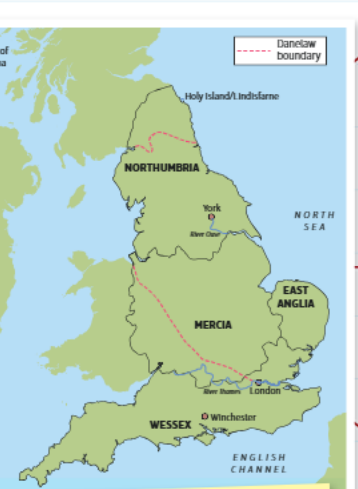
Anglo-Saxon people were initially organised into numerous smaller kingdoms. Over time, through conquest and political manoeuvring, these smaller territories merged to form larger, more powerful kingdoms. By the 9th century, the most significant kingdoms included Northumbria in the north, Mercia in the central region, Wessex in the south, Kent in the southeast, and East Anglia in the east.
Royal authority and governance
Kings held supreme authority within their respective kingdoms, though they typically relied on advice from the most powerful nobles and churchmen in their territories. These advisors could include a mixture of landowners and religious leaders who wielded considerable influence over royal decisions.
Financial and legal systems
The kingdoms generated revenue primarily through taxation based on land ownership, making control of territory crucial for maintaining power. Law enforcement and crime prevention were handled by local communities rather than centralised authorities, which meant that maintaining order often depended on the strength and cooperation of local populations.
Defence challenges
The absence of a unified central government created significant difficulties when organising defence against foreign invaders, as coordinating responses between different kingdoms required complex negotiations and agreements.
Important
The lack of centralised defence was one of mediaeval England's greatest vulnerabilities, making it easier for Viking raiders and other invaders to exploit divisions between kingdoms and launch successful attacks.
Unification under Athelstan
Athelstan achieved the historic milestone of becoming the first king to rule all of England, reigning from 925 to 939. His reign marked a crucial step towards the eventual unification of England under a single monarch.
Key vocabulary
Christendom: All the countries where Christianity was the main religion, representing the broader Christian community that mediaeval England joined.
Timeline of major events
- 410: Roman army leaves Britain
- 563: Irish missionaries establish abbey on Iona
- 597: Augustine arrives from Rome to spread Christianity
- 635: Christian abbey founded at Lindisfarne
- 925-939: Athelstan reigns as first king of all England
- 1066: England becomes fully Christian
Summary
Key Points to Remember:
- Mediaeval England became one of the wealthiest regions in northern Europe during the 9th century due to its rich natural resources, fertile farmland, and established trade networks
- Christianity spread gradually through missionary work, with key moments in 563, 597, and 635 helping to establish England as part of Christendom
- The political system consisted of multiple Anglo-Saxon kingdoms that gradually merged into larger territories, culminating in Athelstan's rule over all England (925-939)
- Economic prosperity came from mining, agriculture (especially wool production), and extensive trade relationships with Ireland and continental Europe
- The lack of central government made defence against invaders challenging, contributing to England's attractiveness as a target for raids and conquest