Notting Hill, c1948-c1970 (Edexcel GCSE History): Model Answers
📚Model Answers
Black Activism and Source Evaluation Notting Hill
Sample Answer
Question 2(a)
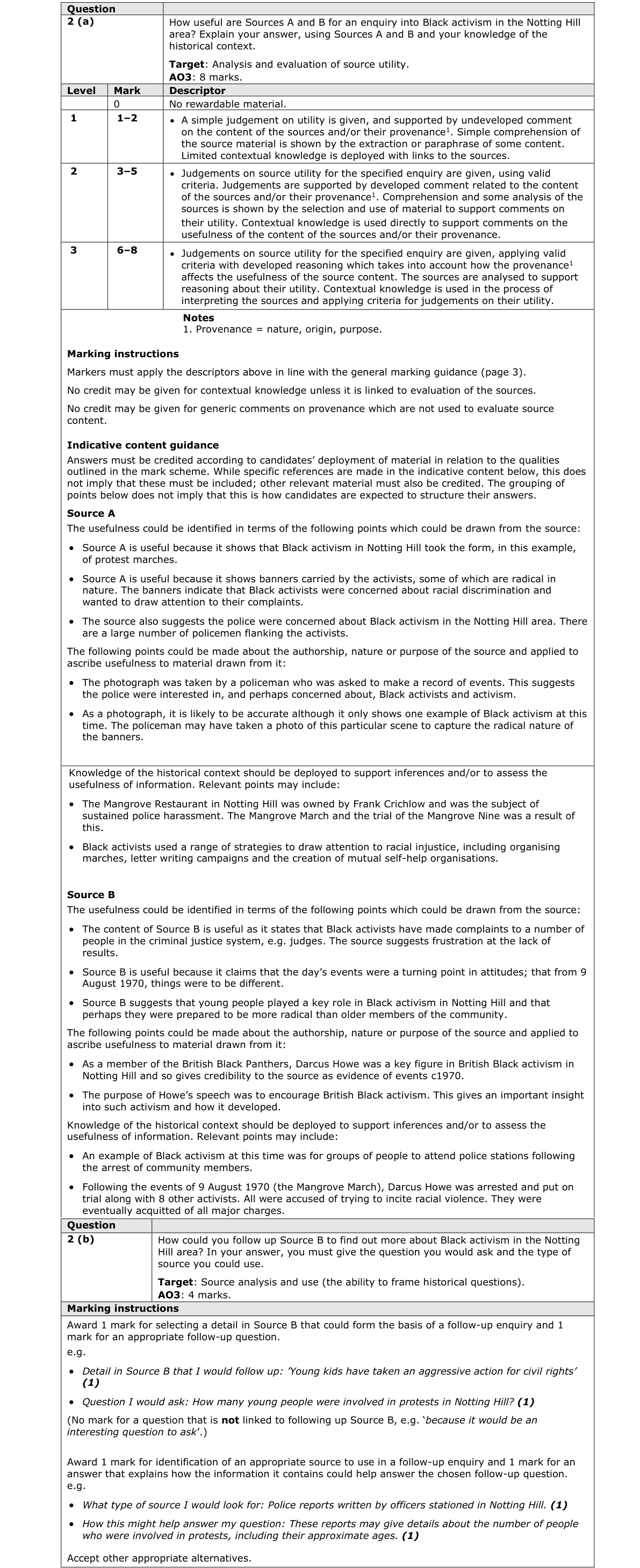
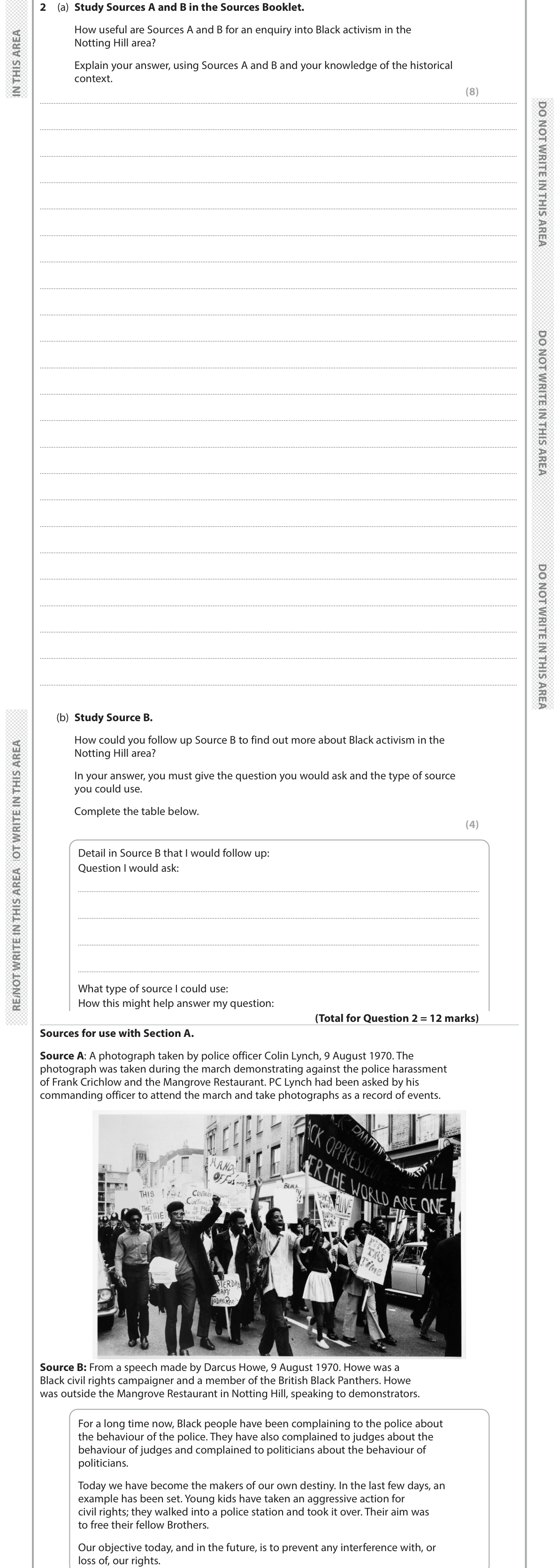
Source A is useful for an enquiry into Black activism in Notting Hill because it provides visual evidence of a protest march that took place on 9 August 1970. The photograph shows Black activists carrying banners with radical messages such as "Black Concentration" and marching through the streets, which demonstrates that Black activism took the form of organised protests and demonstrations. The source is particularly useful because it was taken by a police officer, PC Lynch, who had been asked by his commanding officer Colin Lynch to attend the march and take photographs as a record of events. This shows that the police were monitoring Black activism closely and were concerned about it, which suggests the activism was seen as significant or threatening by authorities.
Source A is also useful because it can be linked to wider historical context about Black activism in Notting Hill. The march was protesting against police harassment of Frank Crichlow and the Mangrove Restaurant, which was a key meeting place for the Black community. The Mangrove had been raided repeatedly by police, and this led to the arrest of nine Black activists, including Darcus Howe, who became known as the Mangrove Nine. This case became a significant moment in highlighting racial injustice in the criminal justice system. However, the photograph only captures one moment in time and doesn't tell us about the full range of Black activism, such as the mutual self-help organisations and letter-writing campaigns that were also used.
Source B is useful because it comes directly from Darcus Howe, who was a key figure in British Black activism in Notting Hill and a member of the British Black Panthers. Speaking at the Mangrove Restaurant on 9 August 1970, Howe explains the frustrations that Black people faced with the police and the criminal justice system, stating they had "complained to judges about the behaviour of politicians". This is useful because it shows the motivation behind Black activism - that peaceful complaints had not worked, so more direct action was needed. Howe also states that "young kids have taken an aggressive action for civil rights" by walking into a police station and taking it over, which demonstrates the increasingly radical tactics being adopted by Black activists.
However, Source B's utility is limited by its purpose. As a speech given at a demonstration, Howe's purpose was to encourage and inspire Black activism, so he may have exaggerated the success or radicalism of their actions to motivate his audience. The source is useful for understanding the attitudes and determination of Black activists at this time, particularly the idea that 9 August 1970 was seen as a turning point from which they would "prevent any interference with, or loss of, our rights". Following this speech, Howe was arrested and put on trial along with eight others in the Mangrove Nine case, which became a landmark moment in exposing racism in the British justice system. Overall, both sources are useful for different aspects of Black activism in Notting Hill - Source A provides visual evidence of the protest methods used, while Source B explains the motivations and attitudes of activists, though we must consider their different purposes and limitations.
Question 2(b)
Detail in Source B that I would follow up: "Young kids have taken an aggressive action for civil rights; they walked into a police station and took it over"
Question I would ask: What happened when young Black activists entered the police station in Notting Hill in August 1970, and what was the police response?
What type of source I could use: Police reports or records from Notting Hill police station, or newspaper articles from August 1970
How this might help answer my question: Police reports would provide official records of the incident, including how many young people were involved, what actions they took, and how the police responded to them. This would help me verify Howe's claim and understand whether this was seen as a significant event by the authorities. Newspaper articles could provide additional perspectives on the incident and show how it was reported to the public at the time.
Note
Examiner's Commentary
Question 2(a): The candidate provides comprehensive evaluation of both sources, deploying detailed contextual knowledge about Black activism in Notting Hill, including the Mangrove Restaurant raids and the Mangrove Nine case. Utility is assessed by considering provenance, purpose and limitations - Source A as visual evidence of protest methods and police monitoring, Source B as insight into activists' motivations though shaped by its purpose as a rallying speech. The response demonstrates sustained reasoning about usefulness with developed judgements throughout.
Question 2(b): The candidate identifies a specific and appropriate detail from Source B with a focused follow-up question. Relevant source types are suggested (police reports and newspaper articles) with clear explanation of how these would verify Howe's claims and provide different perspectives on the incident at the police station.
Estimated Mark Breakdown
| Criteria | Commentary | Likely Mark Range |
|---|---|---|
| Analysis and evaluation of utility (AO3) - Question 2(a) | Applies valid criteria with developed reasoning about provenance, nature and purpose of both sources; deploys sufficient contextual knowledge to interpret utility | 8 out of 8 |
| Identification of detail and follow-up question - Question 2(b) | Identifies specific detail from Source B and formulates focused, appropriate follow-up question | 2 out of 2 |
| Source type and explanation - Question 2(b) | Suggests relevant source types (police reports, newspapers) with clear explanation of how they would answer the follow-up question | 2 out of 2 |
Marking Scheme