Industrialisation (Edexcel GCSE History): Revision Notes
📚Revision Notes
Industrialisation in the Soviet Union, 1924-41
Introduction to Soviet industrialisation
Stalin and the Communist Party launched a massive industrialisation campaign in the Soviet Union for both ideological and practical reasons. This transformation aimed to defend the country against its enemies while fulfilling Marxist principles about industrial development under socialist control.
Motives for rapid industrialisation
Ideological reasons
The Communist Party believed strongly in Marxist theory, which taught that truly socialist countries must become industrialised nations. According to this ideology, industry needed to be controlled by the workers themselves rather than private capitalists. The USSR felt compelled to follow this path to prove the superiority of socialism over capitalism.
Political motivations
Stalin faced significant political pressure to pursue rapid industrialisation. His rival Nikolai Bukharin had supported the New Economic Policy (NEP), which allowed some private enterprise. However, serious problems emerged under NEP, including the "scissors crisis" where food prices fell while manufactured goods remained expensive.
Note
The "scissors crisis" created a vicious cycle: peasants couldn't afford industrial products due to high prices, which meant there was no market for increased industrial production. This economic problem gave Stalin ammunition against Bukharin's more gradual approach to development.
Stalin used these economic difficulties to argue against Bukharin's approach and push for immediate, state-controlled industrialisation. This political battle helped Stalin consolidate his power while addressing the USSR's economic problems.
The Five-Year Plans
In 1926, the Communist Party decided that rapid industrialisation should occur on an enormous scale. The State Planning Committee, known as Gosplan, received the crucial responsibility for planning industrial development across the entire USSR.
Important
The scale of Soviet industrialisation was unprecedented in world history. The state took complete control of economic planning, setting targets for entire industries and coordinating production across a vast territory spanning eleven time zones.
First Five-Year Plan (1928-32)
This initial plan concentrated on dramatically increasing the output of heavy industry. The focus areas included steel-making, engineering, and chemical production. These industries formed the foundation for further industrial growth and military strength.
Second Five-Year Plan (1933-37)
The second plan continued emphasising heavy industry but placed greater importance on efficiency and quality improvements. Unlike the first plan, this period also saw some increase in consumer goods production, though heavy industry remained the priority.
Third Five-Year Plan (1938-41)
By the late 1930s, growing international tensions shifted priorities towards military preparation. This final pre-war plan focused heavily on military production while also investing in education to create a more skilled workforce.
Gosplan and central planning
Gosplan wielded enormous power as the central planning authority. This organisation set production targets for every major industry throughout the Soviet Union. The system involved creating and managing new facilities as well as reorganising existing ones - between 1928 and 1937, approximately 5000 new factories were established.
Note
Central planning required an enormous bureaucracy. Gosplan had to coordinate everything from raw material supplies to worker housing, often making decisions about industries they had limited practical knowledge of. This created both impressive achievements and serious inefficiencies.
The planning process proved extremely complex. Gosplan had to coordinate production targets across different industries, often setting goals that were far more ambitious than realistic. When industries failed to meet these targets, they sometimes reported false production figures back to Gosplan, making the system even less reliable and targets more unrealistic.
Workers and managers could receive rewards like higher wages if they successfully met or exceeded their assigned targets. However, the emphasis on quantity rather than quality often led to problems with the actual usefulness of produced goods.
The Stakhanovite Movement
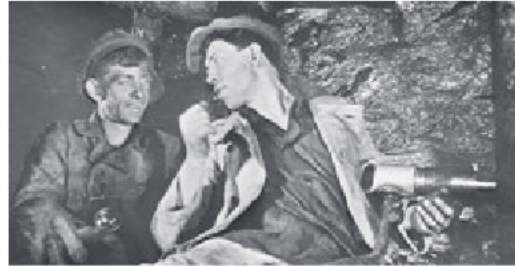
The Stakhanovite Movement emerged as a major propaganda campaign promoting worker productivity. Aleksey Stakhanov, a coalminer, became famous for reportedly mining 14 times his assigned quota in a single shift. Soviet propaganda transformed him into a celebrity and encouraged all workers to become "Stakhanovites" by trying to exceed their targets and help complete the Five-Year Plans ahead of schedule.
Example
The Stakhanov "Achievement": Propaganda vs Reality
On August 31, 1935, Aleksey Stakhanov reportedly cut 102 tonnes of coal in a single shift, far exceeding the normal quota of 7 tonnes. However, this achievement was carefully staged:
- Stakhanov received help from multiple support workers
- He was given the best equipment available
- The work area was specially prepared in advance
- Party officials organised the entire event for maximum propaganda impact
Despite being largely artificial, this "achievement" launched a massive propaganda campaign across the Soviet Union.
However, Stakhanov's achievement was largely a propaganda myth rather than genuine individual effort. He received significant help from other workers and access to high-quality equipment that ordinary workers lacked. Despite this, the movement served important propaganda purposes.
The Stakhanovite campaign produced mixed results. While it motivated some workers to increase productivity, it also created problems. Stakhanovites sometimes disrupted normal factory routines and made regular workers' jobs more difficult. Additionally, non-Stakhanovite workers found it harder to secure good housing and decent wages, creating resentment within the workforce.
Timeline of major events
- 1926: Communist Party commits to rapid industrialisation
- 1928: First Five-Year Plan begins, focusing on heavy industry
- 1928-1937: 5000 new factories constructed across USSR
- 1932: First Five-Year Plan ends
- 1933: Second Five-Year Plan starts, continuing heavy industry emphasis
- 1935: Stakhanovite Movement launches following Aleksey Stakhanov's celebrated mining feat
- 1937: Second Five-Year Plan concludes
- 1938: Third Five-Year Plan begins with military production focus
- 1941: Third Five-Year Plan interrupted by German invasion
Summary
Key Points to Remember:
-
Stalin pursued rapid industrialisation for both ideological reasons (following Marxist theory) and political motives (defeating rivals like Bukharin and defending the USSR)
-
Three Five-Year Plans transformed Soviet industry: heavy industry focus (1928-32), continued heavy industry with some consumer goods (1933-37), and military production emphasis (1938-41)
-
Gosplan coordinated all industrial planning and set targets for over 5000 new factories built between 1928-1937
-
The Stakhanovite Movement used propaganda about worker heroes to motivate productivity, though the famous achievements were often exaggerated or staged
-
Central planning created both rapid industrial growth and significant problems with unrealistic targets, false reporting, and emphasis on quantity over quality