Social changes (Edexcel GCSE History): Revision Notes
📚Revision Notes
Social changes under the Bolsheviks, 1917-24
Introduction
The period from 1917 to 1924 witnessed dramatic social transformations under Bolshevik rule. These changes primarily affected women's rights, education systems, and cultural expression. While the Bolsheviks introduced progressive policies on paper, the reality often fell short of their revolutionary promises, particularly as economic pressures and political control took priority.
Note
The gap between revolutionary ideals and practical implementation became a defining characteristic of early Soviet social policy, as the Bolsheviks struggled to balance their ambitious vision with the harsh realities of economic constraint and political control.
The Bolshevik impact on women's lives
Revolutionary changes (1917-1920)
The Bolsheviks introduced sweeping reforms aimed at liberating women from traditional oppression. In 1917, they declared women legally equal to men for the first time in Russian history. They revolutionised marriage and divorce by introducing non-religious marriages and creating the famous post-card divorces - a simple process costing just 3 roubles where one partner could divorce another simply by sending notification through the post.
Two years later in 1919, the Bolsheviks established Zhenotdel, a specialised women's organisation designed to increase female freedom, equality, and political influence. This organisation was led by Alexandra Kollontai, who became a pioneering figure in women's rights. However, Kollontai's influence remained limited because she had previously opposed Lenin by demanding greater democracy within the Communist Party structure.
By 1920, the Bolsheviks had legalised abortion, making Russia one of the first countries to do so. They also launched major literacy campaigns during the Civil War period, specifically targeting women to improve their education and participation in society.
Example
Worked Example: The Post-Card Divorce Process
Step 1: One spouse decides to end the marriage
Step 2: They pay the required fee of 3 roubles
Step 3: They send a postcard notification to their partner
Step 4: The divorce is legally recognised upon delivery
This revolutionary system eliminated the need for lengthy court proceedings or religious ceremonies that had previously made divorce nearly impossible for ordinary citizens.
The reality of women's liberation
Despite these progressive policies, the actual liberation of women faced significant obstacles. While Kollontai did become Russia's first female ambassador, very few other women advanced to senior government positions. The gap between policy and practice became even more apparent during the New Economic Policy (NEP) period, when the number of crèches (childcare facilities) actually declined. Factory employment opportunities for women also decreased, and society continued to expect women to handle all domestic responsibilities even when they held outside jobs.
Important
The Liberation Paradox
While Bolshevik laws granted women unprecedented legal rights, traditional social attitudes and economic realities meant that most women continued to face the double burden of paid work and unpaid domestic labour, limiting the practical impact of these revolutionary policies.
Communist education policies (1921-24)
Transforming the education system
The Bolsheviks recognised education as crucial for building their communist society. Between 1921 and 1924, they introduced co-education, teaching boys and girls together in the same classrooms. This approach aimed to reduce gender discrimination and promote equality from an early age.
The Communist Party launched extensive literacy drives, particularly focusing on the Red Army where soldiers were systematically taught to read and write. They also encouraged peasants throughout the countryside to acquire basic literacy skills, understanding that an educated population would be more supportive of communist ideals.
Note
The Bolshevik emphasis on education reflected their belief that creating a truly communist society required not just political revolution, but also intellectual transformation of the masses through widespread literacy and ideological education.
Educational achievements and limitations
These efforts produced impressive results. By 1926, approximately 56 percent of the Soviet population could read and write - a substantial improvement from pre-revolutionary literacy rates. However, the Communist Party struggled to achieve all their educational goals because ongoing economic problems severely limited their ability to invest adequately in schools, teachers, and educational materials.
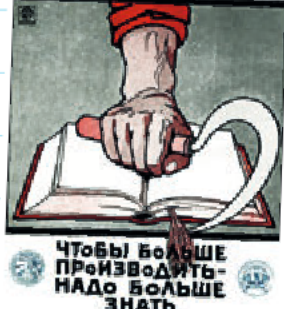
The Soviet emphasis on education and knowledge is illustrated in this propaganda poster, which declares "To produce more - you need to know more," linking education directly to economic productivity and socialist progress.
Important
Economic Constraints on Educational Progress
Despite the impressive literacy gains, chronic underfunding meant that many schools lacked basic supplies, qualified teachers remained scarce in rural areas, and ambitious plans for universal education were repeatedly delayed due to budget limitations.
Cultural and propaganda policies
The power of Agitprop
The Communist Party understood that controlling cultural expression was essential for maintaining popular support. They established Agitprop (the Agitation and Propaganda Section of the Central Committee Secretariat), which became the party's primary propaganda organisation. Agitprop utilised art, literature, film, and music to promote communist ideology and paint an attractive picture of the USSR's communist future.
Note
Agitprop represented a sophisticated understanding that winning hearts and minds required more than political control - it demanded cultural transformation through carefully orchestrated artistic and educational campaigns that would make communist ideals appealing to ordinary citizens.
From artistic freedom to state control
The early 1920s represented a period of remarkable artistic freedom. Avant-garde artists experimented with innovative ways to represent and celebrate communism, creating bold new forms of artistic expression. However, this creative freedom was short-lived as the Communist Party increasingly demanded that art serve specific propaganda purposes.
The state established Glavlit, a censorship department that controlled all forms of cultural expression. Glavlit ensured that books, pictures, films, music, dance, and other artistic works portrayed communism in an accessible and overwhelmingly positive manner. This approach became known as socialist realism - art that presented an idealised version of communist life while remaining understandable to ordinary workers and peasants.
Important
The End of Artistic Freedom
The transition from avant-garde experimentation to socialist realism marked a fundamental shift in Soviet cultural policy - from encouraging creative exploration of communist themes to demanding strict adherence to party-approved artistic standards that prioritised propaganda value over artistic innovation.
Timeline of major social changes
- 1917: Legal equality for women introduced; post-card divorces established; non-religious marriage permitted
- 1919: Zhenotdel women's organisation founded under Alexandra Kollontai's leadership
- 1920: Abortion legalised; women's literacy campaigns expanded during Civil War
- 1921-24: Co-education implemented; major literacy drives launched across the Soviet Union
- 1926: Literacy rates reach 56% of the population
Summary
Key Points to Remember:
-
Women's rights advanced legally but faced practical limitations - while the Bolsheviks introduced progressive policies like easy divorce and legal equality, women still struggled with traditional domestic expectations and limited career advancement.
-
Education became a key Bolshevik priority - literacy rates dramatically improved from pre-revolutionary levels, reaching 56% by 1926, though economic constraints limited the full extent of educational reforms.
-
Cultural control evolved from freedom to propaganda - the 1920s began with artistic experimentation but ended with strict state censorship through Glavlit and the promotion of socialist realism.
-
Key organisations shaped social change - Zhenotdel advanced women's rights, Agitprop controlled propaganda, and co-education systems reduced gender discrimination in schools.
-
Economic realities constrained social progress - despite ambitious policies, ongoing economic problems limited investment in social programmes like childcare facilities and educational infrastructure.