The Red Terror and the Cheka (Edexcel GCSE History): Revision Notes
📚Revision Notes
The Red Terror and the Cheka
Introduction
Following the Bolshevik seizure of power in October 1917, Lenin and his party faced enormous challenges in maintaining control over the vast Russian Empire. Opposition came from many sources - former tsarist supporters, other socialist parties, and ordinary citizens who resented the loss of their freedoms. To deal with these threats, the Bolsheviks established a systematic campaign of political violence known as the Red Terror, enforced by their secret police organisation, the Cheka.
The establishment of the Cheka
The Cheka (short for "Extraordinary Commission") was created in December 1917, just weeks after the Bolsheviks took power. This organisation became the primary tool for eliminating opposition to Bolshevik rule. Unlike previous Russian police forces, the Cheka operated outside normal legal procedures and could arrest, imprison, torture, or execute anyone they considered a threat to the revolution.
Note
The Cheka's full name was the "All-Russian Extraordinary Commission for Combating Counter-Revolution and Sabotage." This deliberately vague title gave the organisation virtually unlimited powers to act against anyone deemed an enemy of the state.
The growth of this organisation was remarkable. By 1919, during the height of the Civil War, the Cheka employed approximately 100,000 people across the former Russian Empire. This massive workforce gave the Bolsheviks eyes and ears in every corner of their territory, making it extremely difficult for opposition groups to organise effectively.
Timeline of Bolshevik consolidation
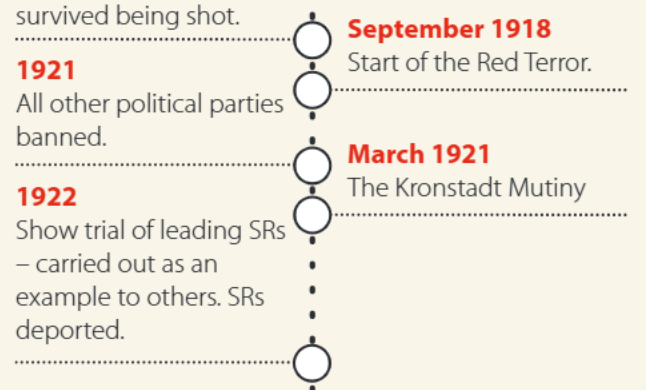
The establishment of Bolshevik dictatorship followed a clear pattern of increasingly harsh measures:
October 1917: The Bolsheviks seized power in Petrograd, overthrowing the Provisional Government.
November 1917: Revolutionary Tribunals were introduced to replace traditional courts and lawyers, giving the Bolsheviks control over the justice system.
December 1917: Liberal political leaders were arrested and non-Bolshevik newspapers were banned. The Cheka was officially established.
January 1918: The Constituent Assembly, Russia's first democratically elected parliament, was shut down after just one day because the Bolsheviks had not won a majority.
February 1918: The "Socialist Fatherland in Danger" decree was issued, allowing forced labour and executions for those who resisted Bolshevik policies.
June 1918: Members of the Socialist Revolutionary and Menshevik parties were arrested en masse.
August 1918: Fanya Kaplan, a Socialist Revolutionary, attempted to assassinate Lenin. Though she failed and Lenin survived, this event triggered even harsher repression.
September 1918: The Red Terror officially began as a systematic campaign of violence against all perceived enemies of the Bolshevik state.
The Red Terror in action
The Red Terror represented a deliberate policy of using extreme violence to intimidate and eliminate opposition. Lenin personally endorsed this approach after surviving Kaplan's assassination attempt, calling on all Bolshevik supporters to report anyone who made anti-soviet remarks or criticised the government.
Important
The Red Terror was not a spontaneous outbreak of violence, but a carefully planned and systematic campaign of state terrorism. Lenin himself wrote that "we must encourage the energy and mass character of the terror against the counter-revolutionaries."
The Cheka was given extraordinary powers to carry out this campaign. They could arrest, imprison, torture, or execute people without trials or legal procedures. The organisation targeted various groups they labelled "class enemies", including:
- Former nobles and wealthy merchants
- Religious leaders and believers
- Members of other political parties
- Anyone suspected of supporting the White Army during the Civil War
- Ordinary workers or peasants who complained about Bolshevik policies
The scale of the Terror was enormous. Historical estimates suggest that between 12,000 and 50,000 people were executed by the Cheka between 1918 and 1920, though exact numbers remain disputed. Many more were imprisoned in concentration camps or died during interrogation.
The role of the Cheka during the Civil War
As the Russian Civil War intensified, the Cheka's role expanded beyond hunting political opponents. They were sent to areas recently recaptured from White Army control to arrest anyone suspected of collaborating with the anti-Bolshevik forces. Many people were executed simply for having lived in White-controlled territory.
Note
The Cheka operated under the principle of "collective responsibility," meaning that entire families, communities, or social groups could be punished for the actions of individual members. This created widespread fear and discouraged any form of resistance.
The Cheka also played a crucial role in enforcing War Communism policies. When peasants resisted grain requisitioning or workers went on strike, Cheka units were dispatched to restore order through force. This created a climate of fear that helped the Bolsheviks maintain control even when their policies proved unpopular.
The Kronstadt Mutiny
One of the most significant challenges to Bolshevik authority came in March 1921 from an unexpected source - the sailors of the Kronstadt naval base near Petrograd. These same sailors had been strong supporters of the Bolsheviks during the February and October Revolutions of 1917.
By 1921, however, the Kronstadt sailors had become disillusioned with Bolshevik rule. They were frustrated with War Communism policies, the lack of political freedom, and the Red Terror's brutality. The sailors demanded free elections, freedom of speech and assembly, and an end to Bolshevik political monopoly.
Important
The Kronstadt Mutiny was particularly shocking to the Bolsheviks because it demonstrated that their own former supporters - revolutionary sailors who had been called "the pride and glory of the Russian Revolution" - had turned against them. This revealed the widespread unpopularity of Bolshevik policies even among the working class.
This rebellion shocked senior Bolsheviks because it came from people who had previously been their most loyal supporters. It demonstrated that opposition to their rule extended beyond traditional "class enemies" to include ordinary workers and soldiers who had initially supported the revolution.
The Bolshevik response was swift and brutal. Leon Trotsky dispatched 50,000 Red Army soldiers to recapture the naval base. The fighting was fierce and lasted until March 17, when the rebels were finally defeated. Approximately 500 surviving sailors were executed by the Cheka, while many others were sent to prison camps.
Consequences and significance
The Red Terror succeeded in its immediate goal of eliminating organised opposition to Bolshevik rule. By 1921, all other political parties had been banned, and most potential rivals had been arrested, executed, or forced into exile. The Cheka's activities created a climate of fear that discouraged ordinary citizens from openly criticising the government.
However, the Terror also had lasting negative consequences. It established a precedent for using extreme violence to solve political problems, which would continue throughout Soviet history. The methods developed by the Cheka became the foundation for later secret police organisations like the NKVD under Stalin.
Important
The Red Terror fundamentally changed the nature of political opposition in Russia. After 1921, dissent was driven underground, creating a society where public criticism of the government became virtually impossible. This pattern of repression would continue for decades.
The suppression of the Kronstadt Mutiny marked a turning point. Even after the Civil War ended, the Bolsheviks continued using repressive methods against their own supporters when they expressed dissent. This showed that the Red Terror was not just a temporary wartime measure but a permanent feature of Bolshevik rule.
Summary
Key Points to Remember:
-
The Red Terror (September 1918 - February 1919) was Lenin's systematic campaign of political violence designed to eliminate all opposition to Bolshevik rule through executions, arrests, and intimidation.
-
The Cheka became a massive organization with 100,000 employees by 1919, operating outside normal legal procedures to arrest, torture, and execute perceived enemies of the state.
-
The scale of repression was enormous, with an estimated 12,000 people executed by the Cheka between 1918-1920, plus many more imprisoned or who died during interrogation.
-
The Kronstadt Mutiny (March 1921) showed that even former Bolshevik supporters had become disillusioned with the party's authoritarian methods, leading to its brutal suppression and 500 executions.
-
The Terror established lasting precedents for using extreme violence to maintain political control, creating the foundation for decades of Soviet repression that would continue long after Lenin's death.