Lenin’s return (Edexcel GCSE History): Revision Notes
📚Revision Notes
Lenin's return (April 1917)
German assistance for Lenin's journey
In April 1917, Vladimir Lenin made a dramatic return to Russia that would change the course of the revolution. The German government provided crucial assistance by arranging for Lenin to travel back from his exile in Switzerland through wartime Europe. The Germans transported Lenin in what became known as a "sealed train" through their territory to reach Russia.
Note
The German strategy was calculated - they believed that Lenin's presence would help destabilise Russia further and potentially knock the country out of World War One entirely. This would give Germany one fewer enemy to fight against.
Lenin's arrival in April 1917 marked a turning point for the Bolshevik movement, setting the stage for the dramatic events that would follow in the months ahead.
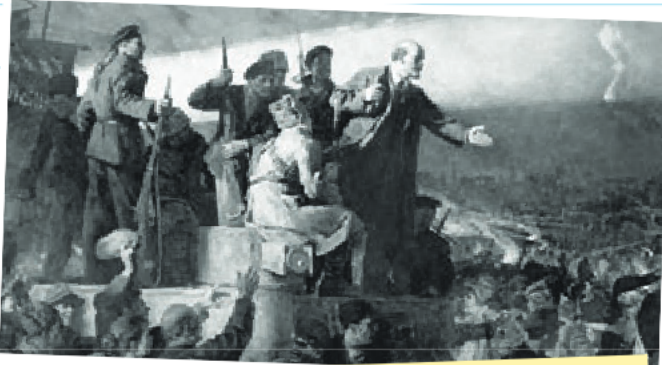
The April Theses
Upon his return, Lenin immediately set out his vision for Russia's future in a document called the April Theses. This manifesto outlined how he believed the working class should seize control of Russia through a second revolution. Lenin's demands were radical and clear, consisting of three main points:
Important
Lenin's Three Key Demands in the April Theses:
1. End the war immediately Lenin called for Russia to withdraw from the capitalist and imperialist conflict of World War One, which he argued was threatening the revolutionary progress already made.
2. Transfer all power to the soviets Lenin demanded that authority should move away from the Provisional Government to the soviets (workers' councils) at every level, from local areas right up to national government. The existing Provisional Government should not receive any support.
3. Redistribute land to the peasants Lenin proposed taking land away from wealthy landowners and distributing it to ordinary peasants through agricultural soviets, fundamentally changing Russia's land ownership system.
Growing Bolshevik support
When Lenin returned, the Bolsheviks were still a relatively small political party. However, their support began to increase significantly for several reasons:
The April Theses gave the Bolsheviks a clear and powerful message that appealed to workers, peasants, and soldiers who were struggling with the ongoing war and economic hardship. Unlike other political groups, the Bolsheviks had specific, understandable demands.
Note
Bolshevik newspapers across Russian cities constantly criticised the failures and shortcomings of the Provisional Government, highlighting how it was not meeting the people's needs effectively. This propaganda campaign proved highly effective in winning over public opinion.
The Germans also secretly provided financial support to help fund Bolshevik campaigning activities, giving them resources to spread their message more widely.
Powerful revolutionary slogans
Lenin understood the importance of simple, memorable messages that ordinary people could easily understand and support. He developed two particularly effective slogans:
Note
"All Power to the Soviets!"
This slogan meant that Lenin wanted all governmental authority to transfer to the workers' soviets rather than remaining with the existing Provisional Government. He envisioned workers' soviets running factories, agricultural soviets managing rural areas, regional soviets governing local districts, and soviets making all decisions at the national level.
Note
"Peace, Land and Bread"
This three-part promise addressed the most pressing concerns of ordinary Russians. It promised an end to Russia's involvement in the devastating war, land redistribution to help peasants, and solutions to the severe food shortages affecting cities across the country.
These slogans became rallying cries that resonated deeply with the Russian people, capturing their immediate needs and frustrations in simple, memorable phrases.
The July Days uprising
During early July 1917, serious riots and demonstrations erupted against the Provisional Government on July 3rd and 7th, which became known as the July Days. This uprising developed because of widespread food shortages and the failure of the recent June Offensive military campaign.
Lenin initially thought this might be the right moment to overthrow the Provisional Government completely, and many Bolsheviks joined the demonstrations. However, the Bolsheviks had not actually started or organised this uprising themselves.
Important
The uprising ultimately failed when the Provisional Government received support from troops loyal to them, and the Petrograd Soviet also backed the government. Many Bolsheviks were arrested and blamed for starting the revolt. Lenin was forced to flee the country in disguise, escaping to Finland to avoid arrest.
Mixed reactions to Lenin's ideas
Lenin's April Theses created quite different reactions among various groups. Many within the Bolshevik Party itself were initially shocked by Lenin's radical proposals. Some party members needed to be persuaded that Russia was truly ready for such a dramatic second revolution.
However, Lenin's forceful personality and his thorough command of Marxist revolutionary theory eventually convinced most of his colleagues. His ability to present clear arguments for why immediate action was necessary helped him win over the party leadership.
Timeline of key events
- April 1917: Lenin returns to Russia with German assistance and announces the April Theses
- April-June 1917: Bolshevik support grows through effective propaganda and slogans
- July 3-7, 1917: July Days uprising fails; many Bolsheviks arrested
- July 1917: Lenin flees to Finland to avoid capture
Summary
Key Points to Remember:
- Lenin's return in April 1917 was made possible by German assistance, as they hoped he would destabilise Russia and end Russian participation in WWI
- The April Theses contained three key demands: end the war, give all power to the soviets, and redistribute land to peasants
- Lenin created powerful slogans like "All Power to the Soviets!" and "Peace, Land and Bread" that appealed to ordinary Russians' immediate needs
- The July Days uprising failed, forcing Lenin to flee temporarily, but demonstrated growing discontent with the Provisional Government
- Lenin's radical ideas initially shocked even some Bolsheviks, but his persuasive arguments eventually won over the party leadership