Détente in the 1970s (Edexcel GCSE History): Revision Notes
📚Revision Notes
Détente in the 1970s
What was détente?
Détente was a period of eased tensions between the superpowers during the late 1960s and 1970s. The term describes the relaxing of hostilities between the USA and Soviet Union, moving away from the intense confrontations that had characterised earlier Cold War relations. This shift towards cooperation represented a significant change in superpower diplomacy.
Note
The word "détente" comes from French, meaning "relaxation" or "easing." It marked a dramatic shift from the confrontational approach that had defined Cold War relations since the late 1940s.
SALT I - Strategic arms limitation treaty (1972)
The Strategic Arms Limitation Treaty marked a crucial milestone in nuclear arms control. Both superpowers recognised the need to slow down the dangerous escalation of their nuclear arsenals.
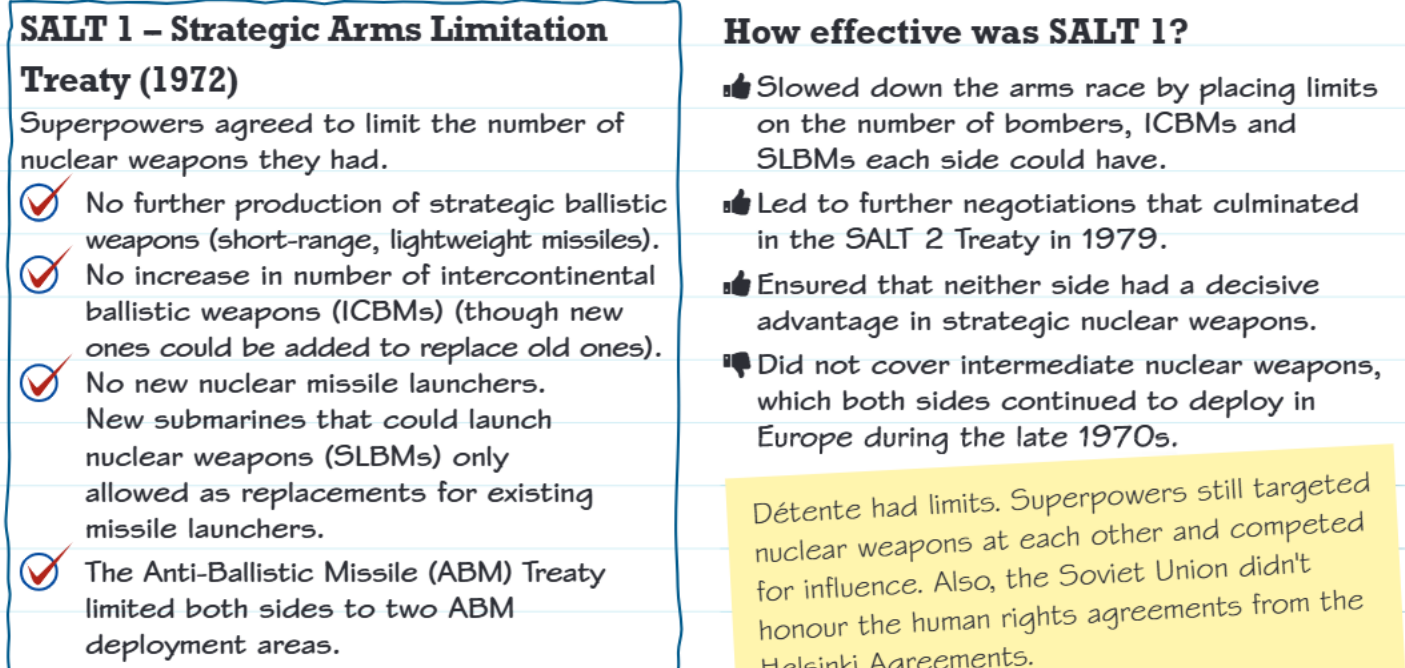
Key provisions of SALT I
The treaty established several important restrictions on nuclear weapons development. The superpowers agreed to halt the production of strategic ballistic weapons, preventing the creation of new short-range, lightweight missiles. They also committed to freezing the number of intercontinental ballistic missiles (ICBMs) that each side could possess, though existing weapons could be replaced when they became outdated.
Note
SALT I included two main components:
- The Interim Agreement on Strategic Offensive Arms (lasting 5 years)
- The Anti-Ballistic Missile (ABM) Treaty (unlimited duration)
Additionally, both nations agreed not to build new nuclear missile launchers, though they could use replacement submarines for existing missile systems. The Anti-Ballistic Missile (ABM) Treaty, which formed part of SALT I, limited each superpower to just two ABM deployment areas.
How effective was SALT I?
The treaty achieved several positive outcomes for superpower relations. Most importantly, it successfully slowed the arms race by placing concrete limits on the number of strategic nuclear weapons each side could deploy. This helped maintain a strategic balance between the USA and USSR, ensuring neither gained a decisive advantage. The agreement also paved the way for further negotiations, ultimately leading to SALT II in 1979.
Important
Major limitation of SALT I: The treaty failed to address intermediate nuclear weapons, which both sides continued to deploy in Europe during the late 1970s. This meant that while strategic weapons were controlled, regional nuclear threats remained unaddressed.
The Helsinki conference (1975)
Three years after SALT I, representatives from 35 countries gathered in Helsinki, Finland, to sign the Helsinki Agreements. This conference included all European nations except Albania and Andorra, alongside the USA, Soviet Union, and Canada.
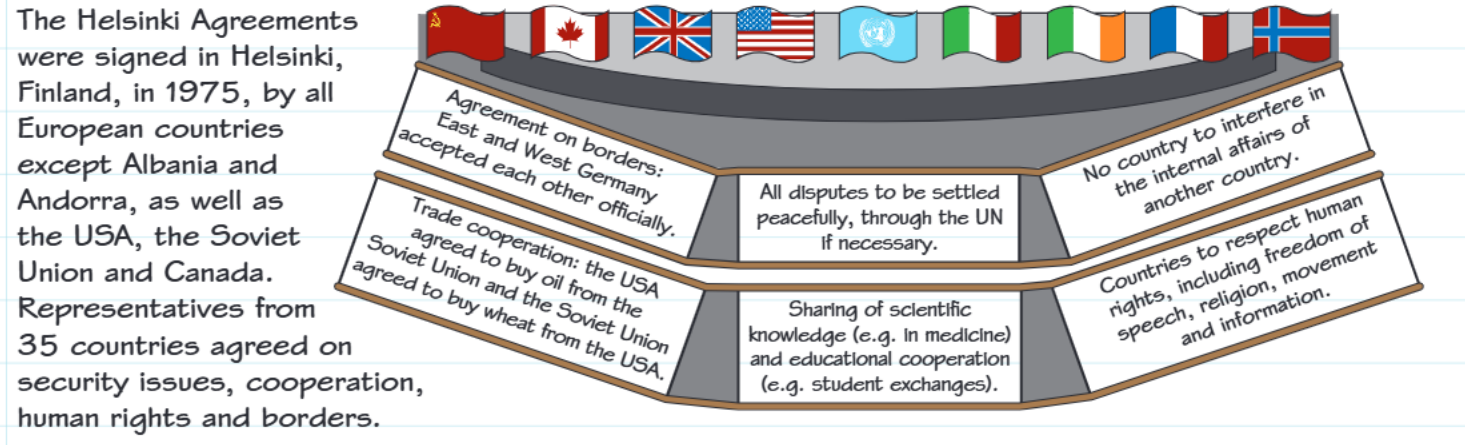
Key agreements reached at Helsinki
The Helsinki Accords covered three main areas of cooperation. Regarding security issues, countries agreed to officially recognise borders, including the division between East and West Germany. They committed to settling all disputes peacefully through the United Nations and promised not to interfere in each other's internal affairs.
Economic cooperation formed another pillar of the agreements. The USA and Soviet Union specifically agreed to trade arrangements involving oil and wheat, while all participating nations committed to sharing scientific knowledge and promoting cultural exchanges through student programmes.
Most significantly, the accords addressed human rights protections. Countries pledged to respect freedom of speech, religion, and movement for their citizens, marking the first time the Soviet Union had officially committed to such principles.
Example
Worked Example: Helsinki's Three Baskets
Basket I - Security: Border recognition, peaceful dispute resolution, non-interference
Basket II - Economic Cooperation: Trade agreements (US-Soviet oil and wheat deals), scientific knowledge sharing, cultural exchanges
Basket III - Human Rights: Freedom of speech, religion, and movement commitments
Importance of the Helsinki agreements
The Helsinki Conference represented the high point of détente between the superpowers. It helped establish a more stable relationship between the USA and Soviet Union by creating formal frameworks for cooperation. The agreements also led to increased collaboration in various fields, including the famous Apollo-Soyuz Test Project in 1975, where American and Soviet spacecraft docked in space.
Limitations of Helsinki
Despite its achievements, the Helsinki Agreements revealed the ongoing limits of détente. The Soviet Union continued implementing the Brezhnev Doctrine in Eastern European countries, treating dissidents harshly. For example, scientist Alexander Sakharov faced arrest, hospitalisation, and force-feeding for his opposition activities.
Important
The reality behind the agreements: While the Soviet Union committed to human rights protections on paper, it continued to suppress dissidents and maintain strict control over Eastern European countries. This showed the gap between diplomatic agreements and actual practice.
Meanwhile, the USA continued prioritising its interests in regions where it held influence, particularly in countries like Chile and El Salvador. This showed that while superpower relations had improved, both sides remained committed to maintaining their spheres of influence.
Timeline of key events
- 1972: SALT I signed, limiting strategic nuclear weapons
- 1975: Helsinki Conference held, 35 countries sign agreements on security, cooperation, and human rights
- 1975: Apollo-Soyuz Test Project demonstrates US-Soviet space cooperation
- 1979: SALT II negotiations concluded (though later affected by Soviet invasion of Afghanistan)
The limits of détente
While the 1970s marked a period of improved relations, détente had clear boundaries. Both superpowers continued targeting nuclear weapons at each other and competing for global influence. The Soviet Union's human rights violations contradicted the spirit of the Helsinki Agreements, while both nations maintained their commitment to supporting allies and opposing enemies in regional conflicts around the world.
Important
Key limitation: Despite diplomatic progress, both superpowers maintained their fundamental ideological differences and continued to compete for influence in developing nations throughout Africa, Asia, and Latin America.
Summary
Key Points to Remember:
- Détente meant the easing of tensions between the USA and USSR during the late 1960s and 1970s
- SALT I (1972) successfully slowed the arms race but didn't cover all types of nuclear weapons
- Helsinki Conference (1975) involved 35 countries and addressed security, economic cooperation, and human rights
- Both agreements represented the high point of détente while revealing its ongoing limitations
- Superpower competition continued despite improved diplomatic relations