New thinking and the INF Treaty (Edexcel GCSE History): Revision Notes
📚Revision Notes
New thinking and the INF Treaty
The breakdown of détente and rising tensions
The Soviet invasion of Afghanistan in December 1979 marked a crucial turning point in superpower relations. This aggressive action effectively ended the period of détente (relaxation of tensions) that had characterised US-Soviet relations during the 1970s. The invasion triggered a series of responses that would escalate Cold War tensions to their highest point since the Cuban Missile Crisis, creating the conditions that would eventually make "new thinking" necessary.
Note
Détente was a foreign policy approach that sought to reduce tensions between the superpowers through diplomatic dialogue, trade agreements, and arms control treaties. It represented a shift away from the confrontational policies that had dominated the early Cold War period.
The consequences of the Afghan invasion demonstrated how quickly diplomatic progress could unravel. What had been a period of cooperation and arms limitation agreements suddenly gave way to what historians call the "Second Cold War" - a renewed period of hostility and competition between the superpowers.
The Carter Doctrine and American response
In January 1980, President Jimmy Carter announced a comprehensive response to the Soviet invasion that became known as the Carter Doctrine. This represented a significant hardening of American foreign policy towards the Soviet Union.
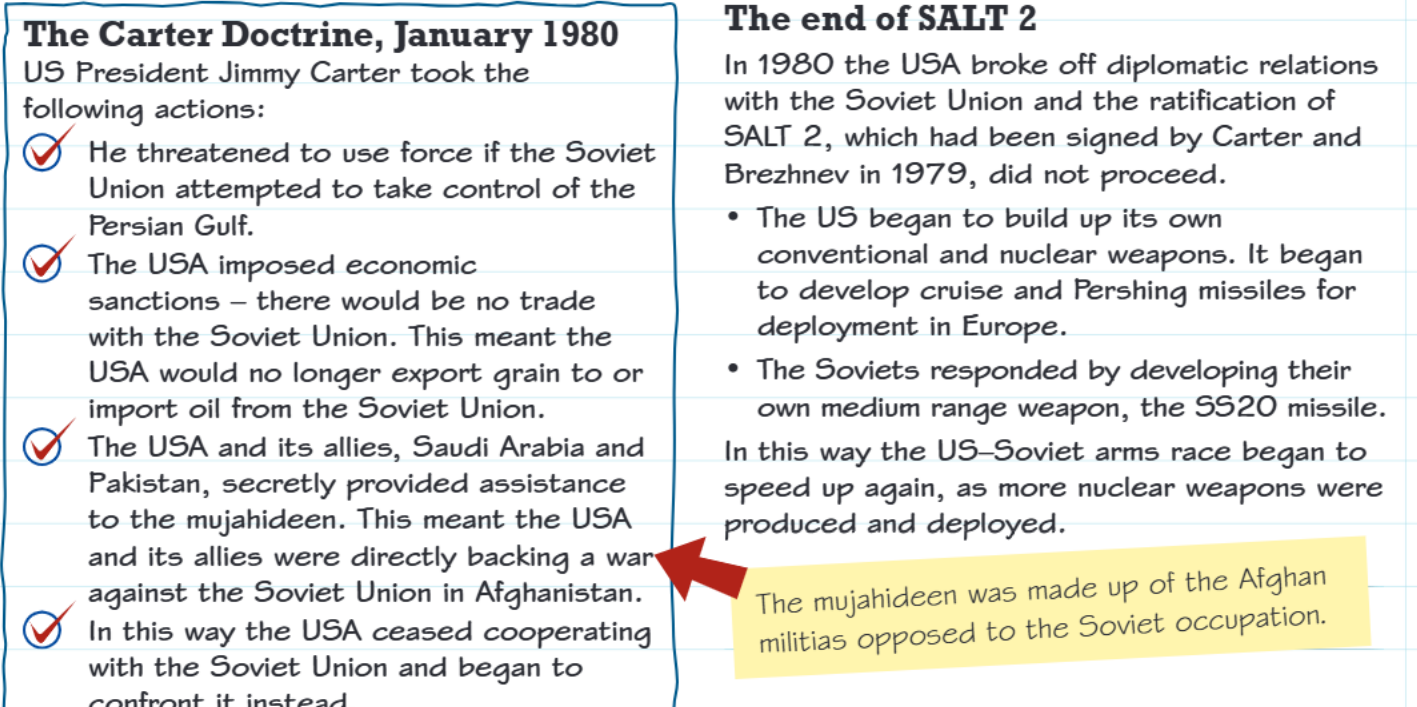
Carter's response included three main elements that would define US policy for years to come. First, he threatened to use military force if the Soviet Union attempted to gain control of the strategically important Persian Gulf region. This was a direct warning that showed how seriously America viewed Soviet expansion in this oil-rich area.
Second, the United States imposed sweeping economic sanctions and trade restrictions on the Soviet Union. These measures meant that America would no longer export grain to the Soviet Union or import oil from them, dealing a significant blow to Soviet economic interests. This economic warfare represented a complete abandonment of the cooperative trade relationships that had developed during détente.
Third, and perhaps most significantly for the future course of the Cold War, the USA began secretly providing assistance to the Afghan mujahideen through allies Saudi Arabia and Pakistan. The mujahideen were Afghan militias opposed to Soviet occupation, and this covert support would turn Afghanistan into a costly and prolonged conflict for the Soviet Union - often called "Russia's Vietnam."
Important
The covert support for the Afghan mujahideen would have far-reaching consequences beyond the Cold War. This policy created a network of armed groups that would later contribute to regional instability and the rise of extremist movements in Afghanistan and surrounding areas.
The collapse of arms control
The breakdown in relations had immediate consequences for nuclear arms control. The SALT 2 treaty, which had been painstakingly negotiated and signed by Carter and Soviet leader Leonid Brezhnev in 1979, failed to be ratified by the US Senate. This marked the end of progress in limiting nuclear weapons that had been a key achievement of détente.
With diplomatic relations in ruins, both superpowers began rapidly building up their conventional and nuclear weapons. The United States started developing cruise missiles and Pershing missiles for deployment in Europe, directly threatening Soviet territory. The Soviet Union responded by developing their own medium-range weapon, the SS20 missile. This arms race acceleration would continue into the early 1980s, creating an increasingly dangerous military standoff.
Note
The failure of SALT 2 ratification was particularly significant because it had taken years to negotiate and represented the most comprehensive arms control agreement between the superpowers at that time. Its collapse symbolised how quickly diplomatic progress could be undone by changing political circumstances.
Sporting boycotts and cultural warfare
The breakdown in relations extended beyond military and diplomatic spheres into cultural and sporting areas. The USA boycotted the 1980 Olympic Games in Moscow as retaliation for the Soviet invasion of Afghanistan.
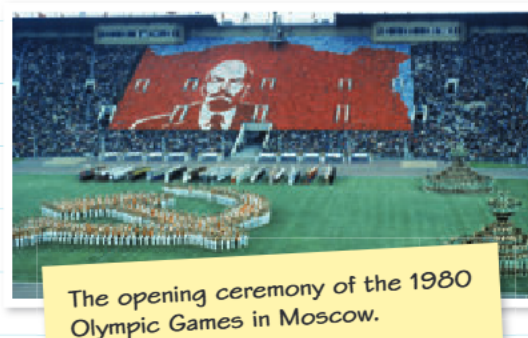
This boycott ended the spirit of cooperation and sporting competition that had characterised détente. The Soviet Union responded by boycotting the 1984 Olympic Games in Los Angeles, further demonstrating how completely the relationship between the superpowers had deteriorated.
These mutual boycotts symbolised the end of the cooperation that had made détente possible. Sports and culture, which had served as bridges between the two systems, now became additional battlegrounds in the renewed Cold War.
Consequences for both superpowers
The escalation had significant impacts on both countries that would eventually create pressure for new approaches. For the United States, the Soviet invasion convinced many Americans that the Soviet Union could not be trusted, contributing to the election of the strongly anti-communist Ronald Reagan as president in November 1980. Reagan brought a much harder line towards the Soviet Union, initially rejecting negotiations in favour of military buildup.
For the Soviet Union, the consequences were equally serious but more economically damaging. Soviet troops remained in Afghanistan to keep the pro-Soviet government in power, but fighting between these troops and the American-backed mujahideen continued throughout the early 1980s. This conflict led to rising casualties on both sides, including large numbers of civilians, and put enormous pressure on Soviet leadership to find a way out.
The increasingly unpopular war in Afghanistan, combined with the massive economic costs of the renewed arms race, would eventually contribute to the economic crisis that forced Soviet leaders to consider radical new approaches to foreign policy.
Important
The combination of military expenditure on the arms race and the costly Afghan conflict created unsustainable economic pressure on the Soviet Union. This economic strain would become a crucial factor in forcing Soviet leaders to embrace "new thinking" and seek diplomatic solutions to reduce military spending.
Timeline of key events leading to new thinking
- December 1979: Soviet invasion of Afghanistan begins
- January 1980: Carter Doctrine announced
- 1980: USA boycotts Moscow Olympics; SALT 2 treaty fails ratification
- November 1980: Reagan elected US President on anti-communist platform
- 1981-1983: Arms race accelerates with new missile deployments
- 1984: Soviet Union boycotts Los Angeles Olympics
- March 1985: Mikhail Gorbachev becomes Soviet leader, begins "new thinking"
Summary
Key Points to Remember:
- The Soviet invasion of Afghanistan in 1979 ended détente and triggered the "Second Cold War" between the superpowers
- The Carter Doctrine established three key American responses: military threats, economic sanctions, and covert support for Afghan resistance fighters
- The breakdown in relations destroyed the SALT 2 arms control treaty and accelerated the nuclear arms race with new missile systems on both sides
- Cultural cooperation collapsed with mutual Olympic boycotts in 1980 and 1984, showing how completely the relationship had deteriorated
- The economic and military costs of this renewed confrontation would eventually force both sides, especially the Soviet Union, to seek new approaches to reduce tensions