Continued settlement (Edexcel GCSE History): Revision Notes
📚Revision Notes
Continued settlement in the American West, c1876-c1895
Introduction
The period from 1876-1895 marked significant changes in the American West, with new waves of settlement transforming the landscape. This era saw different groups of people moving westward for various reasons, fundamentally altering the demographics and development of western territories.
The Exoduster movement (1879)
Background and context
Following the end of the Civil War in 1865, slavery was abolished throughout the United States. However, life for Black Americans in the southern states remained extremely difficult. Despite legal freedom, many faced continued oppression both politically and economically, struggling to achieve genuine equality with white Americans.
Note
The post-Civil War period, known as Reconstruction, officially ended in 1877, leaving many Black Americans vulnerable to discriminatory laws and violent intimidation in the South. This context is crucial for understanding why so many chose to migrate westward.
Violence and poverty plagued their daily lives, prompting some to seek better opportunities elsewhere.
Who were the Exodusters?
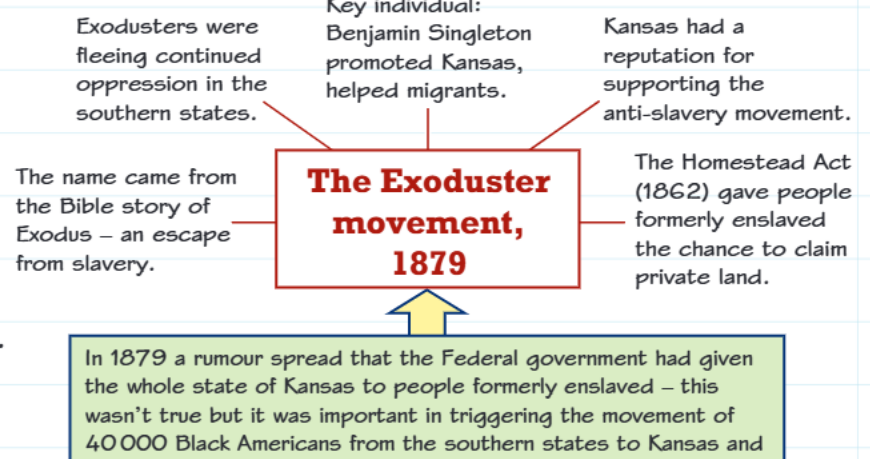
In 1879, approximately 40,000 Black Americans made the dramatic decision to leave their homes in the southern states and migrate to Kansas and other western territories. These migrants became known as "Exodusters", a name derived from the biblical story of Exodus, which tells of the escape from slavery in Egypt. This religious connection was deeply meaningful to many of the migrants, who saw their journey as a form of deliverance.
The movement was significantly influenced by Benjamin Singleton, a key individual who actively promoted Kansas as a destination for Black migrants. Singleton helped organise and assist people making the journey, recognising the potential for a better life in the West.
Why Kansas?
Kansas held special appeal for several important reasons. The state had built a strong reputation for supporting the anti-slavery movement before and during the Civil War, making it seem like a welcoming destination for formerly enslaved people. Additionally, the Homestead Act of 1862 provided opportunities for people to claim private land, offering the possibility of economic independence through farming.
Important
A crucial factor that triggered the massive migration was a false rumor that spread throughout the South in 1879. Word circulated that the federal government had given the entire state of Kansas to formerly enslaved people. Although this rumour was completely untrue, it was widely believed and helped motivate thousands to make the dangerous journey westward.
Consequences of the Exoduster movement
The arrival of so many migrants created both opportunities and challenges. Many Exodusters found that farming presented significant difficulties - other settlers had already claimed the best agricultural land, and most migrants arrived with little money to establish proper farming operations.
Important
Major Challenges Faced by Exodusters:
- The harsh realities of homesteading proved overwhelming for many families who lacked resources and experience
- Most arrived with fewer resources and rights than white migrants
- Mixed responses from existing communities, with some offering support while others showed hostility
The response from existing communities was mixed. While some white Americans in Kansas offered support and assistance to the newcomers, many southerners strongly opposed the migration. They argued that Black Americans should remain in the South and that Kansas should not welcome them.
By 1880, the mass migration phase had largely ended, but its impact was lasting. Approximately 43,000 Black Americans had successfully settled in Kansas, creating new communities and establishing themselves despite facing greater challenges than white migrants. This movement demonstrated both the determination of people seeking better lives and the ongoing struggles for equality in post-Civil War America.
The Oklahoma Land Rush
Background of Indian Territory
Indian Territory occupied a unique position in the American West, with different sections designated for specific Indigenous peoples. However, there was a central section that had not been allocated to any particular tribe, creating an unusual situation in the region's development.
Note
Initially, Indian Territory was completely closed to white settlement, with the US Army actively removing any settlers who attempted to establish themselves in the middle section. This policy maintained the territory's status as reserved land, but pressure from settlers eventually led to significant policy changes.
The 1889 Oklahoma Land Rush
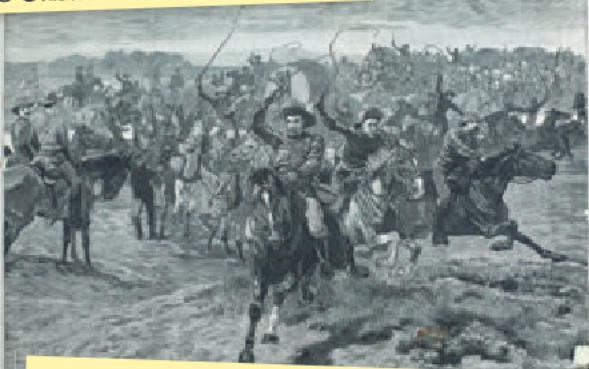
Everything changed in 1889 when the US government made the momentous decision to open the middle section for settlement. On April 22, 1889, at precisely midday, thousands of hopeful settlers rushed across the boundary to claim their 160-acre sections in what became known as a "land rush."
Example
The Dramatic Scene of the 1889 Land Rush
At exactly 12:00 PM on April 22, 1889, a gunshot signalled the start of the rush. Thousands of settlers who had been waiting at the territorial border immediately raced forwards on horseback, in waggons, and even on foot. Within hours, entire towns had been established, and virtually all available land had been claimed. Some settlers who had illegally entered early became known as "Sooners" - giving Oklahoma its nickname "The Sooner State."
This first Oklahoma Land Rush was extraordinary in its scale and intensity, with approximately 2 million acres suddenly made available for settlement. The sight of thousands of people racing to stake their claims created one of the most dramatic scenes of western expansion.
Subsequent land rushes
The success of the initial rush led to a series of similar events. Between 1889 and 1895, there were seven Oklahoma land rushes in total. The final rush in 1895 opened 88,000 acres for settlement, while the largest single event was the Cherokee Strip Land Rush in 1893, which made an enormous 8 million acres available to settlers.
These land rushes represented the end of the "Indian Frontier" concept. By 1890, the US government officially declared that the frontier was closed, marking the conclusion of a defining era in American westward expansion.
Timeline of major events
Summary
Key Dates in Continued Western Settlement:
- 1862: Homestead Act passed, allowing people to claim private land
- 1865: End of Civil War, abolition of slavery
- 1879: Exoduster movement - 40,000 Black Americans migrate to Kansas
- 1889: First Oklahoma Land Rush opens 2 million acres
- 1890: US government declares the frontier officially closed
- 1893: Cherokee Strip Land Rush opens 8 million acres
- 1895: Final Oklahoma Land Rush opens 88,000 acres
Remember!
Summary
Key Points to Remember:
-
The Exoduster movement of 1879 saw 40,000 Black Americans migrate from the South to Kansas, seeking escape from continued oppression and better economic opportunities.
-
Benjamin Singleton played a crucial role in promoting and organising migration to Kansas, while a false rumour about free land helped trigger the mass movement.
-
The Oklahoma Land Rushes (1889-1895) opened Indian Territory to white settlement through seven dramatic events, with the Cherokee Strip Land Rush of 1893 being the largest.
-
By 1890, the US government declared the American frontier officially closed, marking the end of the major westward expansion period.
-
Both the Exoduster movement and Oklahoma Land Rushes demonstrate how different groups sought new opportunities in the West, though they faced varying degrees of success and challenges.