The Mormon migration (Edexcel GCSE History): Revision Notes
📚Revision Notes
The Mormon migration
Introduction to Mormon migration
The Mormon migration between 1846 and 1847 represents one of the most organised and successful examples of westward movement in American history. This religious group faced intense persecution in the eastern United States, which ultimately drove them to seek refuge in the remote territory that would become Utah. Their journey demonstrates how detailed planning, strong leadership, and shared religious beliefs could overcome seemingly impossible challenges during westward expansion.
Note
The Mormon migration stands out in American history as one of the few mass movements that was both voluntary and successful, involving the coordinated relocation of thousands of people across hostile terrain.
Origins and early persecution
Joseph Smith and the founding
Joseph Smith established the Church of Latter-Day Saints (commonly known as the Mormon church) in the 1830s. Smith claimed that his religious teachings came directly from God through divine revelation. His persuasive public speaking attracted followers rapidly, with membership growing to several hundred by 1830. However, Smith's claims of receiving divine messages and his new religious teachings made him a controversial figure. His life ended tragically when he was murdered in Illinois in 1844, creating a leadership crisis that would shape the Mormon migration.
Why Mormons faced persecution
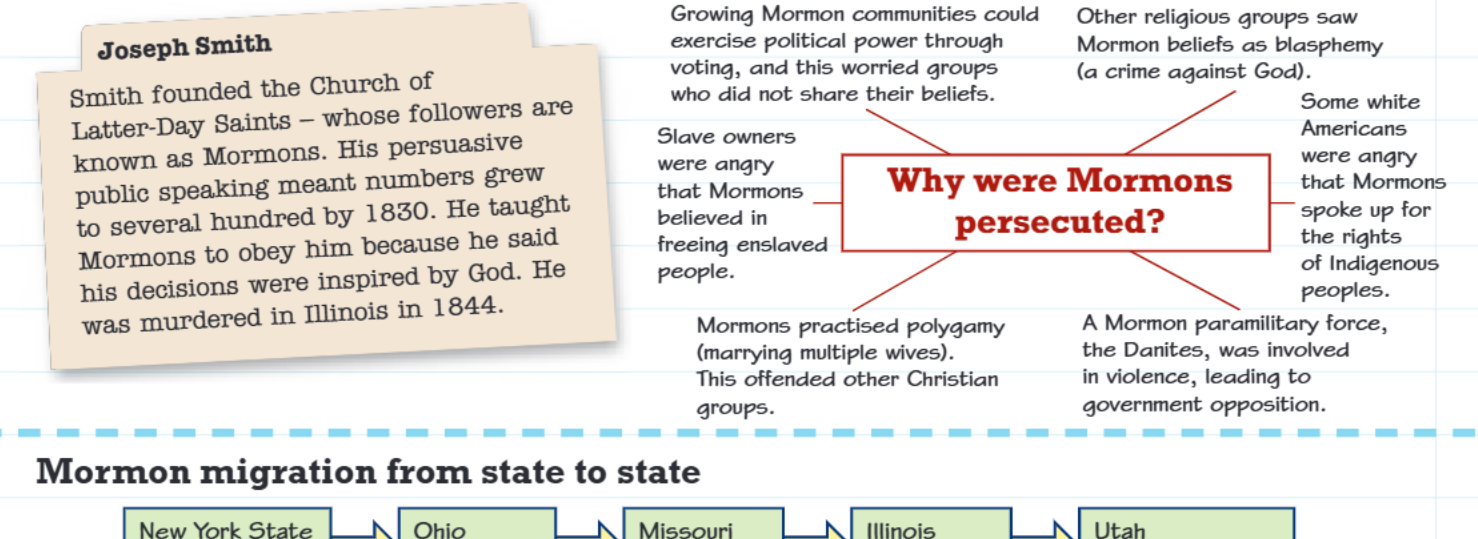
The persecution of Mormons stemmed from multiple interconnected factors that created widespread hostility towards the religious group. Their distinctive beliefs set them apart from mainstream Christianity, leading many to view Mormon teachings as blasphemous or heretical. As Mormon communities expanded, they began exercising significant political influence through coordinated voting, which concerned other residents who feared losing local control.
The practice of polygamy became particularly controversial, as it violated traditional Christian values and American social norms of the time. This practice deeply offended other religious groups and provided ammunition for critics who painted Mormons as immoral. Additionally, Mormon paramilitary groups like the Danites became involved in violence, which escalated tensions and led to government intervention in some areas.
Economic competition also played a role, as successful Mormon communities sometimes displaced or competed with existing settlements. Some white Americans worried that Mormons supported indigenous peoples' rights over traditional settler interests. The combination of these religious, political, social, and economic factors created an environment where Mormons faced increasing hostility and violence.
Important
The persecution of Mormons was not based on a single factor but resulted from a complex combination of religious, political, social, and economic tensions. Understanding this complexity helps explain why the conflict was so intense and widespread.
The great migration west
Migration route across states
The Mormon community's westward journey followed a clear progression across multiple states as they sought refuge from persecution:
- New York State (1829-31): The church's birthplace and early development
- Ohio (1831-37): First major community establishment
- Missouri (1837-39): Attempted permanent settlement ended in conflict
- Illinois (1839-46): Temporary refuge that also became hostile
- Utah (1847-present): Final destination and permanent settlement
Leadership transition and journey planning
Following Smith's death in 1844, Brigham Young emerged as the new leader of the Mormon community. When persecution intensified in Illinois during 1846, Young made the crucial decision to lead approximately 1,500 Mormons away from their homes to find safety near the Great Salt Lake.
Young's organisational skills proved essential for the migration's success. He divided the large group into smaller, manageable units with designated leaders for each section. Every person received specific responsibilities to ensure the journey ran smoothly. Young insisted on purchasing proper equipment, including sturdy waggons arranged in protective circles during rest periods for security.
The leader emphasised strict discipline and regular rest stops to maintain the group's health and morale throughout the arduous 2,250-kilometer journey. Young's advance party of 150 carefully selected individuals went ahead to identify the best route, locate water sources, and prepare trail improvements for the larger group following behind.
Note
Brigham Young's leadership style combined military-like organisation with careful attention to the practical needs of families and individuals, which was crucial for maintaining group cohesion during the difficult journey.
Comparison with other migrations
Young's careful preparation contrasted sharply with other westward migrations of the same period. In 1847, Young led an advance group along a route previously attempted by some members of the ill-fated Donner Party in 1846. Unlike the Donner expedition, which had ended in tragedy when travellers became stranded and ran out of supplies, Young's group conducted thorough advance research of their route.
The Mormon migration succeeded where others failed because Young ensured adequate food supplies for an entire year, while many other groups underestimated their needs. The Donner Party had included many elderly and young people who struggled with the journey's demands, but Young's advance group specifically chose individuals with the skills needed to establish trails, improve routes, and prepare for the larger migration.
Between 1847 and 1869, approximately 70,000 Mormons successfully completed the journey along what became known as the 'Mormon Trail', demonstrating the effectiveness of their organised approach.
Example
Comparison: Mormon Migration vs. Donner Party
Donner Party (1846):
- Poor planning and inadequate supplies
- Mixed group with elderly and children
- Became stranded in winter conditions
- Ended in tragedy with deaths from starvation
Mormon Migration (1847):
- Extensive advance planning and scouting
- Carefully selected advance party with specific skills
- Full year's supply of food and equipment
- Successful establishment of permanent settlements
Success in Utah territory
Reasons for Mormon success
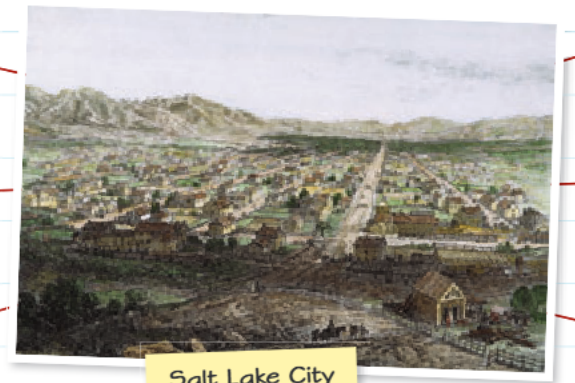
The Mormon settlement in Utah achieved remarkable success through several key factors working together. Their shared religious faith provided powerful motivation to work extremely hard and persevere through terrible hardships that might have defeated other groups. The community's belief that they were fulfilling God's plan gave them strength to continue when conditions seemed hopeless.
Brigham Young's strong leadership proved crucial in making effective decisions for the growing community. His ability to organise settlers and allocate resources efficiently helped the settlement thrive. The Mormon Church's ownership of all land, water rights, and timber resources allowed for systematic distribution to families based on need rather than individual wealth, ensuring the community could function efficiently.
The settlers demonstrated remarkable ingenuity by constructing irrigation systems that brought water to previously barren farmland. This engineering achievement transformed the desert environment into productive agricultural land capable of supporting large populations.
The establishment of the Perpetual Emigration Fund provided essential financial resources to help thousands of additional Mormons emigrate to Utah. This system created a continuous flow of new settlers with diverse skills needed for the community's growth and prosperity.
Young's careful planning ensured that each new settlement had the appropriate combination of skills represented - farmers, craftsmen, merchants, and professionals - allowing communities to become self-sufficient and prosper in the challenging frontier environment.
Note
The Mormon success in Utah was remarkable considering they were settling in what many considered uninhabitable desert. Their achievements in irrigation and community organisation became a model for other western settlements.
Timeline of major events
- 1830s: Joseph Smith founds the Church of Latter-Day Saints
- 1831-1844: Mormons move from state to state seeking acceptance
- 1844: Joseph Smith murdered in Illinois
- 1846: Brigham Young leads Mormons out of Illinois due to persecution
- 1847: Mormon pioneers reach Great Salt Lake Valley
- 1847-1869: Approximately 70,000 Mormons follow the Mormon Trail to Utah
Summary
Key Points to Remember:
- Mormon persecution stemmed from religious differences, political concerns, social practices like polygamy, and economic competition
- Brigham Young's leadership was crucial - he organised the migration into manageable groups with specific roles and ensured adequate supplies
- Careful planning distinguished Mormon migration from failed attempts like the Donner Party
- Success in Utah resulted from religious motivation, strong leadership, irrigation systems, and organised resource allocation
- The Mormon Trail became a major westward route, with 70,000 people using it between 1847-1869