Little Rock High School, 1957 (Edexcel GCSE History): Revision Notes
📚Revision Notes
Little Rock High School, 1957
Background: the road to integration
Following the landmark Brown v. Topeka Supreme Court decision in 1954, which declared school segregation unconstitutional, the city of Little Rock, Arkansas decided to begin desegregating its schools. However, this decision faced fierce opposition from white Americans who wanted racial segregation to continue throughout the South.
The integration plan meant that Black students would finally be able to attend the previously all-white Little Rock High School. This represented a major step forwards in the fight for civil rights, but it would not happen without serious resistance and conflict.
Note
The Brown v. Topeka decision was a watershed moment in American civil rights history. It overturned the previous "separate but equal" doctrine and declared that segregated schools were inherently unequal, setting the legal foundation for integration efforts across the South.
The 'Little Rock Nine'
Around 75 Black students initially applied to attend Little Rock High School following desegregation. The school board accepted 25 of these applications, but by the start of the 1957 school year, only nine brave Black students were still planning to register. These students became known as the 'Little Rock Nine'.
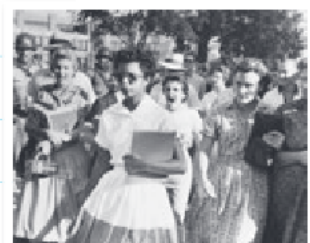
These nine teenagers faced serious threats of violence and harassment from opponents of desegregation. Their families also experienced intimidation and unemployment threats from those who opposed racial integration. Despite these dangers, the students were determined to exercise their right to equal education.
Important
The courage of the Little Rock Nine cannot be overstated. These teenagers risked their physical safety and their families' livelihoods to challenge a system of racial oppression. Their bravery helped pave the way for future civil rights progress.
Governor Orval Faubus fights integration
Governor Orval Faubus of Arkansas became a fierce opponent of school integration after the 1954 Brown v. Topeka verdict. In 1958, Faubus took the extreme step of closing every school in Little Rock to try to prevent racial integration from taking place. This drastic action lasted for a year, but pressure from parents eventually forced him to reopen the schools.
Faubus's opposition represented the broader resistance to civil rights that existed throughout the American South during this period.
Key events in September 1957
The crisis at Little Rock High School unfolded through several crucial events in September 1957:
Example
Key Events Timeline: September 1957
1. School board agreement - The Brown v. Topeka case led to the school board agreeing that Little Rock High School would be desegregated on 3 September 1957, at the start of the new school term.
2. NAACP coordination - The NAACP arranged for the new Black students to arrive together on 4 September for safety and support.
3. National Guard intervention - Governor Faubus sent Arkansas National Guard troops to surround the school when the Little Rock Nine were due to start. He claimed this was to 'keep the peace', but it actually blocked the Black students from gaining entrance.
4. Elizabeth Eckford's ordeal - Elizabeth Eckford did not receive the notification to arrive with the rest of the group. She was targeted by an aggressive crowd and suffered serious racial abuse as she tried to enter the school alone.
5. Legal challenge - District judges and lawyers for the NAACP used the courts to challenge Governor Faubus and force him to withdraw the state troops.
6. Federal intervention - On 24 September, President Eisenhower sent in federal troops to ensure Black students could attend school without being attacked. The Black students were finally able to enter the school successfully.
Presidential intervention and federal power
The rioting outside Little Rock High School after Arkansas state troops were removed forced President Eisenhower to become directly involved. As the situation escalated, the USA's international image was being damaged by worldwide media coverage of the events.
Eisenhower sent in 1000 federal troops to restore order. He used a presidential directive to show that Congress would not approve of state governments interfering in federal civil rights decisions. While Eisenhower wanted to avoid using federal powers, he was concerned about white opposition to integration and wanted to protect the civil rights of Black people while preventing potential violent unrest about racial integration in the Deep South, where segregation was strongest.
Note
This marked a crucial moment in federal-state relations. Eisenhower's decision to use federal troops demonstrated that the federal government would enforce Supreme Court decisions, even against state resistance. This precedent would prove important for future civil rights enforcement.
Significance of the Little Rock crisis
The events at Little Rock High School had several important consequences for the civil rights movement:
National attention: Hundreds of reporters from local and international news stations covered the events. People around the world were shocked by the images of how children were being racially abused.
Continued resistance: There was ongoing resistance to school integration after 1957. Throughout the South, many schools chose to shut down rather than desegregate.
Mixed success: The first Black student graduated from Little Rock High School in 1958, but fellow white students refused to sit with him at the graduation ceremony.
Long-term impact: Even 10 years later, Black students attending newly integrated Southern schools continued to face violence, intimidation and exclusion by teachers and peers.
Note
The international media coverage of Little Rock was particularly damaging to America's reputation during the Cold War. The Soviet Union used images of American racism as propaganda to criticise U.S. claims about freedom and democracy.
Timeline of major events
- 1954: Brown v. Topeka Supreme Court decision declares school segregation unconstitutional
- 1957: Little Rock decides to desegregate its schools
- 3 September 1957: Planned start date for integration at Little Rock High School
- 4 September 1957: Little Rock Nine attempt to enter school; Governor Faubus sends National Guard to block them
- 4 September 1957: Elizabeth Eckford faces hostile mob alone
- 24 September 1957: President Eisenhower sends federal troops; students successfully enter school
- 1958: First Black student graduates from Little Rock High School
- 1958: Governor Faubus closes all Little Rock schools for a year
Summary
Key Points to Remember:
- The Little Rock crisis in 1957 was a major test of the federal government's commitment to enforcing civil rights following Brown v. Topeka
- Nine brave Black students, known as the 'Little Rock Nine', faced serious threats and violence to integrate an all-white high school
- Governor Faubus used state troops to oppose integration, forcing President Eisenhower to send in federal forces
- The crisis received worldwide media attention and damaged America's international reputation
- Despite federal intervention, resistance to school integration continued throughout the South for many years