Opposition to civil rights: the KKK and violence (Edexcel GCSE History): Revision Notes
📚Revision Notes
Opposition to civil rights: the KKK and violence
Introduction
During the 1950s, Black Americans in the Southern states faced serious threats from organised groups opposed to civil rights progress. The most notorious of these groups was the Ku Klux Klan (KKK), which used intimidation, violence, and murder to prevent Black Americans from achieving equality. The media coverage of some brutal cases helped raise public awareness about the terrible injustices faced by Black Americans in the South.
Note
The power of media coverage in the 1950s cannot be understated. Television was becoming more widespread, and graphic images of violence against Black Americans began reaching audiences who had previously been unaware of the extent of Southern brutality.
The Ku Klux Klan: organisation and methods
Background and formation
The KKK was established in 1865, immediately after enslaved Black people gained their freedom following the Civil War. The organisation's primary goal was to prevent Black Americans from achieving equality and maintaining white supremacy in the South.
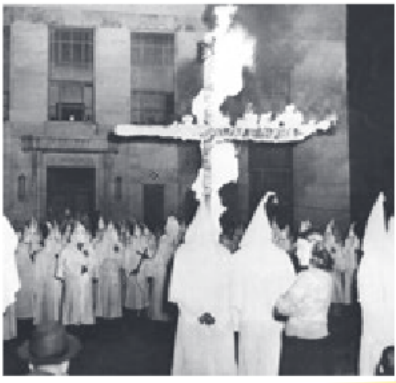
KKK activities and tactics
The Klan operated primarily in Southern states and employed several intimidation tactics:
- Terrorized Black families through extreme violence, including murder
- Used lynching as a method of illegal execution, typically carried out by mobs
- Burned crosses as a symbol to intimidate and spread fear in Black communities
- Targeted various groups including Jews, Catholics, and liberals, though their most extreme hatred was directed at Black Americans
Important
The KKK's tactics were designed not just to harm individuals, but to create a climate of terror that would prevent entire communities from seeking equal rights. The psychological impact of these threats often proved as effective as the physical violence itself.
Membership and secrecy
The KKK maintained strict secrecy around its membership, with members wearing distinctive white robes and hoods to hide their identities. However, in reality, many Southern law enforcement officers were either involved with or sympathetic to the Klan's objectives. Only so-called WASPs (White Anglo-Saxon Protestants) were permitted to join the organisation.
Case study: the murder of Emmett Till (1955)
The events leading to tragedy
Example
Case Study: The Emmett Till Murder - Sequence of Events
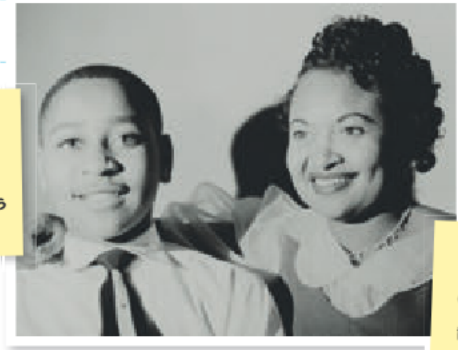
Background: Emmett Till was a 14-year-old Black boy from Chicago who travelled to Mississippi in 1955 to visit family.
The Incident:
- Carolyn Bryant, a white woman, claimed that Till made a sexually suggestive remark and physically assaulted her at her store
- Till's cousins, who were present, said he only wolf-whistled at her
The Murder:
- The following night, Bryant's husband and his half-brother abducted Till from his family's home
- They beat him severely, shot him, and threw his body into the river with a heavy weight around his neck
- Till's body was discovered three days later
The trial and lack of justice
The murder trial became a national news story, but the outcome highlighted the injustice of the Southern legal system:
- The defendants were acquitted (found not guilty) despite overwhelming evidence
- After the trial, they actually sold their story to a magazine, admitting to the murder
- Black people continued to be murdered in Mississippi with killers rarely being convicted
- Even prominent figures like NAACP leader George W. Lee faced assassination in 1955
Important
The acquittal of Till's murderers, despite clear evidence of their guilt, demonstrated how the Southern justice system was deliberately structured to protect white supremacy. This blatant miscarriage of justice became a powerful symbol of institutional racism.
Impact on the civil rights movement
Till's mother, Mamie Bradley, made a crucial decision that changed history:
- She insisted on an open-casket viewing in Chicago, allowing the public to see the extent of the violence
- This led to extensive media coverage that shocked people, particularly in the North
- Many Americans became aware for the first time of the brutal treatment of Black Americans in the South
- The case helped fuel widespread outrage and contributed to the growth of the civil rights movement
- The NAACP produced a booklet in 1955 called "M is for Murder and Mississippi," highlighting the murders of Black people in that state
Note
Mamie Bradley's decision to hold an open-casket funeral was extraordinarily brave. By allowing the world to see what had been done to her son, she transformed a personal tragedy into a catalyst for national change. The images published in Jet magazine and other publications became some of the most powerful documentation of racial violence in American history.
Timeline: key events 1954-1955
- 1954: Brown v. Board of Education Supreme Court decision
- 1955:
- George W. Lee (NAACP leader) murdered in Mississippi
- August: Emmett Till murdered in Mississippi
- September: Till's killers acquitted at trial
- December: Montgomery Bus Boycott begins
Summary
Key Points to Remember:
- The KKK was formed in 1865 specifically to oppose Black equality after the Civil War ended
- The organisation used extreme violence, including lynching, to terrorise Black communities in the South
- The murder of 14-year-old Emmett Till in 1955 became a turning point when his mother's decision for an open-casket funeral exposed the brutality to national media
- Many Southern law enforcement officers were either KKK members or sympathetic to their cause, making justice nearly impossible
- Media coverage of cases like Emmett Till's murder helped raise awareness and fuel the growing civil rights movement