Political opposition to desegregation (Edexcel GCSE History): Revision Notes
📚Revision Notes
Political opposition to desegregation
During the 1950s, attempts to desegregate the South encountered fierce political resistance at multiple levels of government. Politicians from national to local levels worked to maintain racial segregation and block civil rights progress.
Federal opposition to civil rights
At the national level, several groups within the federal government opposed civil rights advancement:
Southern members of Congress
Some Southern representatives in Congress actively worked against civil rights legislation. They used their positions to block or weaken attempts to introduce an effective Civil Rights Act, arguing that states should have the right to maintain their own laws regarding racial separation.
The Dixiecrats
Important
The Dixiecrats represented one of the most significant obstacles to civil rights progress at the federal level. This breakaway faction had enormous influence within the Democratic Party and actively worked to preserve segregation.
A significant political obstacle came from the Dixiecrats, a breakaway faction from the Democratic Party consisting entirely of Southern politicians. This group had extremely strong pro-segregation views and originally split from the main Democratic Party over civil rights disagreements. By 1954, they had rejoined the Democrats, but their return gave them considerable influence within the party. The Dixiecrats maintained their stance on preserving segregation and protecting states' rights to enforce laws that guaranteed white supremacy.
Presidential dependence
Presidents during this period found themselves in a difficult position because they needed the political support of the Dixiecrats in Congress to pass other legislation. This dependency meant that civil rights laws often faced significant obstacles, as presidents had to consider the views of pro-segregation politicians when creating new policies.
State opposition to civil rights
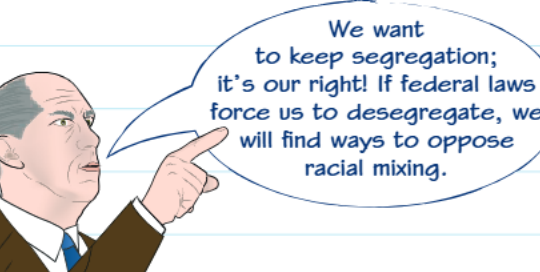
State and local politicians also mounted strong resistance to desegregation efforts:
Governors and mayors
Southern state governors and local mayors ensured there was organised opposition to the civil rights movement and desegregation efforts. They used their authority to resist federal mandates and protect existing segregation practices.
Judicial system manipulation
Important
Local officials often relied on having white judges and juries in court systems, arguing this was the best way to maintain justice. This practice effectively ensured that civil rights cases would be decided by people likely to oppose integration, making it extremely difficult for African Americans to win legal challenges to segregation.
Types of resistance methods
State officials employed various tactics to oppose desegregation:
Direct institutional resistance
Some officials resisted desegregation through open defiance, such as shutting down all state schools rather than allowing them to become integrated. This extreme measure prevented any progress towards educational equality.
Note
School closures became a common tactic across the South, with some districts preferring to have no public education system rather than integrate their schools.
Underhanded tactics
Other state officials used more subtle but equally harmful methods to maintain segregation:
- School admission tests were deliberately designed to be biassed against Black students, preventing them from attending previously all-white schools
- States refused to end literacy tests that were used to prevent Black Americans from exercising their voting rights
- Officials continued to disrupt opportunities for Black voters to participate in elections
These methods allowed officials to claim they were following the letter of desegregation laws while actually undermining their spirit and effectiveness.
White Citizens' Councils (WCC)
The White Citizens' Councils represented one of the most organised forms of resistance to civil rights:
Formation and membership
White Citizens' Councils were established from 1954 onwards specifically to stop desegregation efforts. By the mid-1950s, these organisations had grown to approximately 60,000 members across the South.
Origins and motivation
Note
Many of these councils began as local organisations opposing school desegregation in their communities following the Brown v. Topeka Supreme Court ruling in 1954. They opposed any form of desegregation, including integration of public facilities like libraries and swimming pools.
Methods of opposition
The WCC used several tactics to maintain segregation:
- Economic pressure: They organised boycotts and used economic means to pressure people who supported civil rights
- Employment discrimination: WCC members would target Black employees who signed petitions or participated in civil rights activities, often getting them fired from their jobs
- Intimidation tactics: They used threats of violence and actual violence against those who sought integration
- Community pressure: Members feared that desegregation would lead to increased calls for political and economic equality for Black Americans, so they worked to prevent any progress
Important
The councils represented a coordinated effort to maintain white supremacy through organised community pressure rather than just individual resistance. This made them particularly effective at slowing civil rights progress.
Timeline of key events
- 1954: Brown v. Topeka Supreme Court ruling leads to organised resistance
- 1954 onwards: White Citizens' Councils begin forming across the South
- Mid-1950s: WCC membership reaches approximately 60,000 members
- Throughout 1954-60: Various resistance tactics implemented at federal, state, and local levels
Remember!
Summary
Key Points to Remember:
- Political opposition to desegregation occurred at three levels: federal, state, and local government
- The Dixiecrats were a powerful pro-segregation faction within the Democratic Party who influenced national civil rights policy
- State officials used both open defiance and underhanded tactics like biassed tests and school closures to maintain segregation
- White Citizens' Councils organised community-level resistance using economic pressure and intimidation
- This organised political resistance significantly slowed civil rights progress during the 1950s