Protest and progress, 1960-75 (Edexcel GCSE History): Revision Notes
📚Revision Notes
The civil rights movement, 1965-75
The period from 1965-75 represented a complex phase in the American civil rights movement, marked by urban unrest, government investigations, shifting strategies, and profound tragedy. While earlier years had achieved important legislative victories, this era faced new challenges as the movement grappled with deeper systemic inequalities, particularly in Northern cities.
The riots of 1964-67
Overview and scale
Between 1964 and 1968, America experienced unprecedented urban unrest with 329 major riots erupting across 257 Northern US cities. This wave of violence represented a dramatic departure from the predominantly peaceful Southern protests that had characterised the earlier civil rights movement.
Note
This shift from Southern to Northern cities marked a fundamental change in the civil rights movement's focus, revealing that legal victories in the South had not addressed the deep-seated inequalities in Northern urban areas.
Key riots and their triggers
The cycle of urban violence began in New York City during July 1964, when a police officer fatally shot a young Black man. This incident sparked violent reactions during the Freedom Summer of 1964, setting a pattern that would continue for years. Significant disturbances included:
Example
Major Riot Example: The Watts Riots (August 1965)
Trigger: Police violence and deteriorating living conditions in Los Angeles Significance: These riots highlighted the disconnect between legal progress and daily reality for many African Americans Impact: Established the pattern of annual summer violence that would continue throughout the mid-1960s
Annual summer violence: Riots occurred every year during warmer months in various cities, primarily in Northern areas. Chicago and Cleveland experienced major unrest in 1966, while Newark and Detroit saw significant violence in 1967.
Causes of the riots
The urban uprisings stemmed from both deep-rooted and immediate factors that exposed fundamental problems in American society:
Important
Understanding the Root Causes
Long-term causes centred on the unequal living conditions that Black Americans endured compared to white Americans. This persistent inequality fostered widespread anger and despair, especially in urban areas where African Americans faced continuous educational discrimination and employment barriers imposed by police and local authorities.
Short-term causes typically involved specific incidents, such as police shootings, that served as immediate catalysts for violence in communities already suffering from systematic oppression.
The Kerner Report, 1968
In 1967, President Johnson established a commission to investigate the underlying causes of urban riots, resulting in the groundbreaking Kerner Report published in 1968.
Key findings and recommendations
Important
Critical Findings of the Kerner Report
The commission's comprehensive investigation revealed disturbing truths about American society:
The riots primarily resulted from poor living conditions in urban ghettos and the government's inadequate response to Black Americans' complaints about these circumstances. The report emphasised that African Americans should be genuinely heard and meaningfully involved in addressing problems affecting their communities.
Police methods required fundamental transformation because Black communities had completely lost trust in law enforcement. The investigation found that poor policing during riots actually worsened situations rather than improving them.
Additionally, money designated for improving living conditions and creating opportunities had not been spent on planned improvements but instead on increasing police presence. The media had also exaggerated riot coverage, creating additional division and misunderstanding between communities.
King moves North
In 1966, Martin Luther King Jr. and the Southern Christian Leadership Conference (SCLC) shifted their campaigning focus to Northern cities. However, they encountered significant difficulties connecting with people in these urban environments.
The Chicago campaign
The SCLC launched their Northern initiative in Chicago, concentrating on fair housing issues. Despite their determined efforts, they faced substantial obstacles:
Note
Challenges of Northern Campaigns
The local mayor initially participated in discussions and seemed reasonable, but ultimately failed to implement concrete actions. When riots erupted, media coverage proved negative and counterproductive to their cause.
King's outspoken criticism of America's involvement in Vietnam also meant that President Johnson became less supportive of his civil rights efforts, creating additional political challenges for the movement.
This Northern campaign revealed the different obstacles facing the civil rights movement outside the South, where legal segregation was less visible but economic and social barriers remained equally formidable.
The assassination of Martin Luther King Jr. and its impact
On April 4, 1968, Martin Luther King Jr. was shot and killed by James Earl Ray at the Lorraine Motel in Memphis, Tennessee. This devastating event sent shockwaves throughout America and fundamentally altered the trajectory of the civil rights movement.
Immediate reactions
King's assassination triggered violent responses across the United States, with major rioting occurring in Washington and Cleveland, among other cities. James Earl Ray received a lengthy prison sentence for the murder.
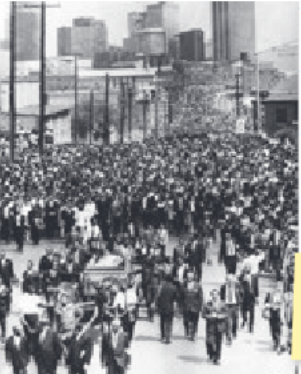
The funeral procession of Martin Luther King Jr. in Atlanta on April 9, 1968, attracted over 100,000 mourners, demonstrating the enormous impact his death had on Americans from all backgrounds.
Long-term impact on society and the movement
Important
Transformative Impact of King's Assassination
King's assassination produced several significant consequences for the civil rights movement and American society:
White American perspectives: Many white Americans had previously regarded King as a moderate leader whose approach they could accept. His death intensified white opposition to Black people's demands for equality, as some feared more radical approaches would emerge without his moderating influence.
Black American radicalization: Many Black Americans became increasingly radical following King's death, expressing heightened frustration with the slow pace of change. The loss of such a prominent advocate for non-violent protest led some to consider more militant approaches to achieving civil rights.
Legislative developments: The 1968 Civil Rights Act was passed, focusing on fair housing and providing federal protection for civil rights workers. However, civil rights organisations began losing funding and membership as the movement faced new challenges without its most visible and respected leader.
Timeline of key events
- July 1964: New York City riots initiate wave of urban unrest
- August 1965: Watts riots occur in Los Angeles
- 1966: King and SCLC begin Northern campaign in Chicago; riots affect Chicago and Cleveland
- 1967: Major riots strike Newark and Detroit; Johnson establishes commission to investigate riot causes
- April 4, 1968: Martin Luther King Jr. assassinated in Memphis
- April 9, 1968: King's funeral procession in Atlanta draws massive crowds
- 1968: Kerner Report published; Civil Rights Act passed focusing on fair housing
Summary
Key Points to Remember:
-
Urban riots from 1964-1968 included 329 major disturbances across 257 Northern cities, revealing the gap between legal progress and actual living conditions for many African Americans
-
The Kerner Report (1968) identified poor living conditions and inadequate government response as main causes of riots, recommending major changes in policing and community involvement
-
King's Northern campaign encountered different obstacles than Southern efforts, struggling with less obvious but equally significant barriers in cities like Chicago
-
Martin Luther King Jr.'s assassination in April 1968 transformed the civil rights movement, resulting in both the 1968 Civil Rights Act and increased radicalization within Black communities
-
This period marked a transition from the optimism of early 1960s civil rights achievements to more complex challenges of addressing systematic inequality in urban America