Malcolm X (Edexcel GCSE History): Revision Notes
📚Revision Notes
Malcolm X
Introduction
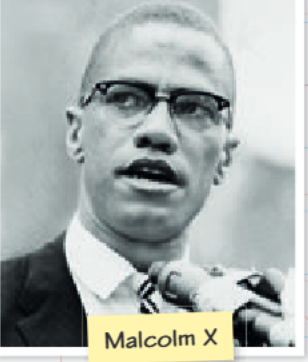
Malcolm X emerged as one of the most influential and controversial figures in the American civil rights movement. Unlike Martin Luther King Jr., who advocated for integration through non-violent resistance, Malcolm X initially promoted Black separatism and defended the right of African Americans to protect themselves "by any means necessary."
Early life and transformation
Malcolm X was born Malcolm Little, but he deliberately rejected this name, viewing "Little" as a "slave name" imposed by white society. He replaced it with "X" to represent his unknown African heritage, symbolising how slavery had stripped Black Americans of their true identities.
Note
The adoption of "X" as a surname was a powerful symbolic act that represented not just personal transformation, but a rejection of the legacy of slavery. This practice was common among Nation of Islam members who viewed their original surnames as remnants of their ancestors' enslavement.
His early years were marked by tragedy and struggle. During his troubled upbringing, white racists killed his father, setting the stage for a difficult youth. Malcolm became involved in crime and illegal drugs, eventually leading to his imprisonment. However, this period proved transformative - while in prison, he joined the Nation of Islam (NOI) and underwent a profound spiritual and intellectual awakening.
Core beliefs and the Nation of Islam
Important
The Nation of Islam, or Black Muslims: A radical group that mixed ideas from Islam with those of Black separatism. They believed Black Americans needed to create their own separate state, independently of white Americans.
As a spokesperson for the Nation of Islam, Malcolm X became known for his powerful public speaking abilities, delivering speeches with remarkable conviction and passion. He argued that Black and white Americans should live completely separately, believing that white Americans could never truly help Black Americans achieve genuine equality.
His philosophy directly challenged the mainstream civil rights approach. In a significant speech delivered in June 1964, Malcolm X stated that Black people should defend themselves "by any means necessary." He strongly criticised those who advocated for non-violence, arguing that white Americans would never voluntarily grant equality unless forced to do so.
Methods and approach
Malcolm X's approach to civil rights differed fundamentally from other leaders like Martin Luther King Jr. He believed that non-violent direct action would prove ineffective because white society would never willingly consider Black Americans as equals. This put him at odds with organisations like the SNCC and CORE, who initially focused on integration through peaceful protest.
He effectively connected with angry young people in Northern US cities, where his message of Black pride and self-reliance resonated strongly. Through the Nation of Islam, he established the Organisation of Afro-American Unity, which aimed to unite all people of African descent and promote political and economic independence from white Americans.
Note
Malcolm X's appeal to urban youth in the North was particularly significant because these communities often felt disconnected from the Southern-based civil rights movement led by figures like Martin Luther King Jr. His message of Black pride and self-defense resonated with young people who had experienced racism and discrimination in Northern cities.
The transformation of 1964
Important
The Pivotal Year of 1964
The year 1964 marked a crucial turning point in Malcolm X's life and beliefs. This transformation would ultimately lead to his assassination, as his evolving views threatened the Nation of Islam's ideology and authority.
Several major changes occurred that would ultimately cost him his life:
First, he left the Nation of Islam to establish his own religious organisation, Muslim Mosque, Inc. (MMI). This break created immediate tension, as the Nation of Islam now viewed him as an enemy and began sending him death threats.
Most significantly, Malcolm X undertook a pilgrimage to Mecca in April 1964. This religious journey profoundly challenged his previous beliefs about race and separatism. Witnessing Muslims of different races worshipping together in unity, he began to reconsider his views about the impossibility of racial integration.
Example
Malcolm X's Transformation at Mecca
During his pilgrimage to Mecca, Malcolm X wrote: "There were tens of thousands of pilgrims, from all over the world. They were of all colours, from blue-eyed blonds to black-skinned Africans. But we were all participating in the same ritual, displaying a spirit of unity and brotherhood that my experiences in America had led me to believe never could exist between the white and non-white."
This experience fundamentally challenged his belief that whites and blacks could never coexist peacefully.
Following his pilgrimage, he decided to work with other civil rights organisations and established the Organisation of Afro-American Unity (OAAU) in 1964. He began meeting with members of the SNCC and CORE to explore opportunities for collaborative efforts in promoting civil rights.
The assassination
Malcolm X's evolving views and break from the Nation of Islam made him a target for assassination. On 21 February 1965, while speaking at a meeting in Harlem, he was shot 15 times by members of the Nation of Islam. The organisation had previously firebombed his home several times, and he required bodyguards due to constant threats.
Note
Malcolm X had become increasingly aware of the danger he faced. In the weeks before his death, he told associates that he believed the Nation of Islam was planning to kill him. The threats had become so serious that he had begun carrying a gun for protection.
His death sent shockwaves through the civil rights community. Approximately 15,000 people attended his funeral on 27 February 1965, demonstrating the significant impact he had made on the movement and the African American community.
Legacy and significance
Before his death, Malcolm X had begun to believe that integration with whites might be possible, representing a dramatic shift from his earlier separatist stance. His pilgrimage to Mecca had shown him that Muslims of different races could unite in their faith, challenging his previous assumptions about racial relations.
Malcolm X's contribution to the civil rights movement was unique and significant. While he initially advocated for complete separation, his evolution towards a more inclusive approach demonstrated the complexity of the struggle for civil rights. His emphasis on Black pride, self-determination, and the right to self-defense would later influence the Black Power movement of the late 1960s and early 1970s.
His powerful oratory and uncompromising stance on racial equality inspired many African Americans to take pride in their heritage and demand respect. Even though his life was cut short, his ideas about Black nationalism and self-reliance continued to resonate throughout the civil rights era and beyond.
Timeline of key events
- Early 1940s: Malcolm Little involved in crime, later imprisoned
- While in prison: Converts to Nation of Islam
- 1950s-early 1960s: Becomes prominent spokesman for Nation of Islam
- June 1964: Delivers speech advocating defence "by any means necessary"
- 1964: Leaves Nation of Islam to form Muslim Mosque, Inc.
- April 1964: Pilgrimage to Mecca, begins reconsidering views on integration
- 1964: Establishes Organisation of Afro-American Unity (OAAU)
- 21 February 1965: Assassinated by Nation of Islam members in Harlem
- 27 February 1965: Funeral attended by 15,000 people
Summary
Key Points to Remember:
- Malcolm X initially advocated for Black separatism through the Nation of Islam, contrasting sharply with Martin Luther King Jr.'s integration approach
- His 1964 pilgrimage to Mecca transformed his views, leading him to consider the possibility of racial integration and cooperation
- He was assassinated in 1965 by Nation of Islam members after breaking from the organisation and evolving his beliefs
- His emphasis on Black pride, self-defense, and "by any means necessary" significantly influenced the later Black Power movement
- Unlike other civil rights leaders, Malcolm X initially rejected non-violence, arguing that Black Americans had the right to defend themselves against oppression