Support for the Vietnam War (Edexcel GCSE History): Revision Notes
📚Revision Notes
Support for the Vietnam War
Despite widespread protests and media criticism, the Vietnam War actually had significant support from many Americans between 1964-1975. Understanding why people backed this controversial conflict helps explain how the war continued for over a decade.
Fear of communism
The Cold War created deep anxiety among Americans about the spread of communist ideology. This fear became a major driving force behind support for military action in Vietnam.
By 1954, concerns about communist expansion remained strong across the United States, even though domestic fears had somewhat decreased. President Eisenhower introduced the concept of the "falling domino" theory during a news conference in 1954, warning that communist victories in one country would inevitably lead to further conquests throughout the region. He argued that losing Vietnam would threaten the security of Southeast Asia, including important allies like Japan and Australia.
Note
The "falling domino" theory became one of the most influential Cold War concepts, suggesting that communist victories would create a chain reaction across neighbouring countries. This theory shaped U.S. foreign policy decisions for decades, not just in Vietnam but throughout the developing world.
President Kennedy reinforced these concerns in his inaugural speech, emphasising that American security faced serious threats from the domino effect. This theory suggested that if South Vietnam fell to communism, neighbouring countries would quickly follow, creating a chain reaction of communist victories across Asia.
Patriotism and national duty
Many Americans viewed supporting the Vietnam War as their patriotic obligation. They worried that a defeat in Vietnam would damage America's reputation and global influence, causing the nation to "lose face" on the world stage.
Working-class Americans, particularly construction workers nicknamed "hard hats", became vocal supporters of the war effort. During anti-war protests in May 1970, groups of hard hats physically confronted protesters, with police offering little protection to the demonstrators. These supporters believed that opposing communism in Vietnam represented their fundamental duty as Americans, regardless of the personal costs involved.
Important
The confrontations between "hard hats" and anti-war protesters in May 1970 revealed the deep divisions in American society over Vietnam. These clashes demonstrated that support for the war wasn't limited to government officials but extended to significant portions of the working class who viewed the conflict as essential to American values.
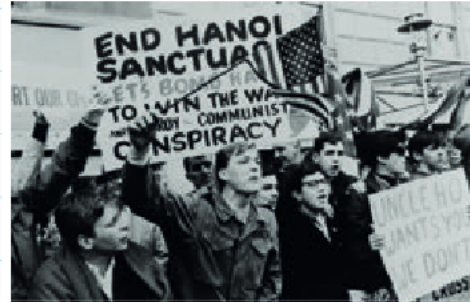
The image above shows pro-war demonstrators holding signs demanding an "END HANOI SANCTUARY" and calling for victory, illustrating the passionate support some Americans felt for escalating military action.
The silent majority
President Nixon skillfully appealed to Americans who supported the war but remained quiet about their views. In a televised speech on November 3, 1969, Nixon claimed that a "great silent majority" of Americans backed his Vietnam policies.
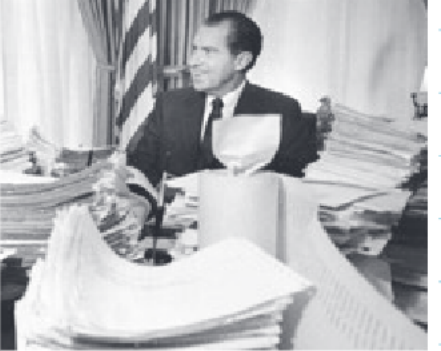
Nixon's strategy proved effective, as surveys revealed that 77% of Americans supported his Vietnam War plans. This widespread backing served several important purposes:
- Congress passed resolutions approving Nixon's approach to the conflict
- North Vietnam saw that the American president had strong domestic support, potentially helping negotiations
- Nixon could argue for an honourable exit from Vietnam that maintained American credibility
Example
The Impact of Nixon's "Silent Majority" Appeal
Nixon's November 3, 1969 speech demonstrated the power of political messaging:
Step 1: He identified a previously unrecognised group - Americans who supported the war but didn't protest publicly
Step 2: He gave them a voice and legitimacy by calling them the "great silent majority"
Step 3: The response was immediate - thousands of supportive telegrams poured in, and polls showed 77% approval
This strategy allowed Nixon to continue the war while claiming democratic mandate from the American people.
The president received thousands of supportive telegrams after his "silent majority" speech, demonstrating that many Americans endorsed his policies despite the vocal opposition from anti-war protesters.
Timeline of key events
- 1954: Eisenhower introduces the "falling domino" theory
- 1961: Kennedy warns about domino effect threats in inaugural address
- May 1970: Hard hat protesters clash with anti-war demonstrators
- November 3, 1969: Nixon delivers his "silent majority" speech
- 1969: Surveys show 77% of Americans support Nixon's Vietnam policies
Summary
Key Points to Remember:
- Fear drove support: Cold War anxieties about communist expansion made many Americans view Vietnam as essential for national security
- Patriotic duty mattered: Working-class "hard hats" and other supporters saw backing the war as their obligation to America
- Silent majority was real: Nixon successfully mobilised quiet supporters, with 77% of Americans backing his Vietnam approach
- Domino theory influenced policy: Presidents from Eisenhower to Nixon used fears of communist chain reactions to justify military involvement
- Support had consequences: Strong domestic backing helped Nixon continue the war and negotiate from a position of perceived strength