The peace process and end of war (Edexcel GCSE History): Revision Notes
📚Revision Notes
The peace process and end of war (1964-75)
The journey towards ending the Vietnam War was a complex and lengthy process that involved extensive negotiations between multiple parties. The peace talks began in Paris in 1968 and continued until 1973, ultimately resulting in the Paris Peace Agreement that formally ended American involvement in the conflict.
Why did all sides want peace?
By the late 1960s, all parties involved in the Vietnam conflict had compelling reasons to seek an end to the fighting. Each side faced mounting pressures that made continued warfare increasingly difficult to sustain.
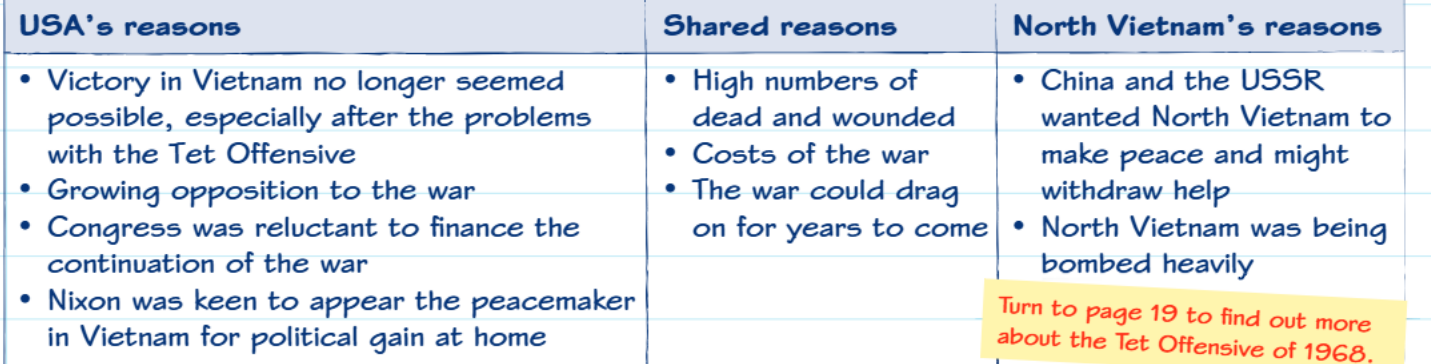
The United States found itself in an increasingly untenable position. Victory in Vietnam no longer seemed achievable, particularly after the devastating impact of the 1968 Tet Offensive, which demonstrated the resilience of North Vietnamese forces. At home, American public opposition to the war was growing rapidly, making it politically difficult to continue. Congress became increasingly reluctant to finance the ongoing conflict, while President Nixon saw an opportunity to appear as a peacemaker for domestic political gain.
Important
The Tet Offensive was a turning point that fundamentally changed American perceptions of the war. Despite being a military defeat for North Vietnam, it was a psychological victory that demonstrated the war was far from won.
North Vietnam also faced significant challenges that motivated peace talks. The sustained heavy bombing campaigns by American forces were taking a severe toll on the country's infrastructure and population. Additionally, their key allies, China and the USSR, were applying diplomatic pressure for North Vietnam to withdraw from the conflict and negotiate a peaceful resolution.
Both sides shared certain concerns that pushed them towards negotiations. The staggering number of casualties - both dead and wounded - was becoming unsustainable for all parties involved. There was also a recognition that the war could potentially drag on for many more years without a decisive outcome, leading to even greater losses.
Note
The diplomatic pressure from China and the USSR on North Vietnam reflected the broader Cold War context, where both superpowers were seeking to avoid direct confrontation while managing their proxy conflicts.
Key features of the peace negotiations
The negotiation process faced significant obstacles from the beginning. There were substantial barriers to reaching agreement between all the different parties involved, each with their own demands and red lines they were unwilling to cross.
President Nixon employed a dual approach to the negotiations. While official talks were taking place in Paris, he also conducted secret diplomatic discussions with North Vietnam behind the scenes. This allowed for more flexible negotiations away from public scrutiny.
A major breakthrough came in October 1972 when the USA and North Vietnam managed to present a preliminary agreement during the official Paris talks. However, this progress was derailed when South Vietnamese President Thieu refused to sign the agreement, effectively blocking its implementation.
Important
President Thieu's refusal to sign the October 1972 agreement was a critical moment that prolonged the war and led to additional casualties. His concerns about the agreement's terms ultimately proved justified when South Vietnam fell in 1975.
Nixon's response to this setback was to resume heavy bombing of North Vietnam in an attempt to force them back to the negotiating table. This strategy proved effective, and formal talks resumed in early January 1973.
The Paris Peace Agreement of 1973
On 27 January 1973, representatives from the USA, North Vietnam, South Vietnam, and the Provisional Revolutionary Government of Vietnam signed the Paris Peace Agreement, formally bringing an end to the war and establishing peace in Vietnam.
Key terms of the agreement
The agreement established several crucial provisions. All countries would recognise Vietnam as a single, unified country through independent negotiations, with no outside interference permitted. An immediate ceasefire would take effect across the region.
The United States committed to completely withdrawing all troops, equipment, and military advisers from Vietnam, while also removing all military bases. The agreement specifically prohibited any future US government intervention in Vietnamese politics or military affairs.
For the future governance of Vietnam, the agreement established that a new unified government would be elected under international supervision to ensure fairness and legitimacy. Finally, the United States pledged to provide aid to support reconstruction efforts across Vietnam.
Significance and consequences of the Paris Agreement
The Paris Peace Agreement provided the United States with a face-saving opportunity to withdraw from Vietnam after years of costly involvement. However, the long-term effectiveness of the agreement proved limited in securing lasting peace for an independent, non-communist South Vietnam.
The immediate aftermath of American withdrawal created serious problems for South Vietnam. The country's economy crashed due to poor harvests and a significant reduction in US aid and investment. This economic instability contributed to growing unpopularity of the South Vietnamese government among its own people.
Note
The economic collapse of South Vietnam after American withdrawal highlighted the country's heavy dependence on US support, which had masked underlying structural problems in the South Vietnamese economy and government.
The situation deteriorated further when the Vietcong regained popularity in village communities following the American withdrawal. North Vietnam, still committed to unification under communist rule, became increasingly impatient with President Thieu's refusal to engage in meaningful negotiations for peaceful reunification.
By late 1974, North Vietnam resumed military action against South Vietnam. The South Vietnamese ARVN (Army of the Republic of Vietnam) proved unable to defend against these attacks without American support. When Congress refused to approve funding for US intervention, South Vietnam's fate was sealed. The South Vietnamese capital, Saigon, fell to North Vietnamese forces in April 1975.
Important
The fall of Saigon just two years after the Paris Peace Agreement demonstrated that the treaty had only temporarily ended US involvement rather than achieving lasting peace in Vietnam.
The economic and human costs for the USA
The Vietnam War exacted an enormous toll on the United States, both financially and in human terms. The economic cost reached a staggering $167 billion, representing a massive drain on the US economy. This enormous expenditure led to significant cutbacks in federal spending on domestic programmes and contributed to various economic problems within the United States.
The human cost was equally devastating. More than 58,000 American soldiers lost their lives in the conflict, while another 75,000 were left with serious permanent disabilities. Perhaps even more concerning was the mental health impact: approximately 250,000 veterans suffered from severe psychological problems, including what we now recognise as post-traumatic stress disorder. The suicide rate among Vietnam War veterans was alarmingly high, highlighting the lasting trauma of the conflict.
Important
The psychological impact of the Vietnam War on veterans was initially poorly understood and inadequately addressed, leading to long-term consequences that affected not just the veterans themselves but their families and communities.
These costs had a profound impact on American society and contributed to a period of national reflexion about the country's role in international conflicts.
Timeline of key events
- 1968: Peace talks begin in Paris
- October 1972: USA and North Vietnam present preliminary agreement
- Late 1972: Nixon orders heavy bombing to restart negotiations
- Early January 1973: Formal talks resume
- 27 January 1973: Paris Peace Agreement signed
- 1973-1974: US withdrawal completed
- Late 1974: North Vietnam resumes combat with South Vietnam
- April 1975: Saigon falls to North Vietnamese forces
Summary
Key Points to Remember:
- The Paris Peace Agreement of 1973 formally ended US involvement in Vietnam but failed to secure lasting peace for South Vietnam
- All parties had strong motivations to end the war, including mounting casualties, economic costs, and political pressures
- The agreement allowed the US to withdraw with some dignity, but South Vietnam fell to North Vietnamese forces just two years later
- The war cost America $167 billion and resulted in over 58,000 deaths, with hundreds of thousands more suffering lasting physical and psychological damage
- The peace process demonstrated the limitations of military solutions to complex political conflicts and the challenges of negotiating lasting settlements in civil wars