US involvement in Vietnam, 1954-61 (Edexcel GCSE History): Revision Notes
📚Revision Notes
US involvement in Vietnam, 1954-61
Background to American involvement
The United States became increasingly involved in Vietnam during the 1950s following the end of French colonial rule. The conflict in Vietnam had been ongoing since 1946, when the Viet Minh, led by Ho Chi Minh, began fighting against French colonial forces. This struggle represented both a fight for independence and part of the broader Cold War conflict between communist and capitalist ideologies.
The turning point came in 1954 with the major battle at Dien Bien Phu, where Vietnamese forces decisively defeated the French. This defeat marked the end of French involvement in Vietnam and created a power vacuum that drew American attention. By this time, the US was already heavily invested, paying approximately 80% of the cost of France's war against the Viet Minh.
Note
The French defeat at Dien Bien Phu was significant not just militarily, but symbolically - it demonstrated that Western colonial powers could be defeated by determined independence movements, influencing anti-colonial struggles worldwide.
The Geneva Accords and division of Vietnam
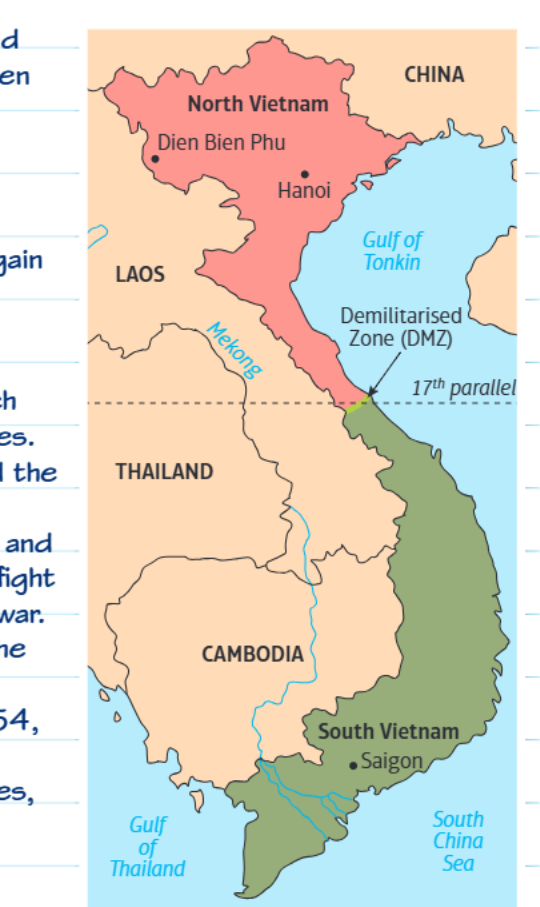
Following the French defeat, the Geneva Accords were signed in 1954, which fundamentally changed the political landscape of Vietnam. These agreements divided Vietnam into two separate countries along the 17th parallel, creating a demilitarised zone where no soldiers were permitted.
Important
The division of Vietnam at the 17th parallel was meant to be temporary, with reunification elections planned for 1956. However, these elections never took place, making the division permanent and setting the stage for future conflict.
The division created two distinct political entities. North Vietnam became the Democratic Republic of Vietnam, led by the communist leader Ho Chi Minh. South Vietnam became the State of Vietnam, initially led by the US-backed ruler Bao Dai. However, in 1955, Ngo Dinh Diem took over as president of South Vietnam, establishing a government that would prove crucial to American involvement.
Eisenhower and the domino theory
President Eisenhower's approach to Vietnam was heavily influenced by his belief in the "domino theory". This theory suggested that if one country in a region fell to communism, neighbouring countries would follow like falling dominoes. Eisenhower was particularly concerned that if Vietnam became communist, other Southeast Asian nations would inevitably follow the same path.
To prevent this spread of communism, Eisenhower established the Southeast Asia Treaty Organisation (SEATO) in September 1954. This military alliance included the USA, Britain, France, and five other countries, all committed to acting collectively to stop communist expansion in the region. The formation of SEATO demonstrated America's determination to contain communism in Southeast Asia, even if it meant avoiding direct military confrontation that could lead to nuclear war with China and the Soviet Union.
Note
The domino theory became a central justification for American foreign policy throughout the Cold War, influencing US involvement not just in Vietnam but in conflicts across the globe from Latin America to Africa.
Weaknesses of Diem's government
Despite American support, Ngo Dinh Diem's government in South Vietnam faced significant challenges that would ultimately draw the United States deeper into Vietnamese affairs. Diem's administration was widely regarded as corrupt and had little respect for the rural population, who made up the majority of South Vietnam's citizens. Additionally, religious tensions arose because South Vietnam was predominantly Buddhist, while Diem was Catholic.
Important
Key Problems with Diem's Rule:
- Government corruption alienated the population
- Religious discrimination against Buddhist majority
- Lack of genuine democratic reforms
- Failure to address land redistribution and rural poverty
These issues made Diem's government vulnerable to insurgency and reduced popular support for the US-backed regime.
These problems led to the emergence of various revolutionary groups opposed to Diem's rule. These groups became collectively known as the "Viet Cong" (VC), which was short for "Vietnamese Communists." The Viet Cong received backing and support from North Vietnam, creating what was effectively a civil war within South Vietnam.
Recognising the instability, Eisenhower provided military advisers to help train the South Vietnamese army, known as the Army of the Republic of Vietnam (ARVN), to fight against the Viet Cong. However, Eisenhower was careful not to send US troops into direct combat, as he wanted to avoid the risk of nuclear confrontation with China and the USSR.
Timeline of key events
- 1946: Conflict begins between France and the Viet Minh
- 1949: China becomes communist, increasing US concerns about Southeast Asia
- 1954:
- Battle of Dien Bien Phu results in French defeat
- Geneva Accords divide Vietnam at the 17th parallel
- SEATO established in September
- 1955: Ngo Dinh Diem becomes president of South Vietnam
- 1954-61: US provides increasing financial and military advisory support to South Vietnam
Example
Worked Example: Understanding the Domino Theory
Step 1: Identify the core concept The domino theory suggested that communist takeover in one country would lead to communist expansion in neighbouring countries.
Step 2: Apply to Vietnam context
- If North Vietnam (communist) united with South Vietnam
- Then Laos, Cambodia, Thailand, and other Southeast Asian nations might fall to communism
- This would threaten US strategic interests in the region
Step 3: Analyse the policy response This theory justified US support for South Vietnam as a way to prevent regional communist expansion, even without direct military involvement initially.
Summary
Key Points to Remember:
- The Geneva Accords of 1954 divided Vietnam into communist North and US-backed South along the 17th parallel following French defeat at Dien Bien Phu
- Eisenhower's domino theory drove US involvement - the fear that communist victory in Vietnam would cause neighbouring countries to fall to communism like dominoes
- SEATO was formed in 1954 as a military alliance to contain communist expansion in Southeast Asia, showing America's commitment to the region
- Diem's corrupt government in South Vietnam was unpopular, leading to the rise of the Viet Cong insurgency backed by North Vietnam
- By 1961, the US was providing military advisers to train South Vietnamese forces but avoided direct combat to prevent nuclear confrontation with China and the USSR