Hitler's rise to power, 1919-33 (Edexcel GCSE History): Revision Notes
📚Revision Notes
Hitler's rise to power: Growth in support, 1929-32
The economic crisis begins
The period from 1929 to 1932 marked a crucial turning point in Hitler's rise to power. During these years, the Nazi Party transformed from a relatively small extremist group into a major political force in Germany. This dramatic change was largely due to the economic crisis that began with the Wall Street Crash and the way Hitler cleverly exploited the resulting hardships.
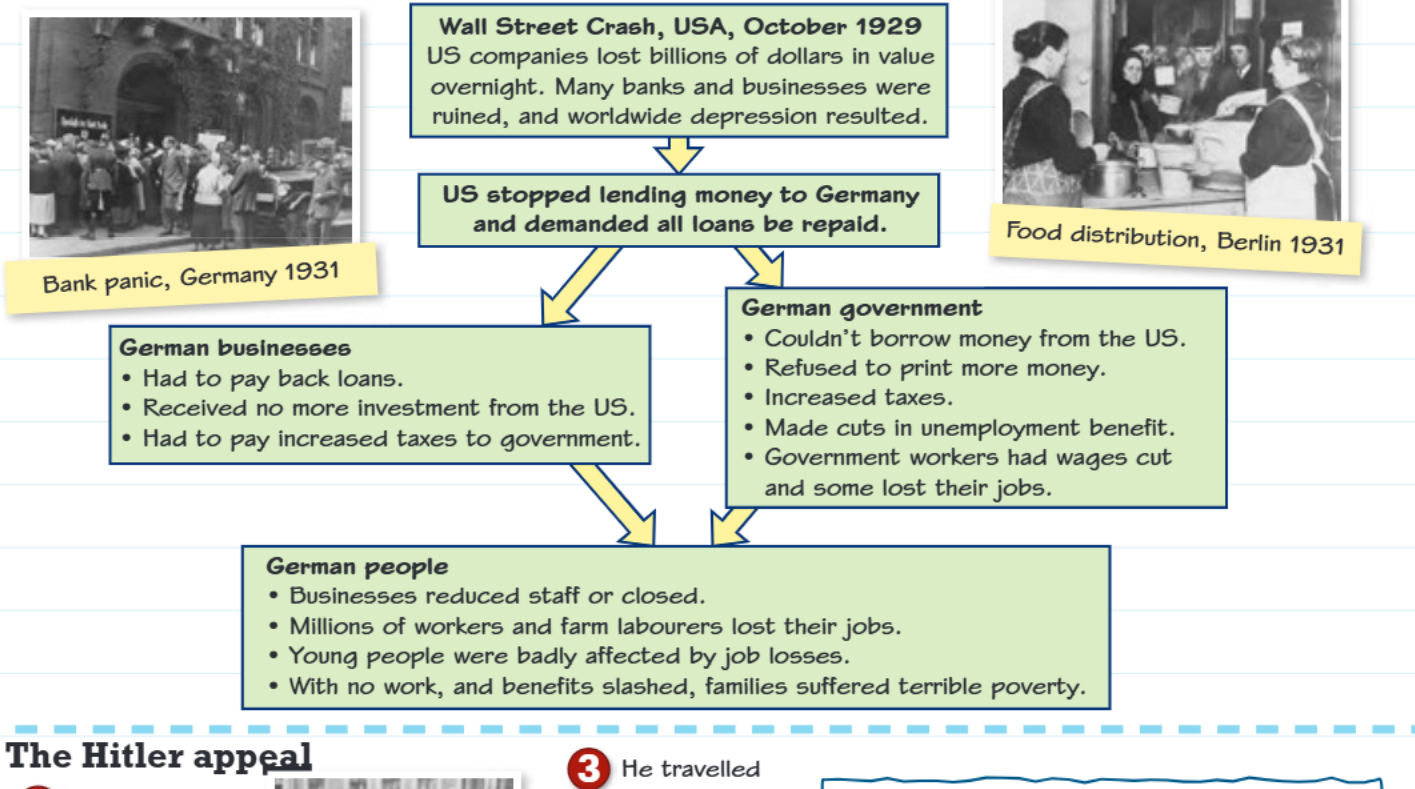
The Wall Street Crash in October 1929 had devastating consequences that reached far beyond America. US companies lost billions of dollars overnight, and many banks and businesses were ruined. This financial disaster quickly spread around the world, creating a global economic depression that hit Germany particularly hard.
Note
The timing of the Wall Street Crash was crucial for Hitler's political fortunes. Just as the Weimar Republic was beginning to stabilise in the mid-1920s, this external economic shock created the perfect conditions for extremist movements to exploit popular discontent.
The chain reaction effect on Germany
Important
The Economic Chain Reaction:
The crisis followed a devastating domino effect that destroyed German society layer by layer:
US Financial Collapse → Loan Recalls to Germany → German Business Failures → Government Austerity → Mass Unemployment → Popular Desperation
This chain reaction was crucial because it meant that Germany's economic problems were not just temporary difficulties, but a systematic collapse that affected every level of society.
German businesses found themselves in an impossible situation. They had to repay their loans to American lenders but received no new investment from the US. Many companies were forced to reduce their workforce or close entirely. At the same time, they had to pay increased taxes to the government, making their financial situation even worse.
The German government faced its own crisis. Unable to borrow money from the United States, officials refused to print more money (fearing hyperinflation like in 1923) and instead chose to raise taxes and make severe cuts to public spending. Government workers saw their wages reduced, and some lost their jobs completely. Most significantly, unemployment benefits were slashed just when they were needed most.
The impact on ordinary German people was severe. Millions of workers and farm labourers lost their jobs as businesses closed or reduced staff. Young people were particularly badly affected by job losses, and with unemployment benefits cut, families across Germany faced terrible poverty.
Hitler's strategic appeal
Hitler and the Nazi Party recognised this crisis as a golden opportunity to gain support. The economic hardships made people desperate for solutions, and Hitler presented himself as the strong leader Germany needed. His appeal strategy had four main elements:
Personal campaigning: Hitler travelled extensively around the country, making himself visible to ordinary Germans and showing that he cared about their problems. This personal approach helped him connect with voters who felt abandoned by traditional politicians.
Image management: His photograph appeared on most Nazi publicity material, creating a recognisable brand. This helped establish Hitler as the face of the movement and made him seem like a dynamic, modern leader.
Media savvy: Hitler embraced new communication methods, travelling around giving speeches and speaking on the radio. This allowed him to reach much larger audiences than traditional politicians and spread his message more effectively.
Modern technology: The Nazi Party adopted cutting-edge techniques for the time, including the use of aeroplanes for campaign travel. This gave them a technological advantage over their competitors and reinforced their image as a forward-thinking, modern movement.
Targeted propaganda campaigns
Example
Worked Example: Hitler's Targeted Propaganda Strategy
Rather than using a single message for everyone, Hitler's propaganda machine created specific appeals for different social groups:
Step 1: Identify the audience
- Business people, working class, middle class, rural communities, women, young people
Step 2: Tailor the message to their fears and needs
- Business people → Economic recovery and prosperity
- Working class → Jobs and food security
- Middle class → Protection from communists and traditional values
- Rural communities → Land protection from communist seizure
- Women → Family protection and national salvation
- Young people → Exciting movement and sense of purpose
Step 3: Deliver through appropriate channels
- Mass rallies, radio broadcasts, poster campaigns, personal appearances
This targeted approach was far more effective than the one-size-fits-all messages used by traditional political parties.
How the depression benefited extremist parties
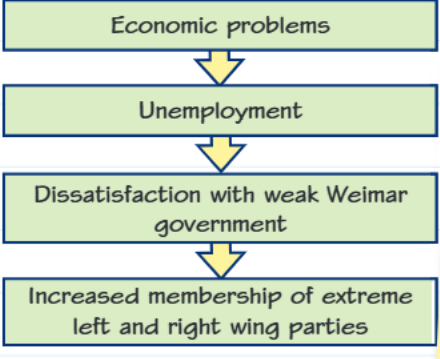
The economic crisis created perfect conditions for extremist political movements to grow. As unemployment rose and living standards fell, more Germans became dissatisfied with the weak Weimar government, which seemed unable to solve the country's problems.
Support for the Communist Party grew during this period, but the Nazi Party grew even faster. The Nazis benefited because they could appeal to a broader range of social groups than the Communists, who mainly attracted working-class supporters in cities. Hitler's party offered something for everyone and positioned itself as the defender against communist revolution.
Note
The intimidation tactics of the SA (stormtroopers) also played a crucial role during this period. These paramilitary groups used violence and threats to discourage people from supporting other parties, while presenting the Nazis as the only force strong enough to restore order to Germany.
Timeline of key events
- October 1929: Wall Street Crash occurs in the United States
- 1930: US stops lending money to Germany and demands loan repayments
- 1931: Bank panic in Germany, widespread business closures begin
- 1931: Food distribution centres established in cities like Berlin
- 1929-1932: Nazi Party membership and electoral support grows dramatically
Summary
Key Points to Remember:
- The Wall Street Crash in October 1929 triggered a global economic depression that hit Germany particularly hard due to its dependence on US loans
- The economic crisis created a devastating chain reaction: US financial problems → German business failures → government austerity measures → mass unemployment
- Hitler successfully exploited this crisis through strategic campaigning, targeted propaganda, and modern communication techniques
- The Nazis appealed to different social groups with tailored messages addressing their specific fears and concerns
- Economic hardship increased support for extremist parties, with the Nazis benefiting more than the Communists due to their broader appeal across social classes
- The period 1929-32 transformed the Nazi Party from a fringe movement into a major political force that threatened the stability of the Weimar Republic