Nazi education (Edexcel GCSE History): Revision Notes
📚Revision Notes
Nazi education
How the Nazis used education as a tool of control
The Nazi regime understood that controlling what children learned was crucial for creating the loyal citizens they needed for their future state. Education became another powerful weapon in their campaign to shape German society according to their ideology, ensuring that young people would grow up completely devoted to Nazi ideas and prepared for their predetermined roles.
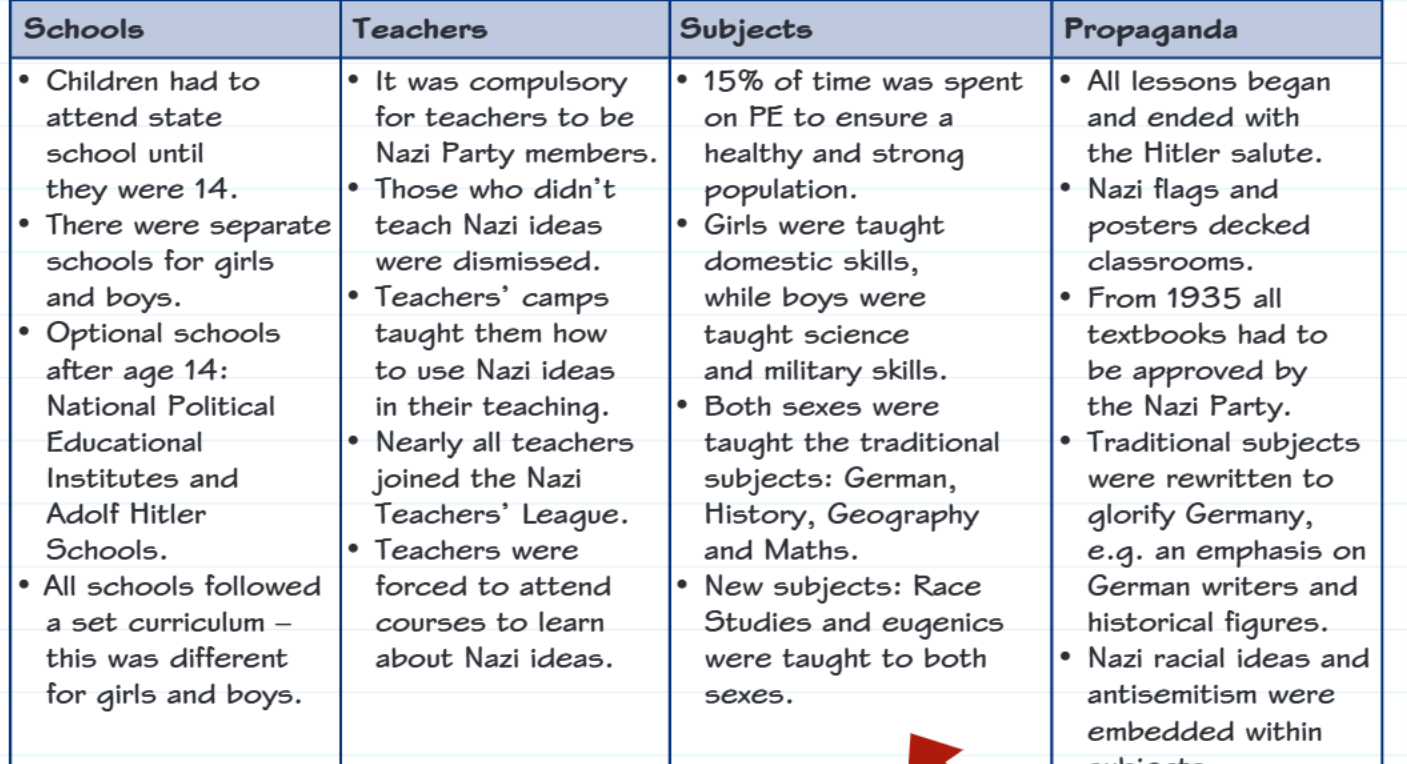
Control of schools
The Nazi government transformed the entire school system to serve their political goals. They made attendance at state schools compulsory for all children until the age of 14, ensuring no child could escape their influence. The regime also introduced gender segregation, creating separate schools for boys and girls to prepare them for their different expected roles in Nazi society.
Note
The Nazi regime established special elite institutions specifically to train future leaders. The National Political Educational Institutes and Adolf Hitler Schools selected children who showed the greatest potential for advancing the party's cause, providing intensive political indoctrination alongside academic subjects.
Every school in Germany had to follow the same Nazi-approved curriculum, creating a unified system of indoctrination. This standardisation meant that regardless of where children lived, they would all receive the same political messages and ideological training.
Control of teachers
The Nazi regime recognised that teachers were the key to successful indoctrination, so they implemented strict controls over the teaching profession. All teachers were required to become members of the Nazi Party, and those who refused to promote Nazi ideas in their classrooms faced immediate dismissal from their positions.
Important
Teachers who refused to join the Nazi Party or promote Nazi ideology in their classrooms faced immediate dismissal. This created a climate of fear and forced compliance throughout the education system, ensuring that educators became active participants in the indoctrination process.
To ensure teachers fully understood and could effectively communicate Nazi ideology, the regime established special training camps. These camps taught educators how to incorporate Nazi ideas into every aspect of their teaching, from traditional subjects to new ideological content.
The creation of the Nazi Teachers' League further strengthened party control over education. Nearly every teacher in Germany joined this organisation, which provided ongoing training and ensured that educators remained committed to Nazi principles. Teachers were also forced to attend additional courses specifically designed to deepen their understanding of Nazi ideology.
Transformation of subjects
The Nazi regime completely restructured what students learned, dramatically increasing the emphasis on physical education to 15% of total class time. This focus aimed to create a "healthy and strong population" that could serve the state effectively, particularly in military roles.
Note
Gender played a crucial role in determining curriculum content. Girls received instruction in domestic skills, preparing them for their future roles as wives and mothers who would raise the next generation of Germans. Boys, meanwhile, learned science and military skills to prepare them for careers as soldiers and leaders in the Nazi state.
Traditional subjects like German, History, Geography, and Mathematics continued to be taught, but their content was completely rewritten. These subjects now served to glorify Germany's achievements and promote Nazi interpretations of historical events and cultural values.
Two entirely new subjects appeared in Nazi schools: Race Studies and eugenics. Race Studies taught children to classify different ethnic groups according to Nazi racial theory, particularly emphasising the supposed superiority of the 'Aryan race.' Eugenics promoted the scientifically unsupported belief that controlled breeding could create superior human beings, supporting Nazi policies of persecution and genocide.
Important
The introduction of Race Studies and eugenics as mandatory subjects represented one of the most dangerous aspects of Nazi education. These pseudoscientific subjects were designed to normalise racist thinking and prepare children to accept and participate in the regime's policies of discrimination and genocide.
Propaganda in education
Every aspect of school life became saturated with Nazi propaganda and symbolism. Each school day began and ended with students performing the Hitler salute, creating a ritual that reinforced their loyalty to the regime and its leader.
Nazi flags and posters decorated every classroom, creating a constant visual reminder of party ideology and ensuring students could not escape political messages even during academic lessons.
From 1935 onwards, all textbooks required approval from the Nazi Party before they could be used in schools. This censorship ensured that every piece of written material students encountered supported Nazi viewpoints and contained no challenging or alternative perspectives.
Note
The propaganda efforts were so comprehensive that even traditional academic subjects were rewritten to serve political purposes. Nazi racial ideas and antisemitic content were woven into seemingly neutral subjects, making political indoctrination appear to be objective education.
The ultimate goals of Nazi education
The Nazi education system had clear and specific aims that reflected the regime's vision for German society. For girls, the primary goal was preparation for domestic roles as devoted wives and mothers who would raise loyal Nazi children and maintain traditional German households.
Boys were being groomed to become strong soldiers who would fight for Germany in future conflicts. Their education emphasised physical strength, military skills, and unquestioning obedience to authority.
Both boys and girls were taught to become completely loyal to the Nazi Party and its ideology, ensuring they would never question or challenge the regime's authority. The system aimed to create citizens who would automatically support all Nazi policies and actions.
Important
The Nazi education system was designed to create a generation that would never question authority or think critically about government policies. By controlling education from an early age, the regime sought to eliminate independent thinking and create automatic compliance with Nazi ideology.
Education also served to glorify Germany and the Nazi Party, teaching children that their nation and its leadership were superior to all others. This nationalism was combined with the promotion of Nazi racial beliefs, ensuring that students accepted theories about racial hierarchy and the supposed superiority of the German people.
Timeline of key developments
Note
Key Timeline of Nazi Education Control:
- 1933: Nazis come to power and begin transforming education system
- 1933: Teachers required to join Nazi Party
- 1935: All textbooks must receive Nazi approval
- 1935-1939: Race Studies and eugenics become mandatory subjects
- 1939: Education system fully aligned with Nazi ideology
Remember!
Summary
Key Points to Remember:
- Education became a powerful tool for Nazi indoctrination, controlling every aspect of children's learning from schools and teachers to subjects and propaganda
- The regime enforced strict gender segregation in education, preparing girls for domestic roles and boys for military service
- All teachers had to join the Nazi Party and attend special training camps to learn how to promote Nazi ideology effectively
- Traditional subjects were completely rewritten to glorify Germany and promote antisemitic ideas, while new subjects like Race Studies taught Nazi racial theories
- The ultimate goal was creating completely loyal citizens who would never question Nazi authority and would fulfil their predetermined roles in the Nazi state