Policies to reduce unemployment (Edexcel GCSE History): Revision Notes
📚Revision Notes
Policies to reduce unemployment
Hitler's motivations for tackling unemployment
When Hitler came to power in 1933, Germany faced severe economic challenges with millions of people out of work. Reducing unemployment became a key priority for the Nazi regime, but Hitler's motivations went beyond simply helping people find jobs.
Note
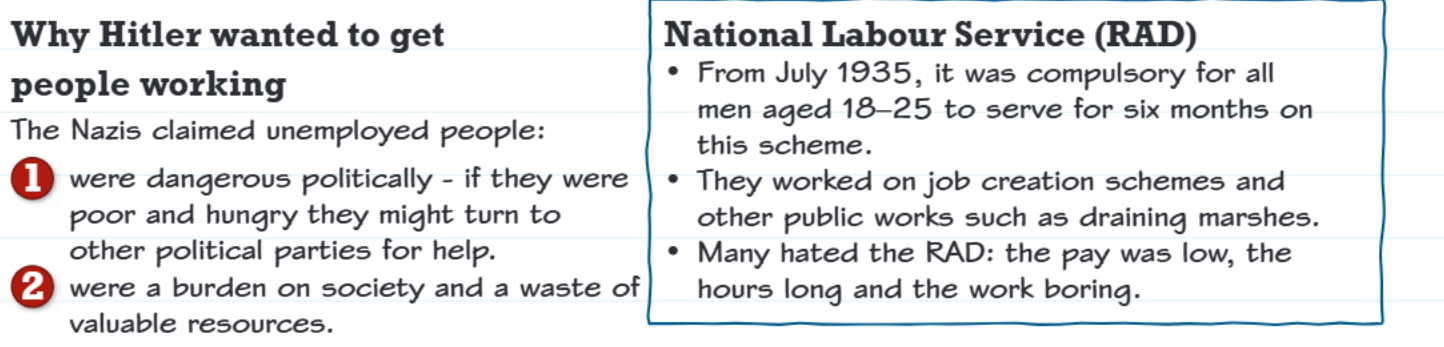
The Nazi leadership viewed unemployment as a serious threat to their control and Germany's stability. They believed that people without work posed political dangers because hungry, desperate citizens might turn to opposition parties or communist groups for support. This fear drove Hitler to act quickly to get people back into employment.
Additionally, the Nazis saw unemployed people as an economic burden on German society. They argued that people not contributing to the workforce were wasting valuable national resources that could be better used to strengthen Germany. This perspective aligned with Nazi ideology about everyone having a role to serve the state.
The National Labour Service (RAD)
One of the most significant employment schemes introduced by the Nazis was the Reichsarbeitsdienst, or National Labour Service. This programme became compulsory in July 1935, requiring all German men between the ages of 18 and 25 to serve for six months.
Note
Key Features of the RAD:
The RAD focused on public works projects that aimed to improve Germany's infrastructure and countryside. Participants worked on job creation schemes such as draining marshes, building roads, and constructing public buildings. These projects served multiple purposes: they provided employment, improved the country's infrastructure, and gave the Nazi regime visible achievements to showcase.
Important
The Reality for Participants
However, the RAD was far from popular among those forced to participate. The work was physically demanding and often monotonous, with participants receiving very low wages for extremely long working hours. Many young men resented being compelled to work on these projects rather than pursuing their own career goals or education.
Infrastructure development - the autobahns
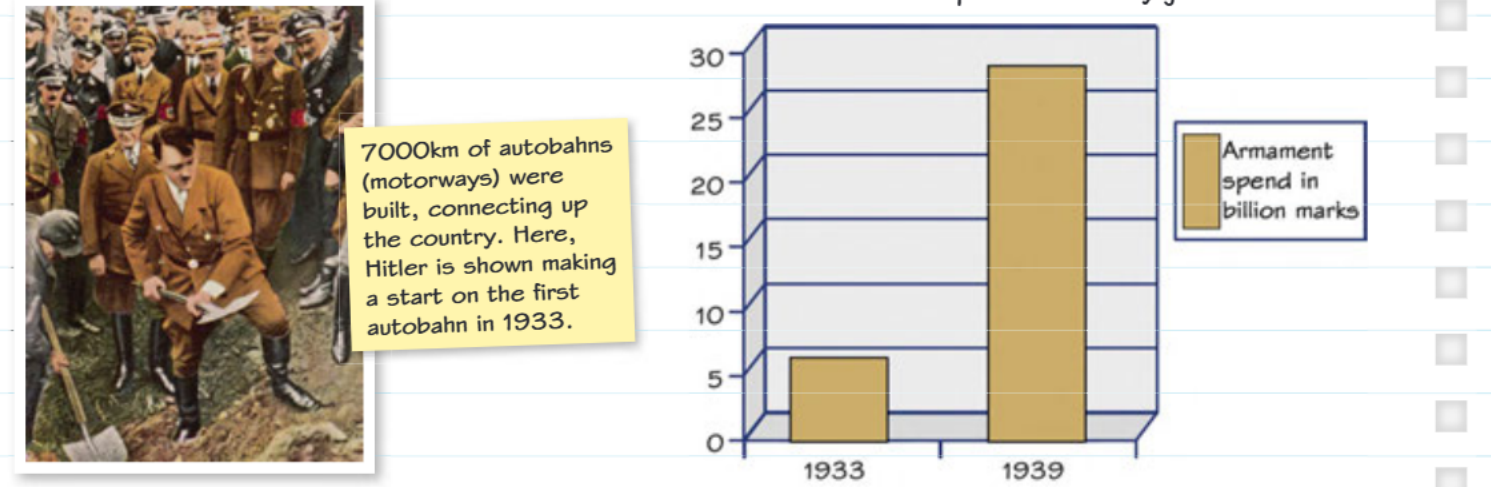
The construction of Germany's motorway system, known as autobahns, became one of the most famous Nazi employment initiatives. This massive infrastructure project involved building 7,000 kilometres of high-quality roads connecting cities across the country.
The autobahn construction served several purposes for the Nazi regime. Economically, it provided thousands of jobs for unemployed workers, from engineers and planners to manual labourers and suppliers. Politically, it demonstrated Nazi efficiency and vision for Germany's future. The project also had potential military benefits, as these roads could facilitate rapid movement of troops and equipment across the country.
Hitler himself participated in ceremonial groundbreaking events, such as the start of the first autobahn in 1933, using these occasions for propaganda purposes to show his personal involvement in Germany's economic recovery.
Rearmament programmes
Despite the restrictions imposed by the Treaty of Versailles, the Nazi regime secretly began rearming Germany from 1933 onwards. This military buildup provided another significant source of employment while serving Hitler's broader political and military goals.
Note
The Scale of German Rearmament
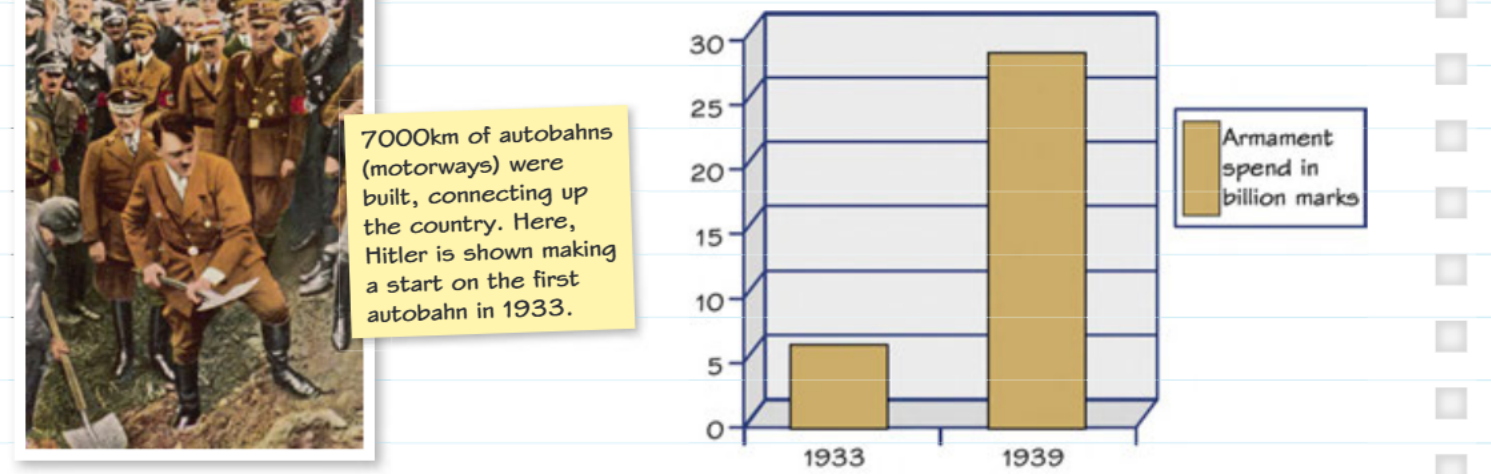
The scale of German rearmament was enormous, with spending on weapons and military equipment increasing dramatically throughout the 1930s. Starting from approximately , armament expenditure soared to nearly . This massive investment created jobs in munitions factories, aircraft production, shipbuilding, and related industries.
The rearmament programme not only reduced unemployment but also prepared Germany for the aggressive foreign policy Hitler planned to pursue. Workers in these industries often received better wages than those in other employment schemes, making these positions highly sought after.
The reality of "invisible unemployment"
While Nazi propaganda celebrated dramatic improvements in employment figures, the reality was more complex due to what historians call "invisible unemployment". The official statistics showed unemployment falling from to just , which appeared to be an amazing achievement.
Important
The Hidden Truth Behind the Statistics
However, these figures deliberately excluded several groups from the unemployment statistics:
- Jewish people were systematically banned from many professions and forced out of jobs, but they weren't counted as unemployed
- Women were encouraged or forced to leave their careers to focus on domestic roles, and they too disappeared from unemployment figures
- Unmarried men under 25 who were doing National Labour Service were not counted as unemployed, even though they weren't in regular paid employment
- Political opponents of the Nazi regime who were sent to concentration camps were removed from unemployment statistics entirely
This created a misleading picture of Nazi success in solving Germany's economic problems.
Timeline of key developments
- 1933: Hitler comes to power; autobahn construction begins; initial rearmament starts secretly
- July 1935: National Labour Service becomes compulsory for all men aged 18-25
- 1933-1939: Official unemployment falls from 4.8 million to 0.3 million
- 1939: Armament spending reaches 30 billion marks, up from 7 billion in 1933
Who benefited and who didn't
The Nazi employment policies created a mixed impact across German society. Young men in the RAD gained work experience but received poor pay and working conditions. Those employed in autobahn construction and rearmament industries generally received better wages and more stable employment.
However, certain groups were deliberately excluded from these benefits. Jewish Germans faced increasing discrimination and job losses. Women were pushed out of careers to make way for male workers. Political opponents found themselves imprisoned rather than employed. These exclusions helped create the illusion of Nazi success while hiding the true cost of their policies.
Summary
Key Points to Remember:
- Hitler reduced unemployment primarily because he saw jobless people as politically dangerous and economically wasteful
- The RAD (National Labour Service) forced young men into six months of compulsory public works from July 1935
- Major infrastructure projects like 7,000km of autobahns and massive rearmament programmes created thousands of jobs
- Official unemployment fell from 4.8 million (1933) to 0.3 million (1939), but this excluded many groups through "invisible unemployment"
- While some Germans benefited from improved employment opportunities, Jewish people, women, and political opponents were systematically excluded from the workforce