Women and the family (Edexcel GCSE History): Revision Notes
📚Revision Notes
Women and the family in Nazi Germany
Nazi transformation of women's roles
The Nazi Party held very strong and specific views about the role and position of women in German society. Once they gained control of Germany in 1933, they quickly introduced a series of policies that dramatically affected women's lives in numerous ways. These changes represented a complete reversal from the freedoms many women had experienced during the Weimar Republic period.
Note
During the Weimar Republic (1919-1933), many German women had gained unprecedented freedoms in careers, politics, and personal expression. They could vote, work in professional jobs, and enjoy greater social independence - freedoms that the Nazis systematically sought to eliminate.
The Nazi approach to women was rooted in their broader racial ideology and their vision of creating a strong, militarised German state. They believed that women had a fundamental biological destiny that should determine their entire social role, and they used both propaganda and legal measures to enforce this vision.
The Nazi ideal of womanhood
The Nazis promoted a very specific image of what they considered the perfect German woman and mother. This idealised vision emphasised traditional, domestic roles and specific physical characteristics that aligned with their racial theories.
Important
The Nazi concept of ideal womanhood was central to their entire social and racial programme. Understanding this ideology is essential to comprehending how Nazi policies affected millions of German women.
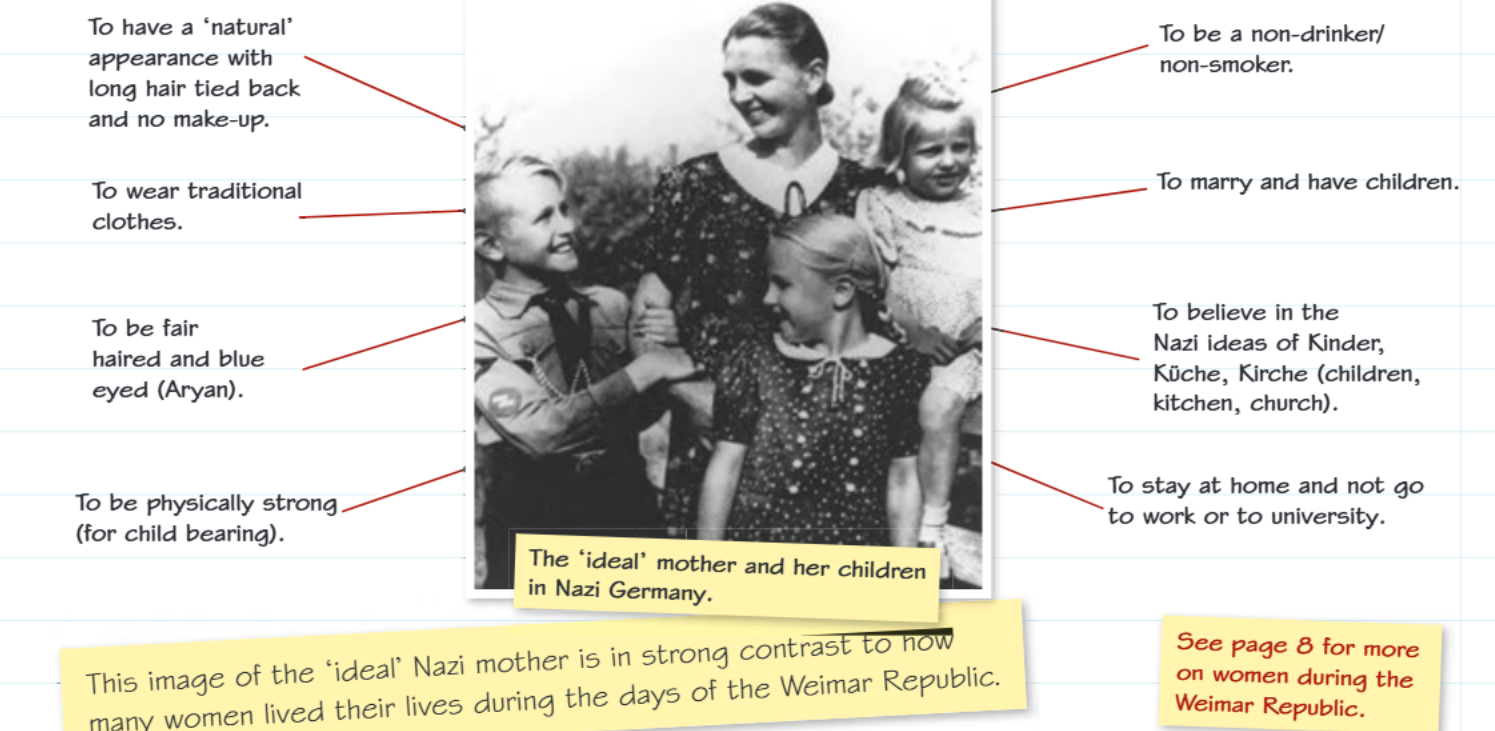
According to Nazi ideology, the ideal German woman should embody both physical and behavioural characteristics that served the state's goals. Physically, they expected women to have fair hair and blue eyes, representing what they called "Aryan" racial purity. Women were encouraged to maintain a natural appearance with long hair tied back and to avoid using makeup, which the Nazis viewed as artificial and inappropriate.
The ideal Nazi woman was also expected to be physically strong, as this was considered essential for bearing children effectively. This emphasis on physical fitness was directly connected to their expectations about women's reproductive role in building the German population.
Behaviorally, Nazi women were expected to abstain from drinking alcohol and smoking, as these habits were seen as harmful to their reproductive capacity and inconsistent with their maternal duties. Most importantly, they were expected to embrace the principle of "Kinder, Küche, Kirche" - children, kitchen, and church - which summarised the Nazi vision of women's proper sphere of activity.
This idealised image stood in sharp contrast to how many women had lived during the Weimar Republic, when they had gained greater freedoms in terms of careers, lifestyle choices, and personal expression.
Key Nazi policies affecting women
Employment and professional restrictions
The Nazi government implemented immediate changes to women's participation in the workforce. They believed that women should not work outside the home, particularly those who were married. Women were systematically banned from key professions, and many lost their existing jobs as they were replaced by men.
This policy was part of the Nazi effort to reduce male unemployment while also pushing women back into domestic roles. During the period from 1933 to 1936, the number of employed married women fell significantly as these restrictions took effect. However, the policy was not entirely consistent, as some married women were later allowed to work to support the growing industrial needs of the expanding German economy.
Marriage incentives and the Marriage Law of 1933
The Nazi government introduced the Marriage Law of 1933, which established a system of financial incentives designed to encourage marriage and childbearing. This law created "Marriage Loans" - vouchers that were given to newly married couples, but only if the woman agreed to stop working.
Example
Worked Example: How Marriage Loans Functioned
A newly married couple in 1933 could receive a Marriage Loan worth 1000 Reichsmarks, but only if:
- The wife agreed to stop working
- They could demonstrate "Aryan" racial characteristics
For each child they had:
- 1st child: of loan forgiven (250 RM)
- 2nd child: Another forgiven (250 RM)
- 3rd child: Another forgiven (250 RM)
- 4th child: Final forgiven (250 RM)
Result: Four children = entire loan forgiven
The loan system was cleverly designed to promote large families. For each child a couple had, they could have one-quarter of their Marriage Loan repayments cancelled. This meant that couples who had four children could effectively have their entire loan forgiven, creating a strong economic incentive for large families.
Promoting motherhood and large families
The Nazi government actively promoted the idea that women should have at least four children each. This policy was driven by their desire to increase the German population for both military and racial reasons. They wanted to ensure a steady supply of future soldiers while also increasing the number of people they considered racially superior.
The German Women's Enterprise
To spread their ideas about women's roles throughout German society, the Nazis established the German Women's Enterprise. This organisation became enormously influential, eventually growing to include six million members. The Enterprise ran classes and radio programmes focused on home-based matters, teaching women domestic skills and reinforcing Nazi ideologies about family life and women's roles.
Note
The German Women's Enterprise was one of the largest women's organisations in Nazi Germany, demonstrating how effectively the regime mobilised women to support their own subordination through organised propaganda activities.
The organisation served as both an educational tool and a means of social control, ensuring that Nazi ideas about women reached into homes across Germany and became part of daily life for millions of women.
Effects and consequences of Nazi policies
Economic and employment impacts
The immediate effect of Nazi employment policies was a significant reduction in the number of married women in the workforce between 1933 and 1936. Many women lost professional careers they had built during the Weimar period and were forced to depend economically on their husbands or families.
However, these policies created some contradictions. As Germany's economy expanded and the country began preparing for war, there was increased demand for workers. This led to some relaxation of the employment restrictions, allowing some married women to return to work to support growing industries.
Marriage and birth rate changes
The Marriage Loan system did succeed in increasing the number of marriages in Germany, though historians debate whether this was primarily due to Nazi policies or to other factors such as economic recovery. The financial incentives certainly made marriage more attractive to young couples who might otherwise have struggled economically.
The birth rate also increased during this period, but again, this may have been influenced by improving economic conditions rather than solely by Nazi family policies. Despite the government's encouragement and financial incentives, few women actually had more than two children, falling short of the Nazi goal of four children per family.
Important
Despite extensive propaganda and financial incentives, most German women did not achieve the Nazi ideal of having four or more children. This represents a significant limitation in the effectiveness of Nazi family policies.
Social and cultural transformation
Perhaps the most significant long-term effect was the cultural transformation in how German society viewed women's roles. The German Women's Enterprise, with its six million members, succeeded in spreading Nazi ideas about women throughout German society. These ideas became deeply embedded in many communities and families.
The contrast with the Weimar period was stark. During the 1920s, many German women had experienced unprecedented freedoms in terms of careers, personal expression, and lifestyle choices. The Nazi period represented a deliberate attempt to reverse these gains and return women to traditional domestic roles.
Timeline of key developments
1933: Marriage Law introduced with voucher system for newlyweds; employment restrictions on married women begin to take effect
1933-1936: Period of most significant decline in married women's employment; Marriage Loan system implemented with child-based repayment reductions
1936 onwards: Some relaxation of employment restrictions as economic demands increase; German Women's Enterprise reaches peak membership and influence
Summary
Key Points to Remember:
-
Nazi ideology centred on "Kinder, Küche, Kirche" - children, kitchen, church - defining women's roles as purely domestic and reproductive
-
Marriage Loans provided economic incentives for traditional family structures, with loan repayments reduced by 25% for each child born
-
Employment restrictions forced many women out of professional careers between 1933-1936, though some were later allowed to return as economic needs grew
-
The German Women's Enterprise reached six million members and served as the main tool for spreading Nazi ideas about women's roles throughout society
-
Nazi policies represented a deliberate reversal of the freedoms and opportunities many women had gained during the Weimar Republic period