A police state (Edexcel GCSE History): Revision Notes
📚Revision Notes
Nazi control and dictatorship: A police state
What was a police state?
A police state occurs when a government uses its police forces to monitor and control every aspect of citizens' lives. The Nazi regime established this system in Germany between 1933-39, using fear as their primary tool of control. The Nazis created a society where anyone could vanish without warning - people could be arrested, imprisoned, or sent to concentration camps simply for being viewed as suspicious by the authorities.
Note
The concept of a police state represents a complete breakdown of civil liberties and legal protections. In Nazi Germany, this meant that traditional legal rights and constitutional protections no longer applied to ordinary citizens.
Nazi policing forces
Hitler understood that Germany's existing police force might not fully support his radical agenda, so he created his own security organisations that answered directly to the Nazi Party rather than the German government. These forces operated using fear as their main strategy to maintain control over the population.
The SS (Protection Squad)
The SS began as Hitler's personal security detail in 1925 but grew into a massive organisation that controlled Germany's entire police and security system. Under Heinrich Himmler's leadership, the SS became one of the most feared organisations in Nazi Germany.
Key features of the SS included:
- Members wore distinctive black uniforms that made them easily recognisable
- They operated completely outside German law, meaning they could arrest, torture, or kill without legal consequences
- SS members had to marry only "racially pure" wives according to Nazi ideology
- They managed and operated the concentration camp system
- By the mid-1930s, they controlled all of Germany's police forces
Important
The SS operated completely outside German law, giving them unlimited power over citizens. This meant they could arrest, torture, or kill anyone without facing legal consequences - a fundamental characteristic of the Nazi police state.
The Gestapo (Secret State Police)
Hermann Goering established the Gestapo in 1933 as Nazi Germany's secret police force. Unlike regular police, the Gestapo operated in secrecy and used informants throughout German society.
The Gestapo's methods included:
- Wearing plain clothes to blend in with ordinary citizens
- Using a network of informants to spy on neighbours, colleagues, and even family members
- Arresting people for speaking against the Nazi regime
- Using torture during interrogations
- Sending prisoners to concentration camps without trial
- Operating under SS control from 1934 onwards
Important
The informant network meant that Germans could never be certain who was watching them. Neighbours, work colleagues, and even family members might report "suspicious" behaviour to the authorities. This created an atmosphere of constant fear and suspicion throughout German society.
Control of the legal system
Hitler systematically dismantled Germany's independent legal system to ensure that courts would always support Nazi policies. This meant that anyone opposing the regime could not expect fair treatment from the justice system.
Control of judges
The Nazi regime required all judges to join the National Socialist League for the Maintenance of the Law, effectively making them Nazi Party members. Furthermore, judges received clear instructions to favour the Nazi Party in all their legal decisions, destroying any pretence of judicial independence.
Changes to court procedures
Hitler made fundamental changes to how German courts operated:
- He eliminated trial by jury, meaning only judges decided guilt or innocence
- He created the People's Court specifically for treason cases
- Trials in the People's Court were conducted in secret with handpicked judges
- These courts almost always delivered guilty verdicts for anyone accused of opposing the Nazi regime
Important
The destruction of judicial independence meant that the legal system became a tool of Nazi oppression rather than justice. The People's Court, in particular, was designed to eliminate political opponents through show trials with predetermined outcomes.
Early concentration camps (1933-1939)
The concentration camp system began immediately after the Nazis gained power, initially to imprison political opponents and groups the Nazis considered "undesirable."
Dachau: The first concentration camp
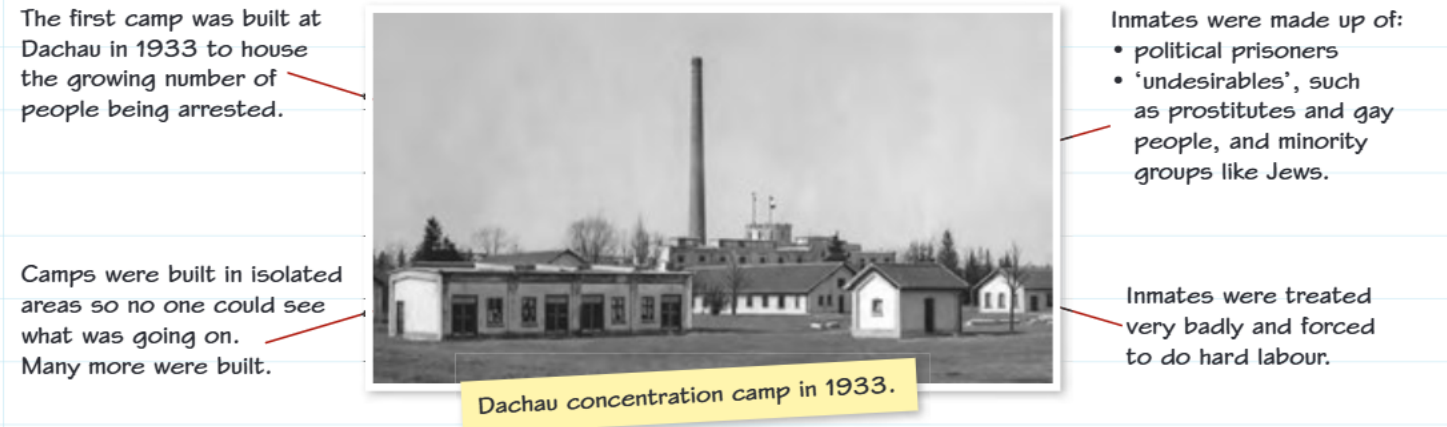
Dachau opened in 1933 as the first Nazi concentration camp, serving as a model for camps built later across Germany and occupied territories. The camp housed various groups of prisoners including political opponents, minority groups, and others persecuted by the Nazi regime.
Example
Dachau as the Blueprint
Dachau became the template for all future Nazi concentration camps:
- Location: Built 16 kilometres from Munich in an isolated area
- Initial purpose: Housing political prisoners and "undesirables"
- Expansion: Grew from holding hundreds to thousands of prisoners
- Model system: Training ground for SS guards and camp procedures used elsewhere
Camp conditions and purpose
These early camps served multiple purposes:
- Imprisoning political prisoners who opposed Nazi rule
- Holding "undesirable" groups including Jewish people, Roma, and other minorities
- Providing forced labour for Nazi projects
- Terrorising the German population through fear of imprisonment
- Camps were deliberately built in isolated locations to prevent outside observation
- Prisoners endured extremely harsh treatment, inadequate food, and brutal working conditions
Note
The early concentration camps (1933-1939) were primarily designed for political control and intimidation. This was before the systematic extermination programmes that would characterise the later death camps during World War II.
Timeline of key events
- 1925: SS established as Hitler's personal bodyguard
- 1933: Gestapo created by Hermann Goering; Dachau concentration camp opens
- 1934: Gestapo placed under SS control; Heinrich Himmler leads both organisations
- 1933-1939: Concentration camp system expands across Germany
Summary
Key Points to Remember:
- A police state uses fear and surveillance to control citizens' daily lives
- The SS and Gestapo operated outside German law, giving them unlimited power to arrest and punish
- Hitler destroyed judicial independence by controlling judges and creating special Nazi courts
- Dachau, opened in 1933, became the template for the entire concentration camp system
- These early years established the foundation for the systematic persecution that would intensify during World War II