Propaganda and censorship (Edexcel GCSE History): Revision Notes
📚Revision Notes
Nazi control of the churches, 1933-39
Why the Nazis wanted to control the churches
The Nazi regime sought complete loyalty to Hitler and his ideology from all German citizens. Both the Catholic and Protestant Churches represented a significant threat to Nazi power because they commanded the allegiance of millions of Germans and promoted values that directly conflicted with Nazi beliefs. Rather than immediately attacking the churches, Hitler initially tried to bring them under his control through a combination of cooperation agreements and the creation of pro-Nazi church organisations.
Note
The churches posed a unique challenge to Nazi control because they offered an alternative source of authority and moral guidance that could potentially unite opposition to the regime.
The fundamental clash: Nazi beliefs versus Christian beliefs
The core problem facing the Nazi regime was that Christian teachings directly contradicted Nazi ideology in almost every important area.

Important
This fundamental ideological conflict meant that truly committed Christians could never fully accept Nazi doctrine, creating an ongoing tension that the regime had to address through various strategies of control and suppression.
Nazi strategy with the Catholic Church
Hitler was particularly concerned about the Catholic Church's potential opposition because Catholics traditionally showed strong loyalty to the Pope in Rome and had historically supported the Catholic Centre Party, which opposed Nazi policies.
The Concordat of July 1933
To neutralise Catholic opposition, Hitler negotiated an agreement called the Concordat with Pope Pius XI in July 1933. Under this deal, the Catholic Church would be allowed to continue worship services and operate their own schools, while in return Catholics would stay out of political activities and not oppose the Nazi government.
Hitler breaks his promises
Despite signing the Concordat, Hitler quickly began violating its terms. The Nazi regime systematically harassed and persecuted Catholic priests who spoke out against Nazi policies, with many being sent to concentration camps. Catholic schools were forced to remove Christian symbols and were eventually closed down entirely. Catholic youth organisations, which had been promised protection under the Concordat, were banned and replaced with Nazi youth groups.
Important
The systematic breaking of the Concordat's terms demonstrated Hitler's typical strategy of using agreements to gain initial compliance before moving to direct persecution.
Papal response: "With Burning Anxiety" (1937)
By 1937, Pope Pius XI could no longer ignore Hitler's broken promises. He issued a statement called "With Burning Anxiety" which directly criticised Nazi policies and condemned the regime's treatment of Catholics. This marked the end of any pretence of cooperation between the Catholic Church and the Nazi state.
The Protestant Church splits in two
The Protestant Church in Germany faced a different challenge because it lacked the international leadership of Catholicism. During the 1930s, German Protestantism divided into two opposing camps.
The Reich Church (pro-Nazi)
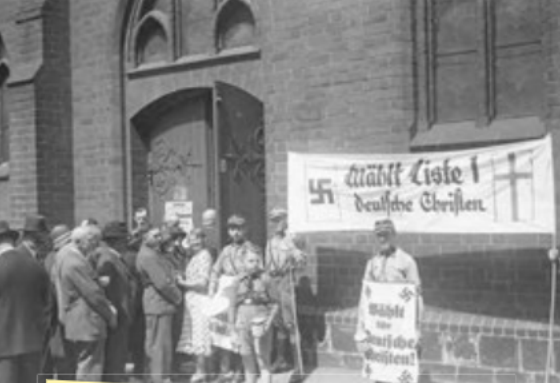
The Reich Church was established in 1933 as a Nazi-supporting religious organisation. It brought together approximately 2,000 Protestant churches under the leadership of Ludwig Müller, who had Hitler's backing. Members of the Reich Church wore Nazi uniforms and called themselves "German Christians." They attempted to merge Christian worship with Nazi ideology, removing Jewish influences from Christianity and promoting Aryan racial superiority as compatible with their faith.
Example
Example of Reich Church Practices:
The Reich Church attempted to "Nazify" Christianity by:
- Removing the Old Testament (Jewish origins)
- Portraying Jesus as an Aryan warrior rather than a Jewish teacher
- Incorporating Nazi symbols and uniforms into worship services
- Teaching that racial purity was a Christian duty
The Confessing Church (anti-Nazi)
In direct response to the Reich Church, opposing Protestant leaders formed the Confessing Church in 1934. This organisation represented about 6,000 Protestant churches and was led by Martin Niemöller, a pastor who courageously spoke out against Nazi policies. The Confessing Church maintained traditional Christian teachings and refused to accept Nazi racial theories or the worship of Hitler as a leader figure.
Important
The Confessing Church faced severe persecution from the Nazi regime, with many of its leaders, including Niemöller himself, being arrested and sent to concentration camps.
Hitler's long-term strategy
Hitler's approach to controlling the churches followed his typical pattern of initially seeking cooperation before moving to direct confrontation. His ultimate goal was to completely replace traditional Christianity with a Nazi-based religion that would worship the state and the Führer instead of God. However, he recognised that openly attacking such deeply held beliefs too quickly might provoke widespread resistance, so he attempted to gradually weaken church influence while building up alternative Nazi organisations.
Timeline of key events
- 1933: Hitler signs the Concordat with the Catholic Church; Reich Church established under Ludwig Müller
- 1934: Confessing Church formed in opposition to Nazi religious policies
- 1937: Pope Pius XI issues "With Burning Anxiety" condemning Nazi treatment of Catholics
- 1933-1939: Ongoing persecution of both Catholic priests and Confessing Church pastors
Summary
Key Points to Remember:
-
The Nazi regime could not tolerate any competing source of loyalty - churches represented a direct threat to total Nazi control because they taught different values and commanded millions of followers.
-
Hitler initially tried cooperation before confrontation - the Concordat with Catholics and support for the Reich Church showed his preference for controlling rather than immediately destroying religious institutions.
-
Christian beliefs directly contradicted Nazi ideology - the fundamental conflict between Christian teachings about equality, peace, and caring for the weak versus Nazi beliefs in racial superiority, violence, and domination of the strong made cooperation impossible in the long term.
-
Both Catholic and Protestant churches experienced splits - while Catholics maintained unity under papal leadership but faced severe persecution, Protestants divided between Nazi supporters (Reich Church) and Nazi opponents (Confessing Church).
-
Religious resistance came at a high personal cost - priests and pastors who opposed Nazi policies faced harassment, imprisonment, and deportation to concentration camps, showing the courage required to maintain Christian principles under dictatorship.