Challenges from left and right (Edexcel GCSE History): Revision Notes
📚Revision Notes
Challenges from left and right
Introduction
The newly established Weimar Republic government faced serious threats from the very beginning. Opposition came from both inside and outside the Reichstag, with extremist groups on both the political left and right seeking to destroy the democratic system. These challenges would test the republic's ability to survive in its crucial early years.
Note
The Weimar Republic faced a unique situation where it was simultaneously attacked from opposite ends of the political spectrum. This dual threat made it particularly difficult for the government to maintain stability, as defeating one enemy often required allying with groups that would later become hostile.
Left-wing opposition: The Spartacists
The Spartacists represented the most significant left-wing threat to the Weimar Republic. This revolutionary communist group emerged from the Independent Socialist Party and received backing from the Soviet Union. The movement was led by two prominent figures: Rosa Luxemburg and Karl Liebknecht, and they established their base of operations in Berlin.
The Spartacists believed that Germany should follow the example of the Russian Revolution and establish a communist state. They rejected the democratic approach of the Weimar Republic and instead favoured violent revolution to achieve their goals.
Right-wing opposition: The Freikorps
On the opposite end of the political spectrum, the Freikorps posed an equally dangerous threat from the right. These paramilitary units were composed of former soldiers who had been allowed to keep their weapons after Germany's defeat in World War I. By March 1919, the Freikorps had grown to an impressive 250,000 members, all organised along military lines by regular army officers.
Important
The Freikorps initially served the Weimar government by helping to suppress left-wing uprisings. However, they would later turn against the very government they had once protected. This ironic twist demonstrates how the republic's enemies could temporarily become allies of convenience, only to pose an even greater threat later.
The Spartacist revolt - January 1919
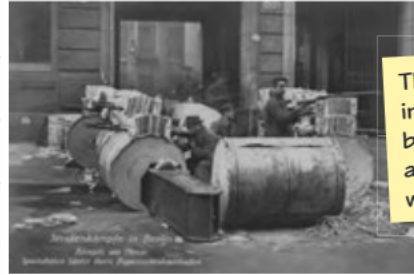
The first major challenge came from the left in January 1919. The Spartacists seized control of the government's newspaper and telegraph offices in Berlin, then attempted to organise a general strike across the city. Their goal was to overthrow the Weimar government and establish a communist regime.
Example
The Spartacist Revolt: A Failed Revolution
Step 1: Initial Action - Spartacists seized key communication centres (newspapers and telegraph offices) in Berlin
Step 2: Escalation - Attempted to organise a city-wide general strike to paralyse the government
Step 3: Government Response - Weimar leaders deployed Freikorps units to crush the uprising
Step 4: Street Fighting - Violent clashes erupted throughout Berlin for several days
Step 5: Defeat - Both Rosa Luxemburg and Karl Liebknecht were captured and shot, ending the revolt
The Weimar government responded decisively by deploying Freikorps units to crush the revolt. Street fighting erupted in Berlin and continued for several days before the revolt was finally suppressed. Both Rosa Luxemburg and Karl Liebknecht were captured and shot during the conflict, effectively ending the Spartacist threat.
The Kapp Putsch - March 1920
Just over a year later, the threat came from the right. In March 1920, Freikorps troops, concerned about unemployment and the government's plans to reduce their numbers, decided to march on Berlin. When the head of the army refused to order regular troops to resist them, a nationalist politician named Dr Wolfgang Kapp was placed in charge by the rebels.
Example
The Kapp Putsch: Defeated by Workers
Step 1: Freikorps March - Unemployed Freikorps troops marched on Berlin, fearing disbandment
Step 2: Military Neutrality - Army leadership refused to order troops to resist the putsch
Step 3: Government Flight - Weimar ministers fled Berlin for their safety
Step 4: Counter-strategy - Government called for a general strike by trade unions
Step 5: Strike Success - The national strike created chaos, making governance impossible for Kapp
Step 6: Collapse - Kapp fled, and the legitimate government returned to power
The situation became so dangerous that the Weimar government was forced to flee Berlin to ensure their safety. In desperation, they called upon trade unions to organise a general strike. This strategy proved highly effective - the national strike created such chaos that Kapp found it impossible to govern effectively. Eventually, he was forced to flee, and the Weimar ministers were able to return to power.
Political violence and assassinations
The early years of the Weimar Republic were marked by widespread political violence. Between 1919 and 1923, politicians lived in constant fear of assassination attempts.
Important
During this period, an alarming total of 376 political assassinations took place across Germany. Much of this violence was carried out by right-wing extremists who used murder as a tool to weaken and intimidate the new republic.
The situation was made worse by the fact that conservative judges often showed sympathy towards right-wing causes, frequently giving light punishments to those convicted of political crimes.
This climate of fear and violence created an atmosphere where democratic politicians struggled to operate safely, undermining the stability and legitimacy of the Weimar system.
Timeline of major events
- January 1919: Spartacist Revolt in Berlin - left-wing communist uprising crushed by Freikorps
- March 1919: Freikorps membership reaches 250,000
- March 1920: Kapp Putsch - right-wing attempt to overthrow government defeated by general strike
- 1919-1923: Period of intense political violence with 376 assassinations
Summary
Key Points to Remember:
- The Weimar Republic faced serious challenges from both left-wing communists (Spartacists) and right-wing paramilitaries (Freikorps) in its early years
- The Spartacist Revolt in January 1919 was crushed when the government used Freikorps troops to restore order, resulting in the deaths of key leaders Rosa Luxemburg and Karl Liebknecht
- The Kapp Putsch in March 1920 saw the Freikorps turn against the government they had once protected, but was defeated through a successful general strike organised by trade unions
- Political assassinations were common between 1919-1923, with 376 killings creating a climate of fear that threatened democratic governance
- These early challenges demonstrated both the weakness of the Weimar Republic and its ability to survive through decisive action and popular support