Changes for workers and women (Edexcel GCSE History): Revision Notes
📚Revision Notes
Changes for workers and women (1924-29)
Introduction
The years between 1924 and 1929 marked a significant period of social change in the Weimar Republic. While there were notable improvements in the lives of both workers and women during this time, important challenges and limitations remained that affected German society.
Note
This period is often referred to as the "Golden Age" of the Weimar Republic, representing a time of relative stability and prosperity between the early crisis years and the later economic collapse.
Improvements in living standards
After 1924, the German government introduced several policies that helped raise living standards for ordinary people. These changes were interconnected and worked together to create a better quality of life for many Germans.
Wages and working conditions
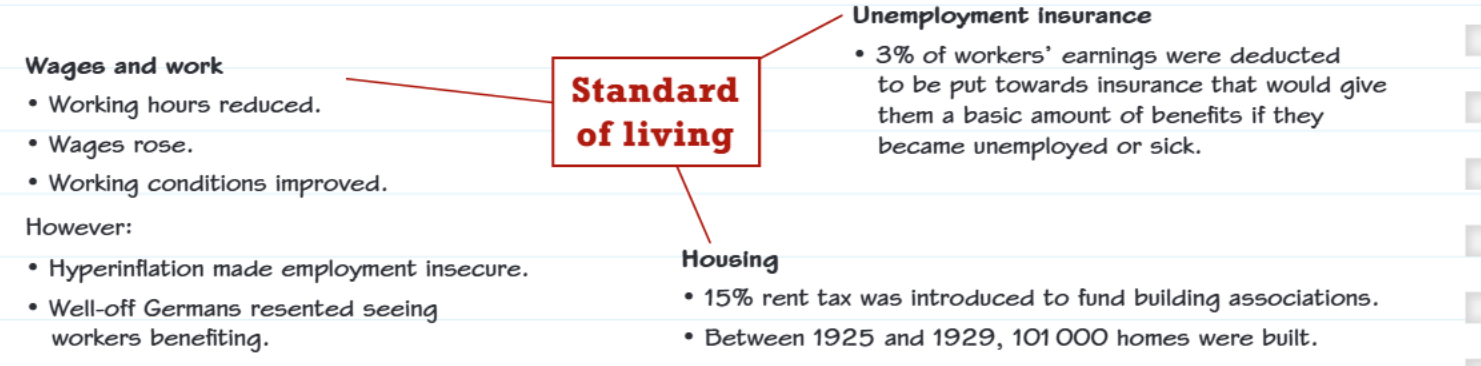
The government successfully negotiated improvements in working life that benefited millions of German workers. Working hours were reduced, making life more manageable for families, while wages generally increased, giving people more spending power. Factory conditions and workplace safety also saw improvements during this period.
Important
Limitations and Concerns
These gains came with serious concerns. The memory of hyperinflation from the early 1920s made many workers worried about job security and the stability of their wages. Additionally, some well-off Germans felt resentful about workers receiving better treatment, creating social tensions within German society.
Unemployment insurance system
A groundbreaking social security system was established that provided a safety net for German workers. This system was revolutionary for its time and gave workers much greater security than they had ever experienced before.
Example
How the Insurance System Worked
Under this scheme, 3% of workers' earnings were automatically deducted from their wages. In return, this created an insurance fund that would provide basic financial support to anyone who became unemployed or fell ill and couldn't work.
This meant that losing a job or becoming sick wouldn't immediately lead to poverty and homelessness.
Housing developments
The housing crisis that had plagued Germany was addressed through innovative government funding. A special 15% rent tax was introduced, with the money raised going directly to building associations that constructed new homes for ordinary families.
Example
Housing Programme Results
Between 1925 and 1929, approximately 101,000 new homes were built through this programme. This represented significant progress and helped many families find decent accommodation.
Note
While this represented substantial progress, Germany still faced a serious housing shortage that wasn't fully resolved during this period.
Changes for women
The period saw complex changes in women's roles across different areas of society. While some progress was made, traditional expectations continued to limit women's opportunities in many ways.
Women in employment
The end of World War I brought mixed results for working women. During the war, women had taken on jobs traditionally done by men, but many of these opportunities disappeared once soldiers returned home.
Important
Employment Statistics Show the Challenge
The number of women in work dropped dramatically from 75% in 1918 to just 36% by 1925. Most women were still expected to give up their jobs once they married and focus on being wives and mothers instead.
Those who did continue working often found themselves in lower-paid, part-time positions rather than the higher-status roles they might have hoped for. However, some positive changes did occur, particularly in professions like teaching and medicine, where new opportunities opened up for women. Universities also began encouraging women to pursue higher education, though this mainly benefited middle-class families who could afford the fees.
Women and social freedom
Young, single women experienced greater independence and earning power than previous generations had known. This economic freedom allowed them to make different lifestyle choices, with some becoming less interested in traditional marriage and family life and more focused on social independence and personal fulfilment.
Note
The "New Woman" Phenomenon
This emergence of what people called the "new woman" - someone who was financially independent, socially active, and less bound by traditional roles - caused considerable controversy. Many Germans, particularly older generations, felt that traditional family values were being undermined and criticised these changing behaviours.
Women in politics
One of the most significant changes came in political participation. Following their contributions during the war, women were granted the right to vote in 1918 and could also stand as candidates in elections.
The response was overwhelmingly positive, with about 90% of eligible women participating in Weimar elections. The constitution included Article 109, which was groundbreaking in stating that women had equal rights with men and could enter any profession on an equal basis.
Important
Constitutional Rights vs. Reality
Article 109 also declared that marriage should be an equal partnership between husband and wife, challenging traditional ideas about family hierarchy. However, despite these constitutional guarantees, the reality often fell short of true equality, and many traditional attitudes about women's roles persisted throughout German society.
Timeline of key events
- 1918: Women granted the right to vote and stand for election
- 1924: Government begins introducing policies to improve living standards
- 1925-1929: 101,000 new homes built through government housing programme
- 1925: Women's employment settles at 36% (down from 75% in 1918)
- 1929: End of the "Golden Age" period
Summary
Key Points to Remember:
- The period 1924-29 saw genuine improvements in living standards through government policies on wages, unemployment insurance, and housing construction
- A comprehensive unemployment insurance system was created, funded by 3% deductions from workers' wages
- Women gained political rights including voting and standing for election, with 90% participating in elections
- Article 109 of the constitution guaranteed women equal rights and equal partnership in marriage
- Despite progress, many women lost work opportunities after the war, with employment dropping from 75% to 36%, and traditional attitudes about gender roles remained strong
- The "new woman" phenomenon created social tensions as younger women pursued greater independence