Strengths and weaknesses of the Weimar Constitution (Edexcel GCSE History): Revision Notes
📚Revision Notes
Strengths and weaknesses of the Weimar Constitution
Introduction to Germany's new democratic system
Following Germany's defeat in World War One, a democratic government was established through the creation of a brand new constitution. This constitution was written and agreed upon on 31 July 1919 in the town of Weimar, rather than in Berlin where there was still political unrest and instability. This marked a completely new chapter in German history, as the country moved away from the authoritarian rule of Kaiser Wilhelm II towards a democratic parliamentary system.
Note
The decision to hold the constitutional assembly in Weimar was symbolic as well as practical. Weimar was associated with German culture and enlightenment, representing a fresh start for the nation. This location choice deliberately connected the new democracy with Germany's intellectual and cultural heritage rather than its military and imperial past.
The new constitution aimed to create a stable, democratic Germany that would be accepted by the international community.
Structure of the Weimar government system
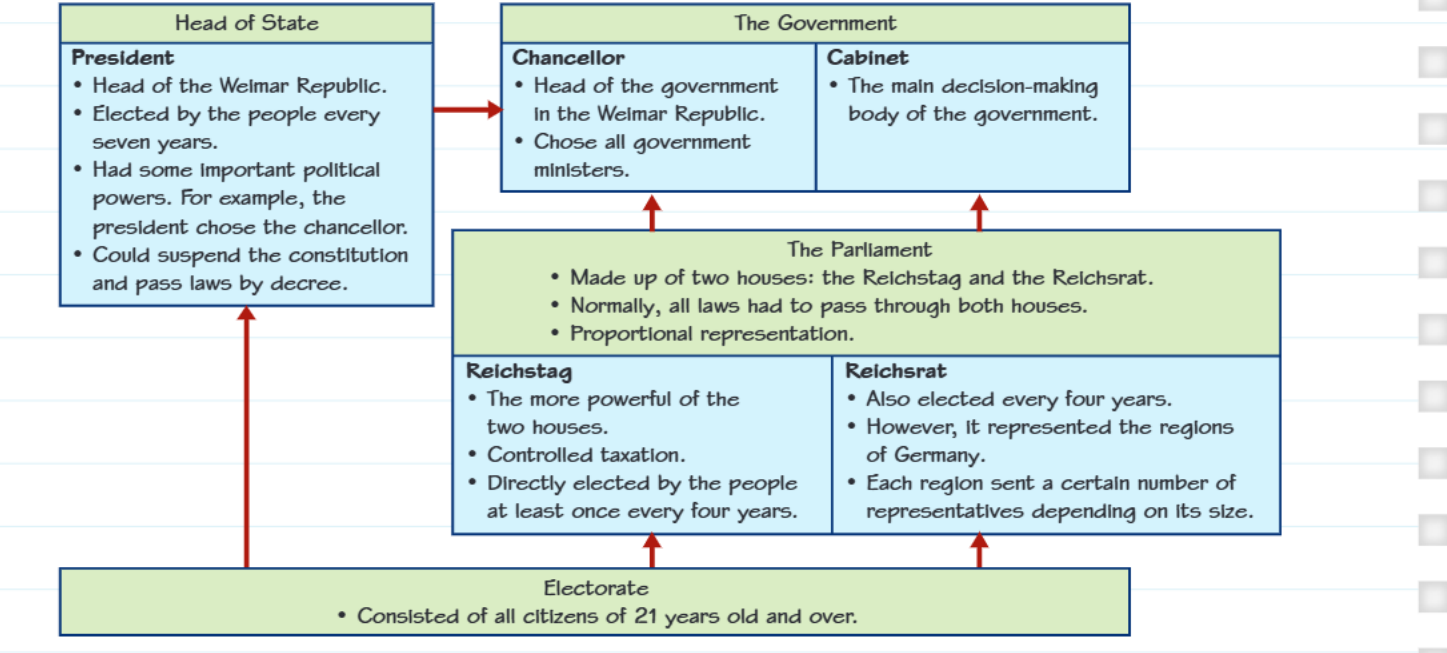
The Weimar Constitution established a complex democratic system with multiple layers of government and clear divisions of power. Understanding this structure is essential to grasp why the system had both significant strengths and critical weaknesses.
The president as head of state
The President served as the head of the Weimar Republic and held considerable political power. Citizens elected the president directly every seven years, giving this position democratic legitimacy. The president's key powers included choosing the chancellor and having the ability to suspend the constitution and pass laws by decree during emergencies.
Important
This emergency power would later prove to be one of the constitution's most controversial features, as it provided a legal pathway to bypass democratic processes entirely.
The government structure
The Chancellor acted as the head of government and was responsible for day-to-day administration. The Chancellor worked alongside a Cabinet, which served as the main decision-making body. This system was designed to ensure that executive power was shared rather than concentrated in a single person, unlike the previous imperial system.
The parliamentary system
Parliament consisted of two houses that represented different interests within German society. The Reichstag was the more powerful house, elected directly by the people at least every four years and controlling taxation. The Reichsrat represented Germany's different regions, with each region sending representatives based on its size. This bicameral system was intended to balance national democracy with regional interests.
Democratic participation
The constitution dramatically expanded democratic participation by allowing all citizens aged 21 and over to vote. This was a significant reduction from the previous voting age of 25 and represented a major step towards universal suffrage.
Democratic strengths of the constitution
The Weimar Constitution introduced several progressive democratic features that represented a major advance in German political development. These strengths reflected the hopes and ideals of those who wanted to create a modern, democratic Germany.
Proportional representation and fair elections
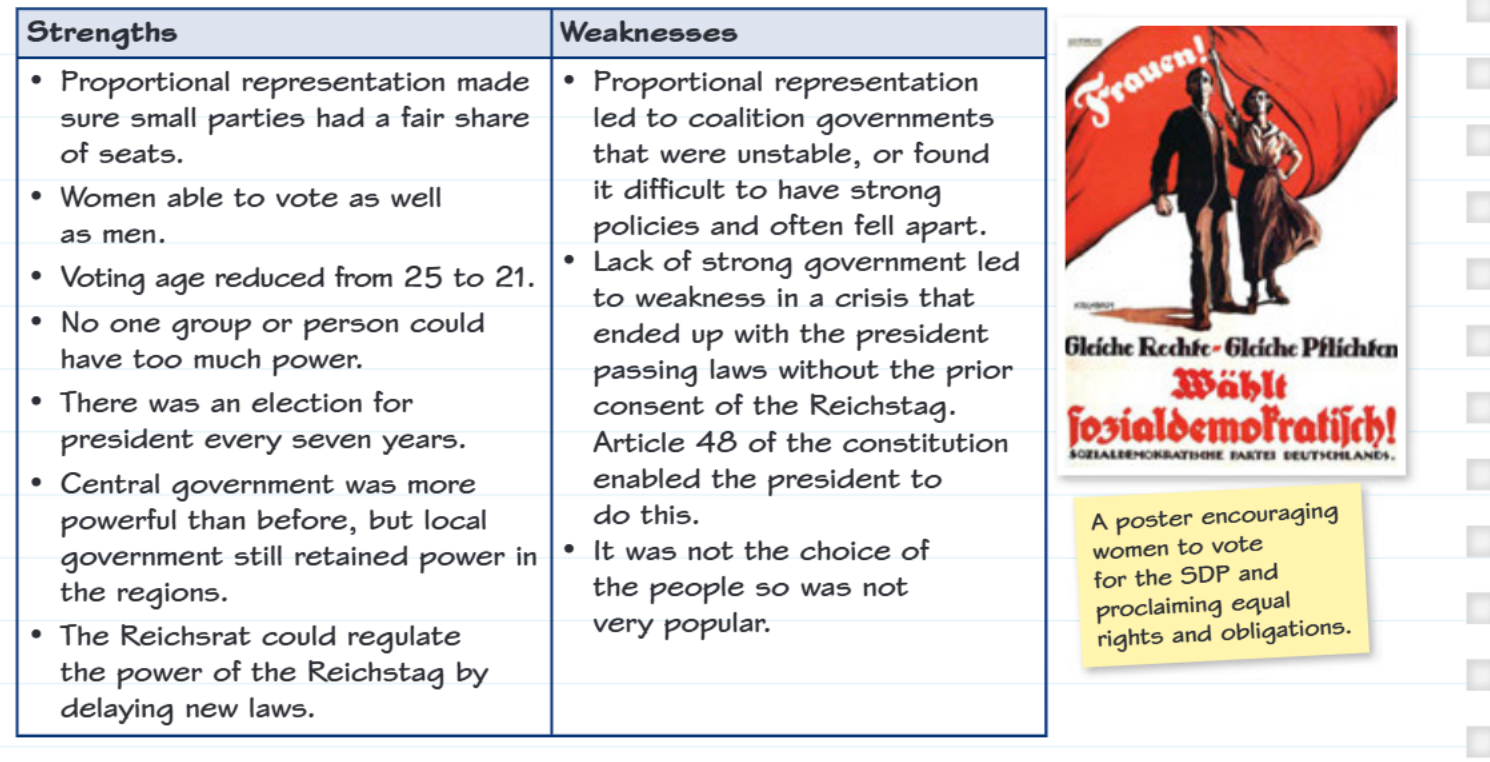
The introduction of proportional representation was designed to ensure that smaller political parties received a fair share of seats in the Reichstag. This system meant that the composition of parliament would accurately reflect how people voted across the country. It prevented any single party from dominating politics and encouraged diverse political voices to be heard.
Note
Proportional representation was considered a major democratic advancement because it gave smaller parties and minority viewpoints a meaningful voice in government, unlike the previous system where only the largest parties could gain significant representation.
Women's political rights
For the first time in German history, women gained the right to vote and participate fully in political life. This represented a huge step forwards for gender equality and doubled the size of the electorate. The Social Democratic Party (SPD) actively campaigned for women's participation, using slogans like "Equal Rights - Equal Obligations" to encourage female voters to engage with the democratic process.
Expanded democratic participation
The reduction of the voting age from 25 to 21 years old brought more young people into the political process. This change recognised that younger citizens had a stake in their country's future and deserved a voice in how it was governed.
Balanced power distribution
The constitution was carefully designed to prevent any one person or group from gaining too much power. Regular presidential elections every seven years meant that even the head of state remained accountable to the people. The federal system also ensured that local and regional governments retained significant powers, preventing excessive centralization.
Legislative checks and balances
The Reichsrat had the ability to delay new laws passed by the Reichstag, creating a system of checks and balances. This meant that legislation had to be carefully considered and couldn't be rushed through without proper scrutiny.
Critical weaknesses that undermined democracy
Despite its democratic ideals, the Weimar Constitution contained several fundamental flaws that would contribute to the eventual collapse of German democracy. These weaknesses became particularly apparent during times of crisis.
Coalition government instability
The proportional representation system, while fair in principle, led to a fragmented parliament where no single party could achieve a majority. This meant that governments had to be formed through coalitions of different parties with often conflicting ideologies.
Important
These coalition governments frequently collapsed when parties disagreed on major issues, leading to political instability and frequent changes of government. This instability made it difficult to implement consistent policies or respond effectively to crises.
The dangerous power of Article 48
Article 48 of the constitution gave the president enormous emergency powers during times of crisis. The president could suspend normal democratic processes and pass laws without the consent of the Reichstag. While intended for genuine emergencies, this provision created a legal pathway to bypass democracy.
Important
This weakness would later be exploited to undermine the democratic system entirely. Article 48 became known as the "suicide clause" of the Weimar Constitution because it provided the legal mechanism for democracy to destroy itself.
Lack of popular support
Many Germans never fully accepted the legitimacy of the Weimar Republic. The new democratic system was associated with Germany's defeat in World War One and the harsh terms of the Treaty of Versailles. This meant that the constitution lacked the deep popular support necessary for a stable democracy, making it vulnerable to attack from extremist groups.
Weak crisis management
The combination of coalition instability and emergency powers created a dangerous dynamic during crises. When coalition governments couldn't agree on solutions to major problems, there was a temptation to use Article 48 to bypass democratic debate. This gradually weakened respect for parliamentary democracy and normalised authoritarian decision-making.
Historical timeline
- 31 July 1919: Weimar Constitution signed in Weimar
- 1919-1923: Period of crisis and instability testing the new system
- 1924-1929: "Golden Years" when the constitution appeared to be working
- 1929 onwards: Economic crisis exposed the constitution's fundamental weaknesses
Summary
Key Points to Remember:
- The Weimar Constitution was created on 31 July 1919 in Weimar to establish Germany's first democratic government
- Key strengths included proportional representation, women's suffrage, reduced voting age to 21, and balanced power distribution
- Major weaknesses were unstable coalition governments, dangerous Article 48 emergency powers, and lack of popular support
- The constitutional structure included President, Chancellor/Cabinet, two-house Parliament (Reichstag and Reichsrat), and expanded electorate
- These strengths and weaknesses would ultimately determine whether German democracy could survive future crises