Communities (OCR GCSE Biology A, Combined (Gateway Science Suite)): Revision Notes
📚Revision Notes
7.1.1 Communities
Note
When multiple populations of different species live together and interact in the same habitat, they form a community. The populations within a community are often dependent on each other for survival.
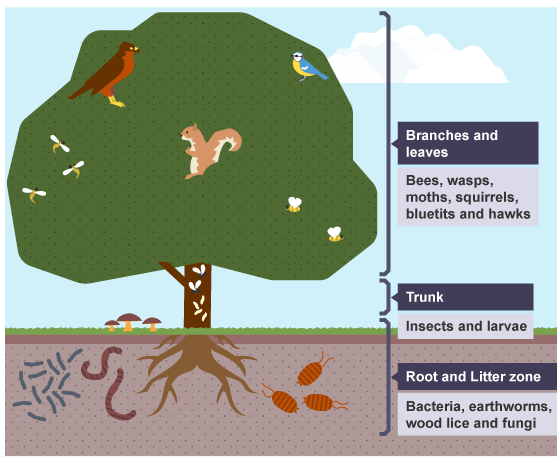
Note
Species: An individual organism belongs to a species, which is a group of similar organisms capable of interbreeding.
Note
Habitat: The specific environment where an organism lives.
Note
Population: A group of individuals of the same species living in a habitat.
Competition
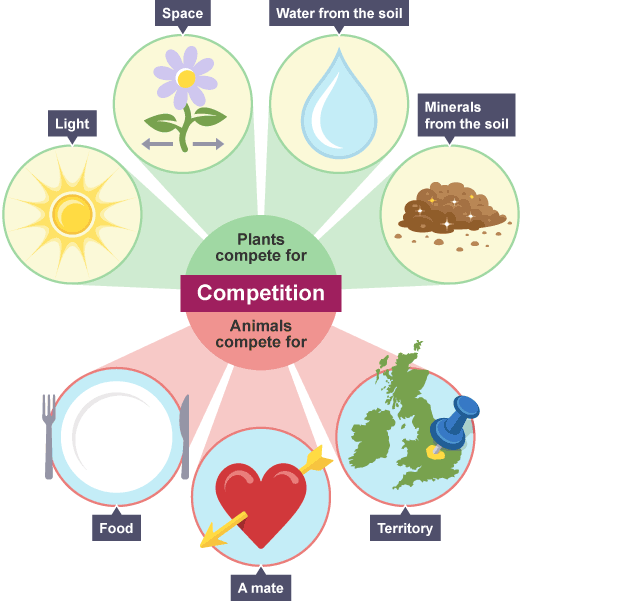
Organisms within a community often compete for the same resources.
-
Intraspecific competition: Competition within the same species.
-
Interspecific competition: Competition between different species. Plants may compete for:
-
Light: Needed for photosynthesis.
-
Space: To grow and spread out.
-
Water: Essential for all biological processes.
-
Mineral ions: Needed for growth, like nitrates for making proteins. Animals may compete for:
-
Space (territory): To live and raise offspring.
-
Food: Necessary for energy and growth.
-
Water: Vital for survival.
-
Mates: To reproduce and pass on genes.
Interdependence
Interdependence is the way in which organisms in a community depend on each other for survival.
- Vital Services:
- Food: Some species are food for others.
- Shelter: Some organisms provide shelter or protection for others.
- Reproduction: Involves processes like pollination and seed dispersal. For example, bees pollinate flowers, while birds may help in spreading seeds. The removal or addition of a species can greatly impact the entire community. For example, changing the number of predators can alter the population sizes of prey species, leading to a ripple effect throughout the community.
Stable Communities
A stable community is one where all biotic (living) and abiotic (non-living) factors are in balance, resulting in population sizes that remain relatively constant over time. Stable communities are often hard to replace once lost.
Examples of stable communities:
- Tropical rainforests
- Oak woodlands
- Coral reefs
Note
Ecosystem: This is the interaction of a community with the non-living (abiotic) parts of the environment, such as water, temperature, and soil. Organisms are adapted to their specific environment, which influences their survival and reproduction.